Pagrus
Pagrus is a genus of marine ray-finned fishes belonging to the family Sparidae, which includes the seabreams and porgies. These fishes are found in the Western Pacific Ocean, Atlantic Ocean and Mediterranean Sea. They are esteemed food fishes which are targeted by commercial fisheries and are grown in aquaculture.

Etrusko25 · Public Domain · via Wikipedia/Commons. May be a photograph of a specimen, or an artist’s reconstruction — an interpretation of a skeleton, since colour and soft tissue are almost never preserved.
On record
Recorded, not inferred- Sits inside
- SparidaePBDB
- Diet
- carnivorePBDB, for Perciformes
- Life habit
- nektonicPBDB, for Perciformes
- Motility
- actively mobilePBDB, for Perciformes
Time the record covers
At least 23 million years on record.
The record covers at least 23.04 Mya to 11.7 ka. No occurrence read is dated outside 33.9 Mya to 0 Mya.
38 occurrences of Pagrus on record, most of them in the Miocene. The Paleobiology Database records this as a living group. Bar height is expected occurrences, not a count: each fossil is spread across the span it is dated to, so a tall narrow bar means tight dating and a low wide one means loose.
When
38 occurrences- Oligocene5%
- Miocene64%
- Pliocene13%
- Pleistocene13%
- Holocene6%
These are dates about fossils, not the animal: the record can only begin after it arose and end before it died out, so either end may reach further. Shares are expected occurrences: a fossil dated to a span is counted partly in each period it straddles. More on what this infers.
Found in
12 formations
- Lagos-Portimão Formation8
- Hrušky Formation4
- Yorktown Formation · Chesapeake Group2
- Grund Formation1
- Calcarenites of Sant Elm Formation1
- Uscari Formation · Limon Group1
Loading coastlines…
The named rock units Pagrus has been recovered from, largest first. Drawn where the rock is now, not where it formed. 15 occurrences have no formation on record, which is common for older literature.
Pagrus and its relatives
MioceneWhere Pagrus and its relatives were recorded in the Miocene.
Found in the same rock
1,084 taxa- Sparus11 sites
- Hemipristis serra10 sites
- Sparidae9 sites
- Carcharhinus8 sites
- Carcharias taurus8 sites
- Dasyatis8 sites
- Isurus oxyrinchus8 sites
- Sparus cinctus8 sites
- Carcharhinus priscus7 sites
- Dasyatis cavernosa7 sites
- Dentex7 sites
- Dentex fossilis7 sites
- Galeocerdo aduncus7 sites
- Otodus megalodon7 sites
- Sparus aurata7 sites
- Acanthurus6 sites
- Carcharhinus egertoni6 sites
- Dasyatis rugosa6 sites
- Diplodus jomnitanus6 sites
- Myliobatis6 sites
- Negaprion eurybathrodon6 sites
- Scarus6 sites
- Sphyraena6 sites
- Sphyrna zygaena6 sites
The Paleobiology Database records 27 sites for Pagrus, and this reads all of them. The number is how many of those sites it was catalogued from too. The 24 sharing the most are listed.
This is not a list of everything alive at the time. It is only what has come out of the same ground as this animal and been written down.
Entered from
24 references- Vertébrés (crocodiliens, poissons) du Miocène marin de l'Argarve occidentale8
- Ictiofauna del Pliocè del barranc de sa Talaia (Mallorca, Illes Balears, Mediterrània Occidental). Implicacions paleoambientals3
- Fish teeth from the Middle Miocene of Kienberg at Mikulov, Czech Republic, Vienna Basin3
- Povoado muculmano na Ponta do Castelo (Aljezur)2
- The Neogene sharks, rays, and bony fishes from Lee Creek Mine, Aurora, North Carolina2
- Les Poissons fossiles d'Oran2
- First Skeletal Fossil Record of the Red Seabream Pagrus major (Sparidae, Perciformes) from the Late Pleistocene of Subtropical West Pacific, Southern Taiwan1
- At the crossroads: early Miocene marine fishes of the proto-Mediterranean Sea1
- Fossil fish otoliths from the Chibanian Miyata Formation, Kanagawa Prefecture, Japan, with comments on the paleoenvironment1
- Reconstruction of the fossil marine bony fish fauna (Teleostei) from the Eocene to Pleistocene of New Zealand by means of otoliths. With studies of Recent congroid, morid and trachinoid otoliths1
- Pleistocene marine fish invasions and paleoenvironmental reconstructions in the eastern Mediterranean1
- Ictiofauna del Mioceno inferior de localidad de Pacuare des Tres Equis, Formación Río Banao, Provincia de Cartago, Costa Rica, y descripción de un nuevo género y una Nueva Especie de Scaridae1
Each of the 38 occurrences read was entered from one of these publications, ordered by how many each accounts for. This is not a search for papers mentioning the name. 12 further references are not listed. Entries link to doi.org where the Paleobiology Database holds an identifier, and to its own record where it does not. Relayed as the Paleobiology Database holds them, not checked against what they resolve to.
Media and terms
Media content2

Picture of Pagrus
- Source
- Wikipedia/Commons
- Credit
- Etrusko25
- Licence
- Public Domain
- Commercial use
- the licence allows it
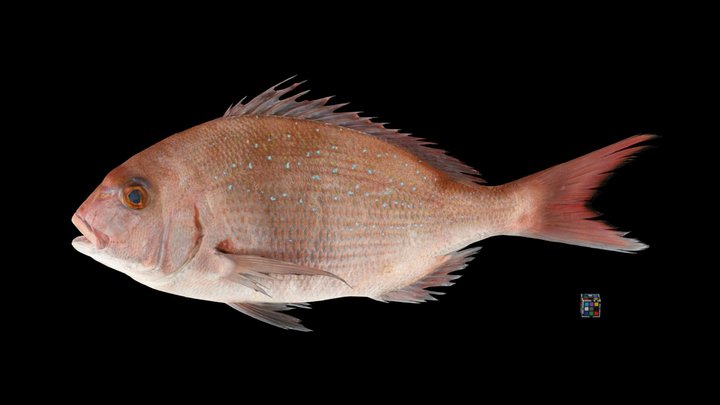
3D model
- Source
- Sketchfab
- Licence
- CC0 Public Domain
- Commercial use
- the licence allows it
Smithsonian Open Access and MorphoSource were not reached for this taxon, so this list is what the others held rather than everything there is.
The description on this site
- Source
- Wikipedia, “Pagrus”
- Licence
- CC BY-SA 4.0
This is what the site found, which is not the same as what exists.
Keep going
What may have been alongside itSparidae through timeFormations of the MioceneThe world it lived on
Occurrence data from the Paleobiology Database, CC BY 4.0. Lacépède 1802