Palaeocarcharodon
Palaeocarcharodon, also known as the pygmy white shark, is a genus of shark within the family Cretoxyrhinidae, that lived about 61.7 to 55.8 Ma during the Middle Paleocene and Early Eocene. It currently contains a sole species P. orientalis. An additional species, P. landanensis, is now considered a possible synonym of P. orientalis.

Hectonichus · CC BY-SA 3.0 · via Wikipedia/Commons. May be a photograph of a specimen, or an artist’s reconstruction — an interpretation of a skeleton, since colour and soft tissue are almost never preserved.
On record
Recorded, not inferred- Sits inside
- OtodontidaePBDB
- Diet
- carnivorePBDB, for Lamniformes
- Life habit
- nektonicPBDB, for Lamniformes
- Motility
- actively mobilePBDB, for Lamniformes
Time the record covers
At least 23 million years on record.
The record covers at least 61.66 Mya to 37.71 Mya. No occurrence read is dated outside 66 Mya to 33.9 Mya.
10 occurrences of Palaeocarcharodon on record, most of them in the Paleocene. Bar height is expected occurrences, not a count: each fossil is spread across the span it is dated to, so a tall narrow bar means tight dating and a low wide one means loose.
When
10 occurrencesThese are dates about fossils, not the animal: the record can only begin after it arose and end before it died out, so either end may reach further. Shares are expected occurrences: a fossil dated to a span is counted partly in each period it straddles. More on what this infers.
Found in
6 formations
- Hornerstown Formation · Rancocas Group2
- Landana Formation2
- Syzran Formation1
- Aquia Formation1
- Akzhar Formation1
- Williamsburg Formation · Black Mingo Group1
Loading coastlines…
The named rock units Palaeocarcharodon has been recovered from, largest first. Drawn where the rock is now, not where it formed. 2 occurrences have no formation on record, which is common for older literature.
Palaeocarcharodon and its relatives
PaleoceneWhere Palaeocarcharodon and its relatives were recorded in the Paleocene.
Found in the same rock
77 taxa- Cretalamna appendiculata4 sites
- Otodus obliquus4 sites
- Aetomylaeus dixoni3 sites
- Odontaspis substriata3 sites
- Sulcidens sulcidens3 sites
- Anomotodon novus2 sites
- Cheloniidae2 sites
- Delpitoscyllium africanum2 sites
- Eotorpedo hilgendorfi2 sites
- Myliobatis2 sites
- Myliobatis nzadinensis2 sites
- Myliobatis toliapicus2 sites
- Nebrius bequaerti2 sites
- Odontaspis2 sites
- Palaeohypotodus speyeri2 sites
- Adocus1 site
- Agomphus alabamensis1 site
- Agomphus pectoralis1 site
- Albulidae1 site
- Anomoeodus phaseolus1 site
- Athleta (Volutocorbis)1 site
- Atractosteus1 site
- Aturia1 site
- Bothremys1 site
The Paleobiology Database records 10 sites for Palaeocarcharodon, and this reads all of them. The number is how many of those sites it was catalogued from too. The 24 sharing the most are listed.
This is not a list of everything alive at the time. It is only what has come out of the same ground as this animal and been written down.
Entered from
8 references- Les poissons fossiles du Bas-Congo et des régions voisines3
- Enigmatic bilophodont molariform tooth from the Eocene of Central Russia1
- Carnivorous dinosaurs (Saurischia, Theropoda) from the Maastrichtian of the Volga-Don interfluve, Russia1
- Faunal changes across the Cretaceous-Tertiary (K-T) boundary in the Atlantic coastal plain of New Jersey: restructuring the marine community after the K-T mass-extinction event1
- Small vertebrates from the Late Cretaceous and Early Tertiary of the northeastern Aral Sea region, Kazakhstan1
- Chondrichthyan fishes from the Paleocene of South Carolina1
- Probable occurrence of the shark genus Palaeocarcharodon (Neoselachii: Cretoxyrhinidae) in the Paleocene of New Jersey1
- Palaeocarcharodon orientalis (Sinzow) (Neoselachii: Cretoxyrhinidae), from the Paleocene of Maryland, U.S.A.1
Each of the 10 occurrences read was entered from one of these publications, ordered by how many each accounts for. This is not a search for papers mentioning the name. Entries link to doi.org where the Paleobiology Database holds an identifier, and to its own record where it does not. Relayed as the Paleobiology Database holds them, not checked against what they resolve to.
Media and terms
Media content1
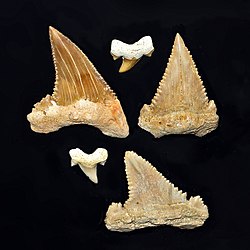
Picture of Palaeocarcharodon
- Source
- Wikipedia/Commons
- Credit
- Hectonichus
- Licence
- CC BY-SA 3.0
- Commercial use
- the licence allows it
No 3D scan of Palaeocarcharodon was found in Smithsonian Open Access and Sketchfab.
MorphoSource was not reached for this taxon, so this list is what the others held rather than everything there is.
The description on this site
- Licence
- CC BY-SA 4.0
This is what the site found, which is not the same as what exists.
Keep going
What may have been alongside itOtodontidae through timeFormations of the PaleoceneThe world it lived on
Occurrence data from the Paleobiology Database, CC BY 4.0. Casier 1960