Pamphiliidae
Pamphiliidae is a small family within Symphyta, containing some 200 species from the temperate regions of North America and Eurasia. The larvae feed on plants, using silk to build webs or tents, or to roll leaves into tubes in which they feed, thus earning them the common names leaf-rolling sawflies or web-spinning sawflies. Some species are gregarious and the larvae live in large groups. Fossils of Pamphiliidae have been dated to the Jurassic period.

Beentree · CC BY-SA 3.0 · via Wikipedia/Commons. May be a photograph of a specimen, or an artist’s reconstruction — an interpretation of a skeleton, since colour and soft tissue are almost never preserved.
On record
Recorded, not inferred- Sits inside
- PamphilioideaPBDB
- Motility
- actively mobilePBDB, for Arthropoda
- Environment
- terrestrialPBDB, for Insecta
Time the record covers
At least 146 million years on record.
The record covers at least 154.8 Mya to 8.725 Mya. No occurrence read is dated outside 165.3 Mya to 5.09 Mya.
20 occurrences of Pamphiliidae on record, most of them in the Miocene. The Paleobiology Database records this as a living group, and the chart stops with its fossils rather than at the present. Bar height is expected occurrences, not a count: each fossil is spread across the span it is dated to, so a tall narrow bar means tight dating and a low wide one means loose.
When
20 occurrences- Middle Jurassic9%
- Late Jurassic21%
- Early Cretaceous20%
- Eocene20%
- Oligocene5%
- Miocene24%
- Plioceneunder 1%
These are dates about fossils, not the animal: the record can only begin after it arose and end before it died out, so either end may reach further. Shares are expected occurrences: a fossil dated to a span is counted partly in each period it straddles. More on what this infers.
Found in
7 formations
- Daohugou Formation5
- Yixian Formation · Jehol Group4
- Florissant Formation3
- Botchi Formation2
- Uda Formation1
- Creede Formation1
Loading coastlines…
The named rock units Pamphiliidae has been recovered from, largest first. Drawn where the rock is now, not where it formed. 3 occurrences have no formation on record, which is common for older literature.
Pamphiliidae and its relatives
MioceneWhere Pamphiliidae and its relatives were recorded in the Miocene.
Found in the same rock
687 taxa- Scabolyda orientalis3 sites
- Acantholyda erythrocephala2 sites
- Allaboilus gigantus2 sites
- Daohugoa bella2 sites
- Eoptychopterina elenae2 sites
- Ferganolyda chungkuei2 sites
- Ferganolyda scylla2 sites
- Francotermes bauzilensis2 sites
- Heteroptera2 sites
- Hymenoptera2 sites
- Kalotermitidae2 sites
- Liassophyllum caii2 sites
- Martynovocossus punctulosus2 sites
- Nevania retenta2 sites
- Nevania robusta2 sites
- Reticulitermes2 sites
- Sinokaratawia prokopi2 sites
- Tapholyda caplani2 sites
- Uranorhagio asymmetricus2 sites
- Aboilus perbellus1 site
- Aboilus stratosus1 site
- Abrocossus longus1 site
- Abrotoxyela curva1 site
- Acantholyda ribesalbesensis1 site
The Paleobiology Database records 12 sites for Pamphiliidae, and this reads all of them. The number is how many of those sites it was catalogued from too. The 24 sharing the most are listed.
This is not a list of everything alive at the time. It is only what has come out of the same ground as this animal and been written down.
Entered from
14 references- Two new fossil sawflies of Pamphiliidae (Hymenoptera: Symphyta) from the Mesozoic of northeastern China3
- New pamphiliids with varying venations from Lower Cretaceous Yixian Formation of northeast China (Hymenoptera, Pamphiliidae)3
- A new fossil genus in Pamphiliidae (Hymenoptera) from China3
- New early Eocene Siricomorpha (Hymenoptera: Symphyta: Pamphiliidae, Siricidae, Cephidae) from the Okanagan Highlands, western North America1
- New and poorly known Cenozoic sawflies of France (Hymenoptera, Tenthredinoidea, Pamphilioidea)1
- Primer registro fósil del género Acantholyda (Insecta: Hymenoptera: Pamphiliidae), Mioceno inferior de Ribesables (España)1
- Descriptions de quelques insectes fossiles du Miocène supérieur de la Montagne d'Andance (Ardèche, France)1
- Miocene fossil bumble bee from the Soviet Far East with comments on the chronology and distribution of fossil bees (Hymenoptera: Apidae)1
- Fossil Hymenoptera of the Superfamily Pamphilioidea1
- New Hymenoptera from the Jurassic and Cretaceous of Asia1
- A fossil sawfly from the Miocene shales near Creede, Colorado1
- On the Tenthredinoidea of the Florissant Shales1
Each of the 20 occurrences read was entered from one of these publications, ordered by how many each accounts for. This is not a search for papers mentioning the name. 2 further references are not listed. Entries link to doi.org where the Paleobiology Database holds an identifier, and to its own record where it does not. Relayed as the Paleobiology Database holds them, not checked against what they resolve to.
Media and terms
Media content1
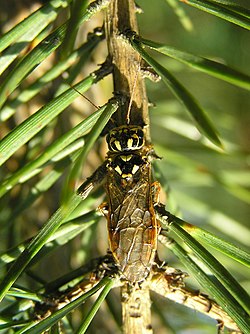
Picture of Pamphiliidae
- Source
- Wikipedia/Commons
- Credit
- Beentree
- Licence
- CC BY-SA 3.0
- Commercial use
- the licence allows it
No 3D scan of Pamphiliidae was found in Sketchfab.
Smithsonian Open Access and MorphoSource were not reached for this taxon, so this list is what the others held rather than everything there is.
The description on this site
- Licence
- CC BY-SA 4.0
This is what the site found, which is not the same as what exists.
Keep going
What may have been alongside itPamphilioidea through timeFormations of the MioceneThe world it lived on
Occurrence data from the Paleobiology Database, CC BY 4.0. (Cameron 1890)