Heteroptera
The Heteroptera are a group of about 40,000 species of insects in the order Hemiptera. They are sometimes called "true bugs", though that name more commonly refers to the Hemiptera as a whole. "Typical bugs" might be used as a more unequivocal alternative, since the heteropterans are most consistently and universally termed "bugs" among the Hemiptera. "Heteroptera" is Greek for "different wings": most species have forewings with both membranous and hardened portions ; members of the primitive sub-group Enicocephalomorpha have completely membranous wings.

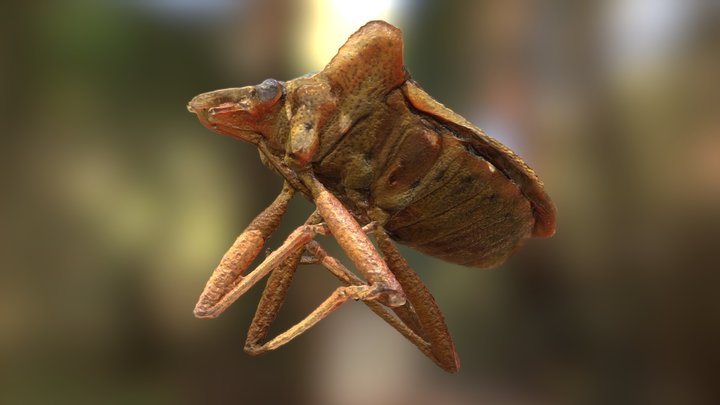
Markus Gayda · CC BY-SA 3.0 · via Wikipedia/Commons. May be a photograph of a specimen, or an artist’s reconstruction — an interpretation of a skeleton, since colour and soft tissue are almost never preserved.
On record
Recorded, not inferred- Sits inside
- HemipteraPBDB
- Motility
- actively mobilePBDB, for Arthropoda
- Environment
- terrestrialPBDB, for Insecta
Time the record covers
At least 245 million years on record.
The record covers at least 245.19 Mya to 11.7 ka. No occurrence read is dated outside 247 Mya to 0 Mya.
2,159 occurrences of Heteroptera on record, most of them in the Eocene. The Paleobiology Database records this as a living group. Bar height is expected occurrences, not a count: each fossil is spread across the span it is dated to, so a tall narrow bar means tight dating and a low wide one means loose.
When
2,159 occurrences- Middle Triassicunder 1%
- Late Triassicunder 1%
- Early Jurassic4%
- Middle Jurassic1%
- Late Jurassic6%
- Early Cretaceous21%
- Late Cretaceous7%
- Paleoceneunder 1%
- Eocene28%
- Oligocene12%
- Miocene16%
- Pliocene1%
- Pleistocene2%
- Holoceneunder 1%
These are dates about fossils, not the animal: the record can only begin after it arose and end before it died out, so either end may reach further. Shares are expected occurrences: a fossil dated to a span is counted partly in each period it straddles. More on what this infers.
Found in
176 formations
- Florissant Formation158
- Yixian Formation · Jehol Group97
- Upper Freshwater-Molasse Formation70
- Rott Formation69
- Gurvan-Eren Formation66
- Niveau du gypse d'Aix Formation58
Loading coastlines…
The named rock units Heteroptera has been recovered from, largest first. Drawn where the rock is now, not where it formed. 152 further formations hold fewer occurrences each and are not listed. 807 occurrences have no formation on record, which is common for older literature.
Heteroptera and its relatives
EoceneWhere Heteroptera and its relatives were recorded in the Eocene.
Found in the same rock
7,670 taxa- Coleoptera23 sites
- Curculionidae17 sites
- Plecia bucklandi12 sites
- Aphanus pulchellus11 sites
- Formicidae11 sites
- Haenbea badamgaravae11 sites
- Cydnus brevicollis10 sites
- Diptera10 sites
- Orthoptera10 sites
- Apioninae9 sites
- Plecia9 sites
- Plecia foersteri9 sites
- Bibio8 sites
- Lygaeidae8 sites
- Pentatomidae8 sites
- Plecia livida8 sites
- Polyphaga8 sites
- Tipula8 sites
- Acrididae7 sites
- Anisoptera7 sites
- Bibionidae7 sites
- Carabidae7 sites
- Cerambycidae7 sites
- Diapherinus ornatipennis7 sites
The Paleobiology Database records at least 736 sites for Heteroptera, and this reads 240 of them. Of that, one read hit the database's own return limit, so every count below is a floor rather than a total. The number is how many of those sites it was catalogued from too. The 24 sharing the most are listed.
This is not a list of everything alive at the time. It is only what has come out of the same ground as this animal and been written down.
Entered from
628 references- The Tertiary Insects of North America150
- Heer, 1853111
- Les insectes fossiles des terrains oligocènes de France67
- Peloridiina (= Coleorrhyncha) and Cimicina (= Heteroptera), in Nasekomye v rannemelovykh ekosistemakh zapadnoy Mongolii65
- Bugs, Cimicina, in Pozdne-Mezozoyskie Nasekomye Vostochnogo Zabaykal'ya49
- Geocorisae (Landwanzen) aus den Oberoligocanen Ablagerungen von Rott45
- Die Insekten der "Plattigen Steinmergels" von Brunstatt39
- Review of true bugs (Insecta: Hemiptera, Heteroptera) from the amber collection of the Museum of the Earth of PAS in Warsaw with some remarks on heteropteran insects from Eocene European amber36
- Water striders from the Paleogene of Denmark and review of fossil record and evolution of semi aquatic bugs (Hemiptera Gerromorpha)29
- Fossil insects from the Laiyang Basin, Shandong Province27
- Die Insektenfauna des Ostniedersachsischen Oberen Lias26
- Die im Bernstein befindlichen Hemipteren und Orthopteren der Vorwelt25
Each of the 2,159 occurrences read was entered from one of these publications, ordered by how many each accounts for. This is not a search for papers mentioning the name. 616 further references are not listed. Entries link to doi.org where the Paleobiology Database holds an identifier, and to its own record where it does not. Relayed as the Paleobiology Database holds them, not checked against what they resolve to.
Media and terms
Media content2

Picture of Heteroptera
- Source
- Wikipedia/Commons
- Credit
- Markus Gayda
- Licence
- CC BY-SA 3.0
- Commercial use
- the licence allows it
The description on this site
- Source
- Wikipedia, “Heteroptera”
- Licence
- CC BY-SA 4.0
This is what the site found, which is not the same as what exists.
Keep going
What may have been alongside itHemiptera through timeFormations of the EoceneThe world it lived on
Occurrence data from the Paleobiology Database, CC BY 4.0. Latreille 1810