Paracordylodus
Paracordylodus is an extinct genus of conodonts in the clade Prioniodontida, also known as the "complex conodonts". The species P. gracilis has been recovered from the chert of the Narooma terrane, a geological structural region on the south coast of New South Wales, Australia.
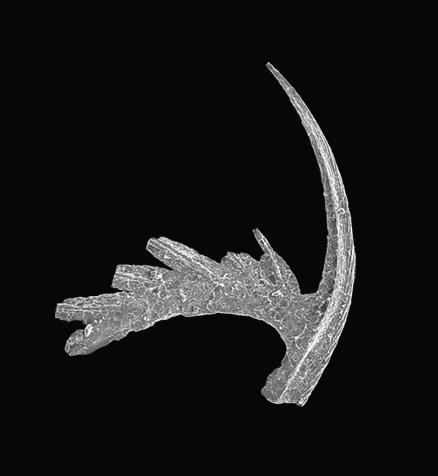
Nemliher, J. · CC BY-NC 4.0 · via GBIF. May be a photograph of a specimen, or an artist’s reconstruction — an interpretation of a skeleton, since colour and soft tissue are almost never preserved.
On record
Recorded, not inferred- Sits inside
- PrioniodontidaPBDB
- Diet
- carnivorePBDB, for Conodonta
- Life habit
- nektonicPBDB, for Conodonta
- Motility
- actively mobilePBDB, for Conodonta
- Vision
- well-developedPBDB, for Conodonta
Time the record covers
At least 12 million years on record.
The record covers at least 477.1 Mya to 464.3 Mya. No occurrence read is dated outside 486.85 Mya to 461.4 Mya.
10 occurrences of Paracordylodus on record, most of them in the Ordovician. Bar height is expected occurrences, not a count: each fossil is spread across the span it is dated to, so a tall narrow bar means tight dating and a low wide one means loose.
When
10 occurrences- Ordovician100%
These are dates about fossils, not the animal: the record can only begin after it arose and end before it died out, so either end may reach further. Shares are expected occurrences: a fossil dated to a span is counted partly in each period it straddles. More on what this infers.
Found in
9 formations
- Emanuel Formation2
- San Juan Formation1
- Xia Majiagou Formation1
- Kandle Formation1
- Vaginatumkalk Formation1
- Ponon Trehue Formation1
Loading coastlines…
The named rock units Paracordylodus has been recovered from, largest first. Drawn where the rock is now, not where it formed.
Paracordylodus and its relatives
OrdovicianWhere Paracordylodus and its relatives were recorded in the Ordovician.
Found in the same rock
161 taxa- Acodus4 sites
- Bergstroemognathus4 sites
- Prioniodus4 sites
- Scandodus3 sites
- Ampyx2 sites
- Dianulites2 sites
- Drepanoistodus forceps2 sites
- Esthoniopora curvata2 sites
- Falodus parvidentatus2 sites
- Holopea eichwaldi2 sites
- Illaenus2 sites
- Jumudontus2 sites
- Libecoviella divaricata2 sites
- Loxoplocus (Lophospira) curvistriata curvistriata2 sites
- Nambeetella fitzroyensis2 sites
- Oistodus2 sites
- Opipeuter emanuelensis2 sites
- Orbipora solida2 sites
- Ottenbyella shidertensis2 sites
- Palaeacmaea2 sites
- Scolopodus2 sites
- Semiacontiodus cornuformis2 sites
- Serratognathus2 sites
- Sinuites rugulosus2 sites
The Paleobiology Database records 9 sites for Paracordylodus, and this reads all of them. The number is how many of those sites it was catalogued from too. The 24 sharing the most are listed.
This is not a list of everything alive at the time. It is only what has come out of the same ground as this animal and been written down.
Entered from
9 references- Stratigrafia viruskoy i kharjuskoy seriy (ordovik) Sevemoy Estonii. [Stratigraphy of the Viruan and Harjuan Series (Ordovician) in North Estonia]2
- The Liexi fauna: a new Lagerstätte from the Lower Ordovician of South China1
- Relatively deep subtidal microbial–lithistid sponge reef communities in Lower Ordovician rocks reveal early escalation of the Great Ordovician Biodiversification Event1
- Ordovician Sedimentary Basin and Paleobiotas of the Gorny Altai1
- Early Ordovician lingulate brachiopods from the Emanuel Formation, Canning Basin, Western Australia1
- Early Ordovician conodonts from the southern Cuyania terrane (Mendoza Province, Argentina)1
- Early Ordovician trilobite taxonomy and biostratigraphy of the Emanuel Formation, Canning Basin, western Australia. Part 11
- The Upper Cambrian and Lower Ordovician of the Precordillera (Western Argentina): Some stratigraphic reconsiderations1
- No.5 The Ordovician System of China1
Each of the 10 occurrences read was entered from one of these publications, ordered by how many each accounts for. This is not a search for papers mentioning the name. Entries link to doi.org where the Paleobiology Database holds an identifier, and to its own record where it does not. Relayed as the Paleobiology Database holds them, not checked against what they resolve to.
Media and terms
Media content1
Picture of Paracordylodus
- Source
- GBIF
- Credit
- Nemliher, J.
- Licence
- CC BY-NC 4.0
- Commercial use
- the licence does not allow it
No 3D scan was found. Smithsonian Open Access, MorphoSource and Sketchfab were all searched.
The description on this site
- Licence
- CC BY-SA 4.0
This is what the site found, which is not the same as what exists.
Keep going
What may have been alongside itPrioniodontida through timeFormations of the OrdovicianThe world it lived on
Occurrence data from the Paleobiology Database, CC BY 4.0. Lindström 1955