Phoebodus
Searched as Phoebodus turnerae. The Paleobiology Database treats Phoebodus as the accepted name.
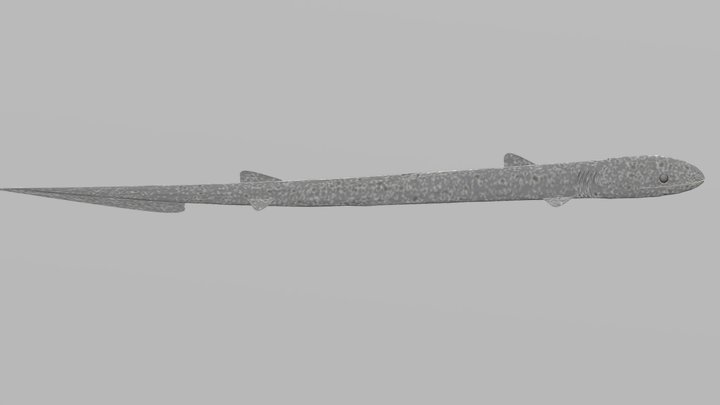
Phoebodus is an extinct genus of phoebodontiform total group elasmobranch, known from over a dozen species found worldwide spanning the middle to late Devonian, making it one of the oldest known total group elasmobranchs. Most species are only known from their isolated tricuspid teeth, but one species, Phoebodus saidselachus from the Late Devonian of Morocco, is known from a complete skeleton, estimated to have been 1.2 metres (3.9 ft) in total length in life, which shows that it had a slender body superficially similar to that of the living frilled shark. The teeth of Phoebodus and frilled sharks are also morphologically similar, and are designed for grasping prey. Phoebodus probably consumed small prey items that were capable of being swallowed whole. Prey of Phoebodus would have included thylacocephalans or cephalopods.

DiBgd · CC BY-SA 4.0 · via Wikipedia/Commons. May be a photograph of a specimen, or an artist’s reconstruction — an interpretation of a skeleton, since colour and soft tissue are almost never preserved.
On record
Recorded, not inferred- Sits inside
- PhoebodontidaePBDB
- Diet
- carnivorePBDB, for Chondrichthyes
- Life habit
- nektonicPBDB, for Chondrichthyes
- Motility
- actively mobilePBDB, for Chondrichthyes
Time the record covers
At most 3.7 million years on record.
The one occurrence read is dated to somewhere between 372.15 Mya and 368.5 Mya, which is a dating window rather than a span.
1 occurrence of Phoebodus on record, most of them in the Devonian. Bar height is expected occurrences, not a count: each fossil is spread across the span it is dated to, so a tall narrow bar means tight dating and a low wide one means loose.
When
1 occurrences- Devonian100%
These are dates about fossils, not the animal: the record can only begin after it arose and end before it died out, so either end may reach further. Shares are expected occurrences: a fossil dated to a span is counted partly in each period it straddles. More on what this infers.
Found in
1 formation
Loading coastlines…
The named rock units Phoebodus has been recovered from, largest first. Drawn where the rock is now, not where it formed.
Phoebodus and its relatives
DevonianWhere Phoebodus and its relatives were recorded in the Devonian.
Found in the same rock
155 taxa- Protacrodus5 sites
- Australolepis seddoni4 sites
- Chondrichthyes4 sites
- Acanthodii3 sites
- Elasmobranchii3 sites
- Ischnacanthiformes3 sites
- Moythomasia3 sites
- Iranolepis ginteri2 sites
- Manberodus fortis2 sites
- Milesacanthus antarctica2 sites
- Nostolepis gaujensis2 sites
- Omalodus grabaui2 sites
- Palmatolepis2 sites
- Sycidium2 sites
- Turinia2 sites
- Acaenasuchus geoffreyi1 site
- Acanthodes1 site
- Acrodus1 site
- Actinoconchus1 site
- Anaschisma browni1 site
- Antarctilamna1 site
- Apachesaurus gregorii1 site
- Archaeacanthus1 site
- Archosauria1 site
The Paleobiology Database records 23 sites for Phoebodus, and this reads all of them. The number is how many of those sites it was catalogued from too. The 24 sharing the most are listed.
This is not a list of everything alive at the time. It is only what has come out of the same ground as this animal and been written down.
Entered from
1 referenceEach of the 1 occurrence read was entered from one of these publications, ordered by how many each accounts for. This is not a search for papers mentioning the name. Each entry links to doi.org. Relayed as the Paleobiology Database holds them, not checked against what they resolve to.
Media and terms
Media content2

Picture of Phoebodus
- Source
- Wikipedia/Commons
- Credit
- DiBgd
- Licence
- CC BY-SA 4.0
- Commercial use
- the licence allows it
Smithsonian Open Access was not reached for this taxon, so this list is what the others held rather than everything there is.
The description on this site
- Source
- Wikipedia, “Phoebodus”
- Licence
- CC BY-SA 4.0
This is what the site found, which is not the same as what exists.
Keep going
What may have been alongside itPhoebodontidae through timeFormations of the DevonianThe world it lived on
Occurrence data from the Paleobiology Database, CC BY 4.0. St. John and Worthen 1875