Protoceratops andrewsi

Daderot · CC0 · via Wikidata/Commons. May be a photograph of a specimen, or an artist’s reconstruction — an interpretation of a skeleton, since colour and soft tissue are almost never preserved.
On record
Recorded, not inferred- Sits inside
- ProtoceratopsPBDB
- Diet
- herbivorePBDB, for Ceratopsia
- Life habit
- ground dwellingPBDB, for Ceratopsia
- Motility
- actively mobilePBDB, for Ornithischia
- Environment
- terrestrialPBDB, for Ceratopsia
Time the record covers
At most 14 million years on record.
Every occurrence read is dated to somewhere between 85.7 Mya and 72.2 Mya, and nothing in the dating separates them, so that window is what the record shows rather than a span.
19 occurrences of Protoceratops andrewsi on record, most of them in the Late Cretaceous. Bar height is expected occurrences, not a count: each fossil is spread across the span it is dated to, so a tall narrow bar means tight dating and a low wide one means loose.
When
19 occurrences- Late Cretaceous100%
These are dates about fossils, not the animal: the record can only begin after it arose and end before it died out, so either end may reach further. Shares are expected occurrences: a fossil dated to a span is counted partly in each period it straddles. More on what this infers.
Found in
3 formations
Loading coastlines…
The named rock units Protoceratops andrewsi has been recovered from, largest first. Drawn where the rock is now, not where it formed.
Protoceratops andrewsi and its relatives
Late CretaceousWhere Protoceratops andrewsi and its relatives were recorded in the Late Cretaceous.
Found in the same rock
82 taxa- Dinosauria6 sites
- Pinacosaurus grangeri5 sites
- Bagaceratops4 sites
- Lacertilia4 sites
- Ankylosauridae3 sites
- Elongatoolithidae3 sites
- Mammalia3 sites
- Multituberculata3 sites
- Nanhsiungchelyidae3 sites
- Pinacosaurus3 sites
- Theropoda3 sites
- Velociraptor3 sites
- Velociraptor mongoliensis3 sites
- Adamisaurus magnidentatus2 sites
- Ankylosauria2 sites
- Djadochtatherium matthewi2 sites
- Elongatoolithus2 sites
- Elongatoolithus frustrabilis2 sites
- Faveoloolithus ningxiaensis2 sites
- Hadrosauridae2 sites
- Kryptobaatar dashzevegi2 sites
- Mimeosaurus crassus2 sites
- Protoceratopsidae2 sites
- Protoceratopsidovum2 sites
The Paleobiology Database records 17 sites for Protoceratops andrewsi, and this reads all of them. The number is how many of those sites it was catalogued from too. The 24 sharing the most are listed.
This is not a list of everything alive at the time. It is only what has come out of the same ground as this animal and been written down.
Entered from
13 references- Report of preparation works for Mongolian specimens in HMNS from March 1994 to December 19984
- New specimens of Protoceratops (Dinosauria: Neoceratopsia) from the Upper Cretaceous in Udyn Sayr, southern Gobi area, Mongolia2
- Sexual dimorphism in protoceratopsians2
- Polish-Mongolian Palaeontological Expeditions to the Gobi Desert in 1963 and 19642
- New insights on the frill ornamentations of protoceratopsids1
- New protoceratopsid specimens improve the age correlation of the Upper Cretaceous Gobi Desert strata1
- A nest of Protoceratops andrewsi (Dinosauria, Ornithischia)1
- Bainoceratops efremovi, a new protoceratopid dinosaur (Protoceratopidae, Neoceratopsia) from the Bain-Dzak locality (south Mongolia)1
- A reconstruction of the locomotion of Protoceratops1
- Upper Cretaceous Djadokhta, Barun Goyot and Nemegt formations of Mongolia, including remarks on previous subdivisions1
- Poyedinok dinozavrov [Dueling dinosaurs]1
- Third (1965) Polish-Mongolian Palaeontological Expedition to the Gobi Desert and western Mongolia1
Each of the 19 occurrences read was entered from one of these publications, ordered by how many each accounts for. This is not a search for papers mentioning the name. 1 further reference is not listed. Entries link to doi.org where the Paleobiology Database holds an identifier, and to its own record where it does not. Relayed as the Paleobiology Database holds them, not checked against what they resolve to.
Media and terms
Media content3
Picture of Protoceratops andrewsi
- Source
- Wikidata/Commons
- Credit
- Daderot
- Licence
- CC0
- Commercial use
- the licence allows it
Photogrammetry
- Source
- MorphoSource
- Licence
- In Copyright
- Commercial use
- cannot be read from the licence given — check the record
- Specimen
- Protoceratops andrewsi · AMNH:FARB:6424
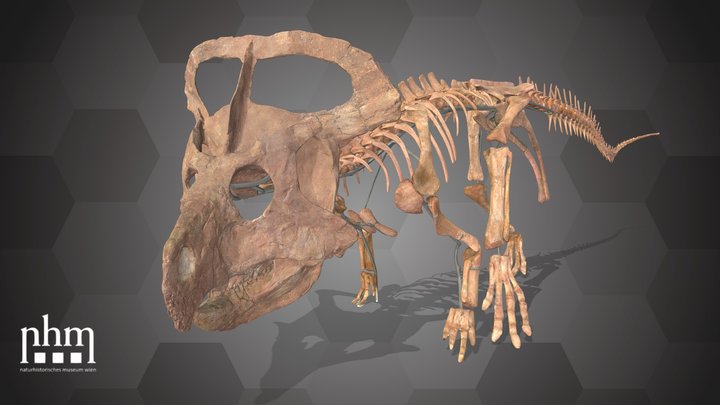
3D model
- Source
- Sketchfab
- Licence
- CC Attribution-NonCommercial
- Commercial use
- the licence does not allow it
This is what the site found, which is not the same as what exists.
Keep going
What may have been alongside itProtoceratops through timeFormations of the Late CretaceousThe world it lived on
Occurrence data from the Paleobiology Database, CC BY 4.0. Granger and Gregory 1923