Pseudolarix
Pseudolarix is a genus of coniferous trees in the pine family, Pinaceae, containing three species, the single extant Pseudolarix amabilis and the two extinct species Pseudolarix japonica and Pseudolarix wehrii. Pseudolarix species are commonly known as golden larch, but are not true larches (Larix) being more closely related to Keteleeria, Abies and Cedrus. P. amabilis is native to eastern China, occurring in small areas in the mountains of southern Anhui, Zhejiang, Fujian, Jiangxi, Hunan, Hubei and eastern Sichuan, at altitudes of 100–1,500 m (328–4,921 ft). P. wehrii is described from fossils dating to the Early Eocene (Ypresian), of Western North America where it is found in the Eocene Okanagan Highlands Allenby and Klondike Mountain Formations. The youngest known occurrence is of mummified fossils found in the Late Eocene Buchanan Lake Formation on Axel Heiberg Island. P. japonica is known from Middle Miocene to Pliocene sediments in Japan and Miocene deposits of Korea. Fossils assigned to Pseudolarix as a genus date possibly as old as the Early Cretaceous Hauterivian stage in Mongolia.

Eric Hunt · CC BY 2.5 · via Wikipedia/Commons. May be a photograph of a specimen, or an artist’s reconstruction — an interpretation of a skeleton, since colour and soft tissue are almost never preserved.
On record
Recorded, not inferred- Sits inside
- AbietoideaePBDB
- Diet
- "photoautotroph"PBDB, for Streptophyta
Time the record covers
At least 137 million years on record.
The record covers at least 143.1 Mya to 5.333 Mya. No occurrence read is dated outside 161.5 Mya to 2.58 Mya.
32 occurrences of Pseudolarix on record, most of them in the Eocene. The Paleobiology Database records this as a living group, and the chart stops with its fossils rather than at the present. Bar height is expected occurrences, not a count: each fossil is spread across the span it is dated to, so a tall narrow bar means tight dating and a low wide one means loose.
When
32 occurrencesThese are dates about fossils, not the animal: the record can only begin after it arose and end before it died out, so either end may reach further. Shares are expected occurrences: a fossil dated to a span is counted partly in each period it straddles. More on what this infers.
Found in
13 formations
- Challis Volcanics Formation5
- Itahana Formation · Tomioka Group2
- Ogawa Formation1
- Tokoname Formation1
- Kholodzhikan Suite Formation1
- Krivorechenskaya Formation1
Loading coastlines…
The named rock units Pseudolarix has been recovered from, largest first. Drawn where the rock is now, not where it formed. 14 occurrences have no formation on record, which is common for older literature.
Pseudolarix and its relatives
EoceneWhere Pseudolarix and its relatives were recorded in the Eocene.
Found in the same rock
459 taxa- Acer9 sites
- Alnus8 sites
- Quercus8 sites
- Carya7 sites
- Fagus7 sites
- Metasequoia occidentalis7 sites
- Ulmus7 sites
- Carpinus6 sites
- Cornus6 sites
- Picea6 sites
- Pinus6 sites
- Pseudotsuga6 sites
- Pterocarya6 sites
- Salix6 sites
- Sassafras6 sites
- Tilia6 sites
- Chamaecyparis5 sites
- Corylus5 sites
- Ginkgo5 sites
- Zelkova ungeri5 sites
- Abies4 sites
- Betula4 sites
- Castanea4 sites
- Cercidiphyllum4 sites
The Paleobiology Database records 19 sites for Pseudolarix, and this reads all of them. The number is how many of those sites it was catalogued from too. The 24 sharing the most are listed.
This is not a list of everything alive at the time. It is only what has come out of the same ground as this animal and been written down.
Entered from
18 references- Die oberoligozanen Floren am Nordrand der Sachsischen Lausitz5
- The Eocene Germer Basin Flora of South-Central Idaho5
- Late Miocene and Pliocene Floras in Central Honshu, Japan4
- A catalogue of Cenozoic megafossil plants in China3
- Fossil Plants of the Tertiary Beaverhead Basins in Southwestern Montana2
- The Khasurty fossil insect Lagerstätte1
- The Eocene Thomas Ranch flora, Allenby Formation, Princeton, British Columbia, Canada1
- The McAbee flora of British Columbia and its relation to the Early-Middle Eocene Okanagan Highlands flora of the Pacific Northwest1
- Palaeoenvironment and ecology of the middle Cretaceous Grebenka flora of northeastern Asia1
- A Dendroctonus bark engraving (Coleoptera: Scolytidae) from a middle Eocene Larix (Coniferales: Pinaceae): early or delayed colonization?1
- Die mittelmiozaenen und obermiozaenen Floren aus der Meuroer und Raunoer Folge in der Lausitz. III. Fundstellen und Palaeobiologie1
- Die pliozaenen Floren von Thueringen, Deutsche Demokratische Republik1
Each of the 32 occurrences read was entered from one of these publications, ordered by how many each accounts for. This is not a search for papers mentioning the name. 6 further references are not listed. Entries link to doi.org where the Paleobiology Database holds an identifier, and to its own record where it does not. Relayed as the Paleobiology Database holds them, not checked against what they resolve to.
Media and terms
Media content1
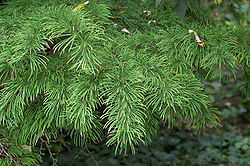
Picture of Pseudolarix
- Source
- Wikipedia/Commons
- Credit
- Eric Hunt
- Licence
- CC BY 2.5
- Commercial use
- the licence allows it
No 3D scan was found. Smithsonian Open Access, MorphoSource and Sketchfab were all searched.
The description on this site
- Source
- Wikipedia, “Pseudolarix”
- Licence
- CC BY-SA 4.0
This is what the site found, which is not the same as what exists.
Keep going
What may have been alongside itAbietoideae through timeFormations of the EoceneThe world it lived on
Occurrence data from the Paleobiology Database, CC BY 4.0. Gordon and Glendinning 1858