Pteranodontidae
The Pteranodontidae are a family of large pterosaurs from the Late Cretaceous of North America and possibly other continents including Europe and Africa. The family was named in 1876 by Othniel Charles Marsh. Pteranodontids had a distinctive, elongated crest jutting from the rear of the head. The spectacularly-crested Nyctosaurus is sometimes included in this family, though usually placed in its own family, the Nyctosauridae.

Kenn Chaplin from Toronto, Canada · CC BY-SA 2.0 · via Wikipedia/Commons. May be a photograph of a specimen, or an artist’s reconstruction — an interpretation of a skeleton, since colour and soft tissue are almost never preserved.
On record
Recorded, not inferred- Sits inside
- PteranodontiaPBDB
- Diet
- piscivorePBDB, for Pterosauria
- Life habit
- volantPBDB, for Pterosauria
- Motility
- actively mobilePBDB, for Osteichthyes
- Environment
- marinePBDB, for Pterosauria
Time the record covers
At least 41 million years on record.
The record covers at least 113.2 Mya to 72.2 Mya. No occurrence read is dated outside 119.57 Mya to 66 Mya.
15 occurrences of Pteranodontidae on record, most of them in the Late Cretaceous. Bar height is expected occurrences, not a count: each fossil is spread across the span it is dated to, so a tall narrow bar means tight dating and a low wide one means loose.
When
15 occurrencesThese are dates about fossils, not the animal: the record can only begin after it arose and end before it died out, so either end may reach further. Shares are expected occurrences: a fossil dated to a span is counted partly in each period it straddles. More on what this infers.
Found in
9 formations
- Rybushka Formation3
- Romualdo Formation · Santana Group2
- Couche III Formation2
- Chulec Formation1
- Toolebuc Formation · Rolling Downs Group1
- Chico Formation1
Loading coastlines…
The named rock units Pteranodontidae has been recovered from, largest first. Drawn where the rock is now, not where it formed. 2 occurrences have no formation on record, which is common for older literature.
Pteranodontidae and its relatives
Late CretaceousWhere Pteranodontidae and its relatives were recorded in the Late Cretaceous.
Found in the same rock
89 taxa- Azhdarchidae2 sites
- Mammalia2 sites
- Tethydraco regalis2 sites
- Volgadraco bogolubovi2 sites
- Alanqa saharica1 site
- Alcione elainus1 site
- Amylodon karamysh1 site
- Anhanguera1 site
- Anhanguera araripensis1 site
- Anhanguera blittersdorffi1 site
- Anhanguera ligabuei1 site
- Anhanguera robustus1 site
- Anhanguera santanae1 site
- Anhangueridae1 site
- Araripecarcinus ferreirae1 site
- Araripesuchus gomesii1 site
- Aussiedraco molnari1 site
- Azhdarchoidea1 site
- Banguela oberlii1 site
- Barbaridactylus grandis1 site
- Barbosania gracilirostris1 site
- Belonostomus1 site
- Brachiopoda1 site
- Brasilemys josai1 site
The Paleobiology Database records 14 sites for Pteranodontidae, and this reads all of them. The number is how many of those sites it was catalogued from too. The 24 sharing the most are listed.
This is not a list of everything alive at the time. It is only what has come out of the same ground as this animal and been written down.
Entered from
13 references- A new pterosaur (Pterodactyloidea: Azharchidae) from the Upper Cretaceous of Morocco2
- Comments on the Pteranodontidae (Pterosauria, Pterodactyloidea) with a description of two new species2
- A large pteranodontid pterosaur from the Late Cretaceous of Eastern Europe1
- An articulated pterosaur wing from the Upper Cretaceous (Maastrichtian) phosphates of Morocco1
- Late Maastrichtian pterosaurs from North Africa and mass extinction of Pterosauria at the Cretaceous-Paleogene boundary1
- Redescription of the first pterosaur remains from Japan: the largest flying reptile from Asia1
- A pterosaurian vertebra from the Upper Cretaceous of the Saratov Region1
- A new Late Cretaceous azhdarchid (Pterosauria, Azhdarchidae) from the Volga region1
- An incomplete pterosaur skull from the Cretaceous of north-central Queensland, Australia1
- California's first fossil evidence of Cretaceous winged vertebrates1
- A pteranodontid pterosaur from the Early Cretaceous of Peru, with comments on the relationships of Cretaceous pterosaurs1
- Neue Pterosaurier aus der Santana-Formation (Apt) der Chapada do Araripe, Brasilien1
Each of the 15 occurrences read was entered from one of these publications, ordered by how many each accounts for. This is not a search for papers mentioning the name. 1 further reference is not listed. Entries link to doi.org where the Paleobiology Database holds an identifier, and to its own record where it does not. Relayed as the Paleobiology Database holds them, not checked against what they resolve to.
Media and terms
Media content2
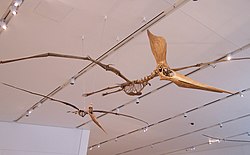
Picture of Pteranodontidae
- Source
- Wikipedia/Commons
- Credit
- Kenn Chaplin from Toronto, Canada
- Licence
- CC BY-SA 2.0
- Commercial use
- the licence allows it
Photogrammetry
- Source
- MorphoSource
- Licence
- In Copyright
- Commercial use
- cannot be read from the licence given — check the record
- Specimen
- Pteranodontidae indet. · amnh:farb:5819
Smithsonian Open Access was not reached for this taxon, so this list is what the others held rather than everything there is.
The description on this site
- Licence
- CC BY-SA 4.0
This is what the site found, which is not the same as what exists.
Keep going
What may have been alongside itPteranodontia through timeFormations of the Late CretaceousThe world it lived on
Occurrence data from the Paleobiology Database, CC BY 4.0. (Marsh 1876)