Pteriidae

Uncredited · via Wikidata/Commons. May be a photograph of a specimen, or an artist’s reconstruction — an interpretation of a skeleton, since colour and soft tissue are almost never preserved.
On record
Recorded, not inferred- Also called
- pearl oysterPBDB
- Sits inside
- PterioideaPBDB
- Diet
- suspension feederPBDB
- Life habit
- epifaunalPBDB
- Motility
- stationary, attached, epibiontPBDB
- Vision
- blindPBDB, for Bivalvia
- Environment
- coastal,inner shelf,outer shelf,oceanicPBDB
Time the record covers
At least 451 million years on record.
The record covers at least 451.8 Mya to 11.7 ka. No occurrence read is dated outside 453.9 Mya to 0 Mya.
1,394 occurrences of Pteriidae on record, most of them in the Late Cretaceous. The Paleobiology Database records this as a living group. Bar height is expected occurrences, not a count: each fossil is spread across the span it is dated to, so a tall narrow bar means tight dating and a low wide one means loose.
When
1,394 occurrences- Ordovicianunder 1%
- Silurianunder 1%
- Devonianunder 1%
- Carboniferousunder 1%
- Permian2%
- Early Triassic8%
- Middle Triassic9%
- Late Triassic16%
- Early Jurassic2%
- Middle Jurassic5%
- Late Jurassic9%
- Early Cretaceous2%
- Late Cretaceous22%
- Paleocene1%
- Eocene8%
- Oligocene4%
- Miocene5%
- Pliocene1%
- Pleistocene3%
- Holoceneunder 1%
These are dates about fossils, not the animal: the record can only begin after it arose and end before it died out, so either end may reach further. Shares are expected occurrences: a fossil dated to a span is counted partly in each period it straddles. More on what this infers.
Found in
327 formations
- Qingyan Formation87
- Kossen Formation46
- Woodbine Formation31
- Moodys Branch Formation · Jackson Group30
- Mancos Shale Formation29
- Koessen Formation27
Loading coastlines…
The named rock units Pteriidae has been recovered from, largest first. Drawn where the rock is now, not where it formed. 303 further formations hold fewer occurrences each and are not listed. 214 occurrences have no formation on record, which is common for older literature.
Pteriidae and its relatives
Late CretaceousWhere Pteriidae and its relatives were recorded in the Late Cretaceous.
Found in the same rock
1,640 taxa- Pteria92 sites
- Nuculana80 sites
- Cymbophora75 sites
- Syncyclonema64 sites
- Corbula61 sites
- Turritella55 sites
- Anomia argentaria54 sites
- Striarca53 sites
- Phelopteria52 sites
- Cyprimeria47 sites
- Crenella serica45 sites
- Cadulus43 sites
- Granocardium42 sites
- Linearis42 sites
- Pycnodonte41 sites
- Bryozoa40 sites
- Vetericardiella40 sites
- Astarte39 sites
- Cyclorisma39 sites
- Dentalium39 sites
- Modiolus39 sites
- Lucina38 sites
- Vertebrata37 sites
- Veniella conradi36 sites
The Paleobiology Database records 1,065 sites for Pteriidae, and this reads 240 of them. The number is how many of those sites it was catalogued from too. The 24 sharing the most are listed.
This is not a list of everything alive at the time. It is only what has come out of the same ground as this animal and been written down.
Entered from
352 references- Unpublished data74
- Fossilvergesellschaftungen, Paläoökologie und paläosynökologische Entwicklung im Oberen Anisium (Mittlere Trias) von Qingyan, insbesondere Bangtoupo, Provinz Guizhou, Südwestchina65
- Stratigraphie und Biofacies der Koessener Formation (Obertrias, Nordliche Kalkalpen)45
- The paleoecology of the Cenomanian-Turonian (Cretaceous) stage boundary extinctions at Black Mesa, Arizona38
- Taxonomic and ecological variations of Permian-Triassic transitional bivalve communities from the littoral clastic facies in southwestern China35
- Unpublished data on Cretaceous-Paleocene molluscan assemblages33
- Larger invertebrate fossils of the Woodbine formation (Cenomanian) of Texas33
- Palökologische und biofazielle Analyse des Kimmeridge (Oberjura) von Consolacao, Mittelportugal [Paleoecological and biofacies analysis of the Kimmeridgian (Upper Jurassic) of Consolacao, central Portugal]26
- Unpublished data from Kachchh25
- Upper Cretaceous (Maestrichtian) larger invertebrates from the Haustator bilira Assemblage Zone in the Atlantic Coastal Plain with further data for the East Gulf25
- Biostratigraphie et paleoecologie des gisements types du Stampian de la region d''Etampes (Essonne)25
- Molluscs at the K/Pg boundary in Argentina: Extinction and recovery patterns. unpublished Ph.D. thesis24
Each of the 1,394 occurrences read was entered from one of these publications, ordered by how many each accounts for. This is not a search for papers mentioning the name. 340 further references are not listed. Entries link to doi.org where the Paleobiology Database holds an identifier, and to its own record where it does not. Relayed as the Paleobiology Database holds them, not checked against what they resolve to.
Media and terms
Media content2
Picture of Pteriidae
- Source
- Wikidata/Commons
- Credit
- nobody named on the record
- Licence
- not stated by the source
- Commercial use
- cannot be read from the licence given — check the record
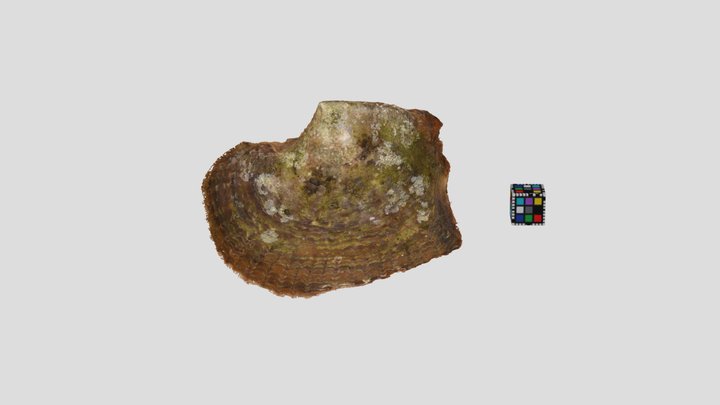
3D model
- Source
- Sketchfab
- Licence
- CC0 Public Domain
- Commercial use
- the licence allows it
Smithsonian Open Access was not reached for this taxon, so this list is what the others held rather than everything there is.
This is what the site found, which is not the same as what exists.
Keep going
What may have been alongside itPterioidea through timeFormations of the Late CretaceousThe world it lived on
Occurrence data from the Paleobiology Database, CC BY 4.0. Gray 1847