Pullenia
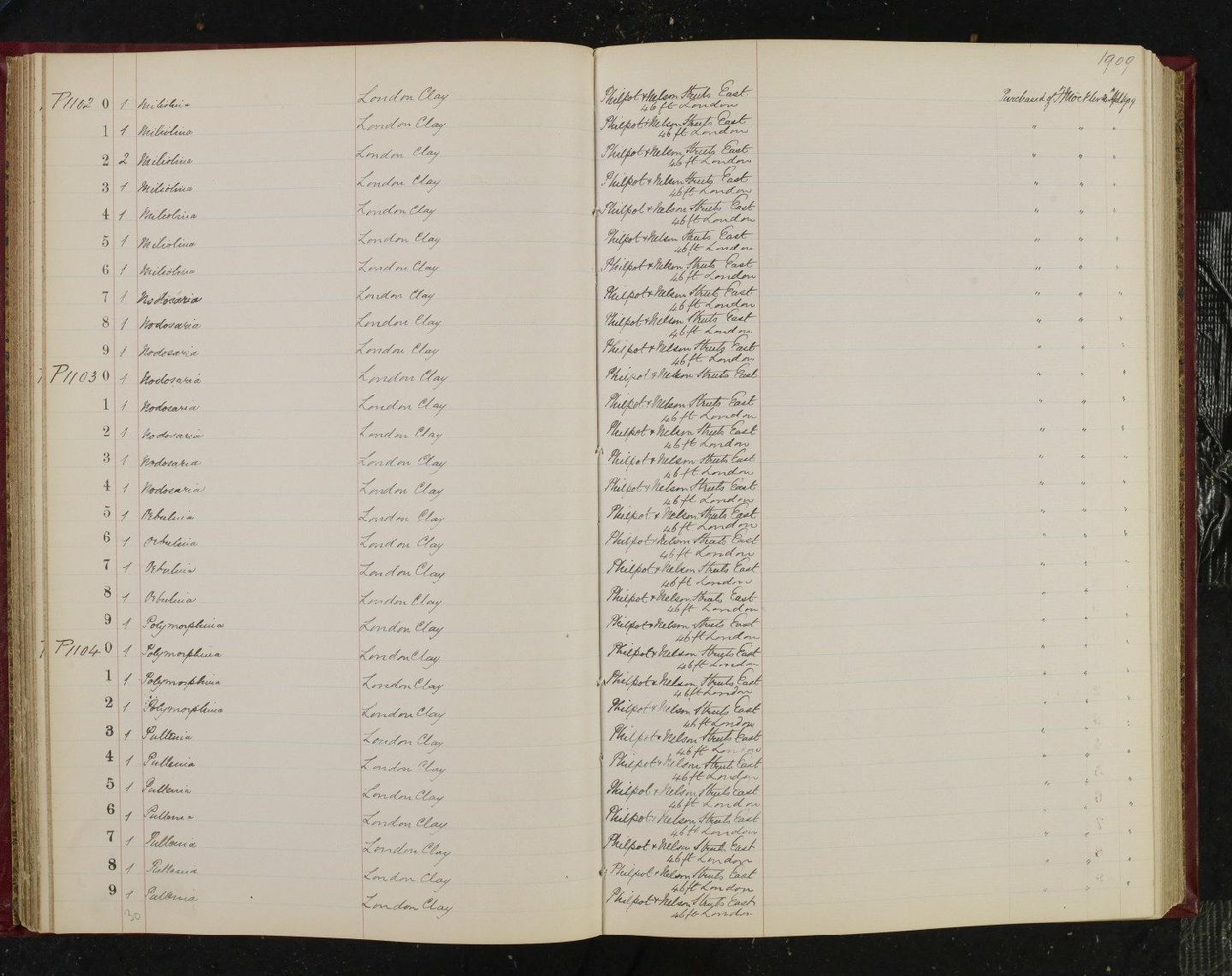
via iDigBio · CC BY · via iDigBio. May be a photograph of a specimen, or an artist’s reconstruction — an interpretation of a skeleton, since colour and soft tissue are almost never preserved.
On record
Recorded, not inferred- Sits inside
- ChilostomellidaePBDB
- Diet
- omnivorePBDB, for Foraminifera
- Life habit
- semi-infaunalPBDB, for Foraminifera
- Motility
- stationaryPBDB, for Foraminifera
Time the record covers
At least 100 million years on record.
The record covers at least 100.5 Mya to 11.7 ka. No occurrence read is dated outside 113.2 Mya to 0 Mya.
2,161 occurrences of Pullenia on record, most of them in the Pleistocene. The Paleobiology Database records this as a living group. Bar height is expected occurrences, not a count: each fossil is spread across the span it is dated to, so a tall narrow bar means tight dating and a low wide one means loose.
When
2,161 occurrences- Early Cretaceousunder 1%
- Late Cretaceous5%
- Paleocene1%
- Eocene11%
- Oligocene17%
- Miocene26%
- Pliocene10%
- Pleistocene28%
- Holocene2%
These are dates about fossils, not the animal: the record can only begin after it arose and end before it died out, so either end may reach further. Shares are expected occurrences: a fossil dated to a span is counted partly in each period it straddles. More on what this infers.
Found in
15 formations
- El Haria Formation93
- Keasey Formation5
- Ihungia Formation3
- Coamo Formation2
- Northumberland Formation · Nanaimo Group2
- Butano Formation2
Loading coastlines…
The named rock units Pullenia has been recovered from, largest first. Drawn where the rock is now, not where it formed. 2,045 occurrences have no formation on record, which is common for older literature.
Pullenia and its relatives
PleistoceneWhere Pullenia and its relatives were recorded in the Pleistocene.
Found in the same rock
847 taxa- Cibicidoides141 sites
- Uvigerina102 sites
- Oridorsalis100 sites
- Gyroidinoides96 sites
- Gyroidina67 sites
- Lenticulina67 sites
- Dentalina63 sites
- Gaudryina60 sites
- Planulina60 sites
- Globocassidulina59 sites
- Melonis barleeanum55 sites
- Anomalinoides52 sites
- Osangularia50 sites
- Saracenaria48 sites
- Sphaeroidina bulloides48 sites
- Brizalina47 sites
- Martinottiella communis47 sites
- Praebulimina47 sites
- Sigmoilopsis47 sites
- Spiroplectammina47 sites
- Anomalinoides acuta46 sites
- Bulimina46 sites
- Coryphostoma46 sites
- Cibicides45 sites
The Paleobiology Database records at least 1,371 sites for Pullenia, and this reads 240 of them. The number is how many of those sites it was catalogued from too. The 24 sharing the most are listed.
This is not a list of everything alive at the time. It is only what has come out of the same ground as this animal and been written down.
Entered from
103 references- Site U1335170
- Site U1334162
- The Late Campian and Maastrichtian in northwestern Tunisia: palaeoenvironmental inferences from lithology, macrofauna and benthic formainifera93
- Site U133381
- Neogene benthic foraminifera of the Hatton-Rockall Basin81
- Site U150780
- Site U140580
- Site U143773
- Site U133767
- Site U140661
- Site U133652
- Input Site U141450
Each of the 2,161 occurrences read was entered from one of these publications, ordered by how many each accounts for. This is not a search for papers mentioning the name. 91 further references are not listed. Entries link to doi.org where the Paleobiology Database holds an identifier, and to its own record where it does not. Relayed as the Paleobiology Database holds them, not checked against what they resolve to.
Media and terms
Media content1
Picture of Pullenia
- Source
- iDigBio
- Credit
- via iDigBio
- Licence
- CC BY
- Commercial use
- the licence allows it
No 3D scan of Pullenia was found in Sketchfab.
Smithsonian Open Access and MorphoSource were not reached for this taxon, so this list is what the others held rather than everything there is.
This is what the site found, which is not the same as what exists.
Keep going
What may have been alongside itChilostomellidae through timeFormations of the PleistoceneThe world it lived on
Occurrence data from the Paleobiology Database, CC BY 4.0. Parker and Jones 1862