Pygodus serra
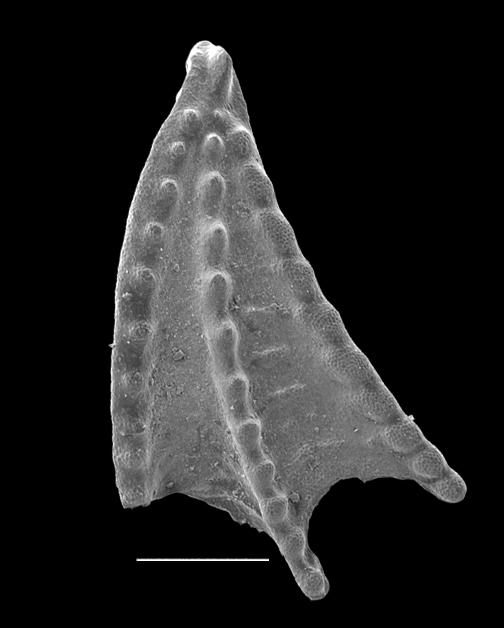
Hints, Olle · CC BY-NC 4.0 · via GBIF. May be a photograph of a specimen, or an artist’s reconstruction — an interpretation of a skeleton, since colour and soft tissue are almost never preserved.
On record
Recorded, not inferred- Sits inside
- PygodusPBDB
- Diet
- carnivorePBDB, for Conodonta
- Life habit
- nektonicPBDB, for Conodonta
- Motility
- actively mobilePBDB, for Conodonta
- Vision
- well-developedPBDB, for Conodonta
Time the record covers
At most 14 million years on record.
Every occurrence read is dated to somewhere between 471.3 Mya and 457.3 Mya, and nothing in the dating separates them, so that window is what the record shows rather than a span.
9 occurrences of Pygodus serra on record, most of them in the Ordovician. Bar height is expected occurrences, not a count: each fossil is spread across the span it is dated to, so a tall narrow bar means tight dating and a low wide one means loose.
When
9 occurrences- Ordovician100%
These are dates about fossils, not the animal: the record can only begin after it arose and end before it died out, so either end may reach further. Shares are expected occurrences: a fossil dated to a span is counted partly in each period it straddles. More on what this infers.
Found in
5 formations
- Antelope Valley Formation · Pogonip Group4
- Väo Formation2
- Lower Chaitsun Formation1
- Elnes Formation1
- Väo Formation1
Loading coastlines…
The named rock units Pygodus serra has been recovered from, largest first. Drawn where the rock is now, not where it formed.
Pygodus serra and its relatives
OrdovicianWhere Pygodus serra and its relatives were recorded in the Ordovician.
Found in the same rock
48 taxa- Acodus4 sites
- Ansella nevadensis4 sites
- Baltoniodus4 sites
- Belodina monitorensis4 sites
- Conodonta4 sites
- Panderodus4 sites
- Periodon4 sites
- Scandodus4 sites
- Baltoplacognathus reclinatus3 sites
- Cahabagnathus friendsvillensis3 sites
- Erraticodon3 sites
- Oslodus semisymmetricus3 sites
- Panderodus sulcatus3 sites
- Phragmodus flexuosus3 sites
- Semiacontiodus cornuformis3 sites
- "Roundia" bispicata2 sites
- Ansella serrata2 sites
- Drepanoistodus basiovalis2 sites
- Polyplacognathus2 sites
- Prioniodus2 sites
- Amorphognathus1 site
- Aporthophyla perelegans1 site
- Aporthophylina intermedia1 site
- Bathyurus extans1 site
The Paleobiology Database records 9 sites for Pygodus serra, and this reads all of them. The number is how many of those sites it was catalogued from too. The 24 sharing the most are listed.
This is not a list of everything alive at the time. It is only what has come out of the same ground as this animal and been written down.
Entered from
5 references- Aspects of Middle and Upper Ordovician Conodont Biostratigraphy of Carbonate Facies in Nevada and Southeast California and Comparison with Some Appalachian Successions4
- Darriwilian (Middle Ordovician) conodont biostratigraphy in NW Estonia2
- Trilobites from the Middle Ordovician Stairway Sandstone, Amadeus Basin, central Australia1
- A primitive cladid crinoid from the Jiacun Group, Tibet (Darriwilian, Middle Ordovician)1
- Conodont biostratigraphy and taxonomy of the Ordovician shelf margin deposits in the Scandinavian Caledonides1
Each of the 9 occurrences read was entered from one of these publications, ordered by how many each accounts for. This is not a search for papers mentioning the name. Entries link to doi.org where the Paleobiology Database holds an identifier, and to its own record where it does not. Relayed as the Paleobiology Database holds them, not checked against what they resolve to.
Media and terms
Media content2
Picture of Pygodus serra
- Source
- GBIF
- Credit
- Hints, Olle
- Licence
- CC BY-NC 4.0
- Commercial use
- the licence does not allow it
CT scan
- Source
- MorphoSource
- Licence
- not stated by the source
- Commercial use
- cannot be read from the licence given — check the record
- Specimen
- Pygodus serra · CUGB:Paleontology primative vertebrates:CUGB2023
Smithsonian Open Access was not reached for this taxon, so this list is what the others held rather than everything there is.
This is what the site found, which is not the same as what exists.
Keep going
What may have been alongside itPygodus through timeFormations of the OrdovicianThe world it lived on
Occurrence data from the Paleobiology Database, CC BY 4.0. (Hadding 1913)