Amorphognathus
Amorphognathus is an extinct conodont genus in the family Balognathidae from the Ordovician.
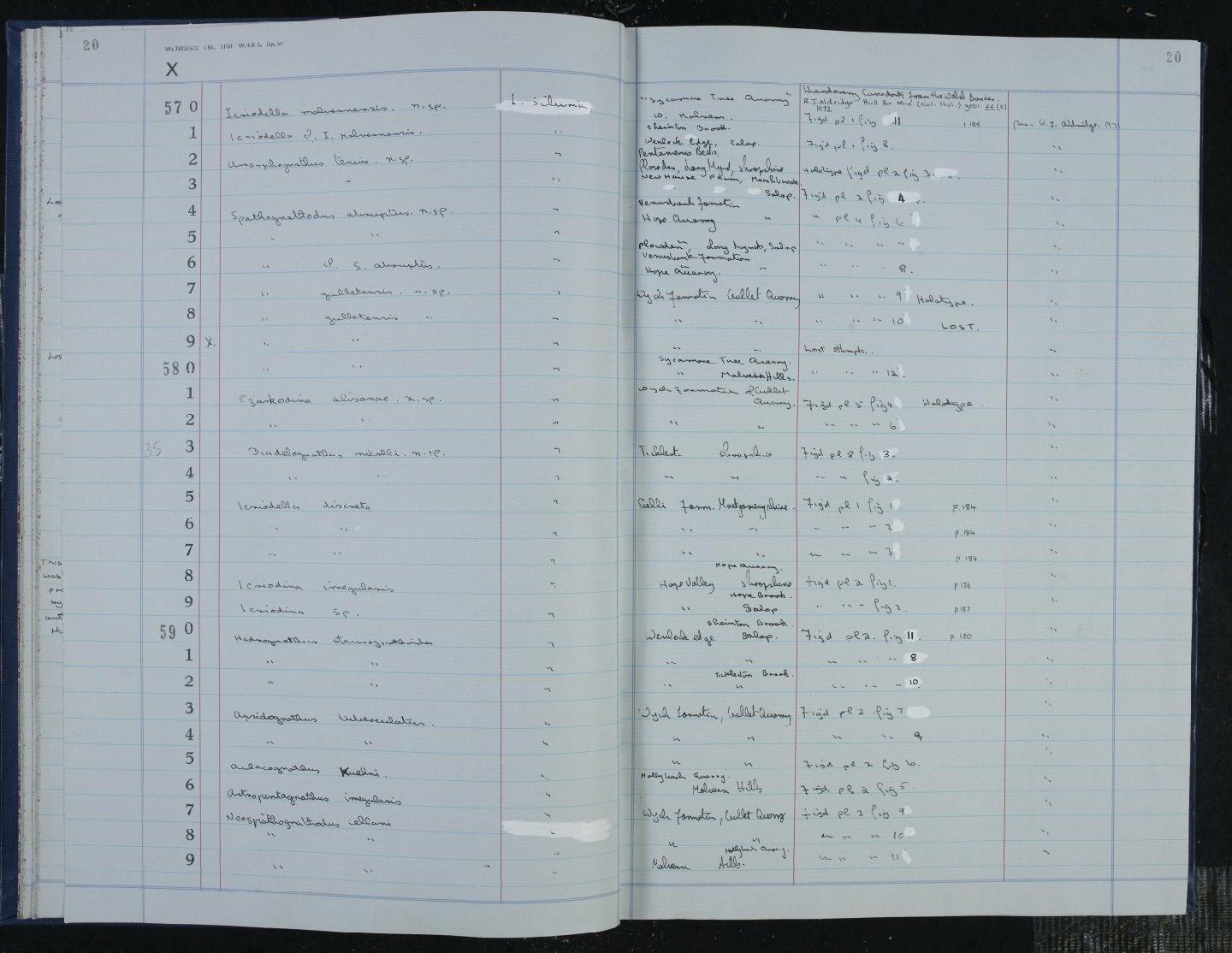
Professor Richard J. Aldridge · CC0 · via GBIF. May be a photograph of a specimen, or an artist’s reconstruction — an interpretation of a skeleton, since colour and soft tissue are almost never preserved.
On record
Recorded, not inferred- Sits inside
- BalognathidaePBDB
- Diet
- carnivorePBDB, for Conodonta
- Life habit
- nektonicPBDB, for Conodonta
- Motility
- actively mobilePBDB, for Conodonta
- Vision
- well-developedPBDB, for Conodonta
Time the record covers
At least 85 million years on record.
The record covers at least 468 Mya to 382.31 Mya. No occurrence read is dated outside 477.1 Mya to 298.9 Mya.
198 occurrences of Amorphognathus on record, most of them in the Ordovician. Bar height is expected occurrences, not a count: each fossil is spread across the span it is dated to, so a tall narrow bar means tight dating and a low wide one means loose.
When
198 occurrences- Ordovician94%
- Silurian5%
- Devonianunder 1%
- Carboniferousunder 1%
These are dates about fossils, not the animal: the record can only begin after it arose and end before it died out, so either end may reach further. Shares are expected occurrences: a fossil dated to a span is counted partly in each period it straddles. More on what this infers.
Found in
64 formations
- Welling Formation23
- Zalesie Formation17
- Allen Bay Formation11
- Jonstorp Formation10
- White Head Formation7
- Wolayer Formation6
Loading coastlines…
The named rock units Amorphognathus has been recovered from, largest first. Drawn where the rock is now, not where it formed. 40 further formations hold fewer occurrences each and are not listed. 7 occurrences have no formation on record, which is common for older literature.
Amorphognathus and its relatives
OrdovicianWhere Amorphognathus and its relatives were recorded in the Ordovician.
Found in the same rock
625 taxa- Drepanoistodus suberectus66 sites
- Dapsilodus mutatus53 sites
- Panderodus49 sites
- Panderodus gracilis35 sites
- Phragmodus undatus33 sites
- Plectodina33 sites
- Scabbardella altipes24 sites
- Hamarodus brevirameus23 sites
- Oulodus23 sites
- Walliserodus21 sites
- Belodina confluens19 sites
- Periodon grandis19 sites
- Scabbardella19 sites
- Drepanoistodus18 sites
- Icriodella18 sites
- Pseudooneotodus18 sites
- Panderodus panderi17 sites
- Protopanderodus17 sites
- Protopanderodus liripipus17 sites
- Staufferella15 sites
- Aphelognathus14 sites
- Cornuodus longibasis13 sites
- Drepanodus13 sites
- Paroistodus12 sites
The Paleobiology Database records 138 sites for Amorphognathus, and this reads all of them. The number is how many of those sites it was catalogued from too. The 24 sharing the most are listed.
This is not a list of everything alive at the time. It is only what has come out of the same ground as this animal and been written down.
Entered from
57 references- Sedimentation and Fossils of the Mojcza Limestone17
- Upper Ordovician – Upper Silurian conodont biostratigraphy, Devon Island and southern Ellesmere Island, Canadian Arctic Islands, with implications for regional stratigraphy, eustasy, and thermal maturation16
- Articulate brachiopods of the Viola Formation (Ordovician) in the Arbuckle Mountains, Oklahoma15
- Integrated Upper Ordovician - lower Silurian biostratigraphy of the Grötlingbo-1 core section, Sweden11
- The Ordovician conodont biostratigraphy in the Siljan region, south-central Sweden: a brief review of an international reference standard9
- Late Ordovician- Early Silurian conodont biostratigraphy and thermal maturity, Hudson Bay Basin7
- Upper Bromide Formation and Viola Group (Middle and Upper Ordovician) in Eastern Oklahoma - Part II - Conodont Biostratigraphy of Fite Formation7
- Chrono-, litho- and conodont bio-stratigraphy of the Rauchkofel Boden Section (Upper Ordovician–Lower Devonian), Carnic Alps, Austria6
- New conodont faunas from the Late Ordovician of the Central Carnic Alps, Austria6
- Late Ordovician - Early Silurian conodont biostratigraphy of the Gaspé Peninsula - a preliminary report6
- Upper Ordovician carbon isotope chemostratigraphy on the Yangtze Platform, Southwestern China: Implications for the correlation of the Guttenberg δ13C excursion (GICE) and paleoceanic change5
- Katian conodonts from the Portrane Limestone: the first Ordovician conodont fauna described from Ireland5
Each of the 198 occurrences read was entered from one of these publications, ordered by how many each accounts for. This is not a search for papers mentioning the name. 45 further references are not listed. Entries link to doi.org where the Paleobiology Database holds an identifier, and to its own record where it does not. Relayed as the Paleobiology Database holds them, not checked against what they resolve to.
Media and terms
Media content1
Picture of Amorphognathus
- Source
- GBIF
- Credit
- Professor Richard J. Aldridge
- Licence
- CC0
- Commercial use
- the licence allows it
No 3D scan was found. Smithsonian Open Access, MorphoSource and Sketchfab were all searched.
The description on this site
- Licence
- CC BY-SA 4.0
This is what the site found, which is not the same as what exists.
Keep going
What may have been alongside itBalognathidae through timeFormations of the OrdovicianThe world it lived on
Occurrence data from the Paleobiology Database, CC BY 4.0. Branson and Mehl 1933