Rajiformes
Rajiformes is one of the four orders in the clade Batomorphi, often referred to as the superorder Batoidea, flattened cartilaginous fishes related to sharks. Rajiforms are distinguished by the presence of greatly enlarged pectoral fins, which reach as far forward as the sides of the head, with a generally flattened body. The undulatory pectoral fin motion diagnostic to this taxon is known as rajiform locomotion. The eyes and spiracles are located on the upper surface of the head and the gill slits are on the underside of the body. Most species give birth to live young, although some lay eggs enclosed in a horny capsule.

Andy Martinez/NOAA · Public Domain · via Wikipedia/Commons. May be a photograph of a specimen, or an artist’s reconstruction — an interpretation of a skeleton, since colour and soft tissue are almost never preserved.
On record
Recorded, not inferred- Also called
- rayPBDB
- Sits inside
- BatomorphiiPBDB
- Diet
- carnivorePBDB
- Life habit
- nektobenthicPBDB
- Motility
- actively mobilePBDB
Time the record covers
At least 201 million years on record.
The record covers at least 201.4 Mya to 11.7 ka. No occurrence read is dated outside 205.7 Mya to 0 Mya.
680 occurrences of Rajiformes on record, most of them in the Late Cretaceous. The Paleobiology Database records this as a living group. Bar height is expected occurrences, not a count: each fossil is spread across the span it is dated to, so a tall narrow bar means tight dating and a low wide one means loose.
When
680 occurrences- Late Triassicunder 1%
- Early Jurassicunder 1%
- Late Jurassic4%
- Early Cretaceous7%
- Late Cretaceous46%
- Paleoceneunder 1%
- Eocene6%
- Oligocene16%
- Miocene11%
- Pliocene5%
- Pleistocene3%
- Holoceneunder 1%
These are dates about fossils, not the animal: the record can only begin after it arose and end before it died out, so either end may reach further. Shares are expected occurrences: a fossil dated to a span is counted partly in each period it straddles. More on what this infers.
Found in
160 formations
- Boom Clay Formation86
- Fox Hills Formation · Montana Group21
- Paluxy Formation · Trinity Group17
- Lower Kimmeridge marls Formation15
- Marnes de Donzacq Formation14
- Mesaverde Formation13
Loading coastlines…
The named rock units Rajiformes has been recovered from, largest first. Drawn where the rock is now, not where it formed. 136 further formations hold fewer occurrences each and are not listed. 186 occurrences have no formation on record, which is common for older literature.
Rajiformes and its relatives
Late CretaceousWhere Rajiformes and its relatives were recorded in the Late Cretaceous.
Found in the same rock
2,476 taxa- Pseudohypolophus mcnultyi50 sites
- Squalicorax kaupi45 sites
- Archaeolamna kopingensis40 sites
- Hybodus39 sites
- Raja36 sites
- Ischyrhiza mira34 sites
- Rhinobatos34 sites
- Cretalamna appendiculata33 sites
- Dasyatis28 sites
- Protoplatyrhina renae26 sites
- Rhinobatoidei26 sites
- Squalicorax24 sites
- Crocodylia23 sites
- Myledaphus bipartitus22 sites
- Odontaspis aculeatus22 sites
- Scapanorhynchus texanus22 sites
- Squatina22 sites
- Squatina (Cretascyllium) hassei22 sites
- Cretodus semiplicatus21 sites
- Teleostei21 sites
- Squatirhina20 sites
- Cretorectolobus olsoni19 sites
- Meristodonoides montanensis19 sites
- Otodus megalodon19 sites
The Paleobiology Database records 489 sites for Rajiformes, and this reads 240 of them. The number is how many of those sites it was catalogued from too. The 24 sharing the most are listed.
This is not a list of everything alive at the time. It is only what has come out of the same ground as this animal and been written down.
Entered from
228 references- Biostratigraphie et poissons fossiles de la formation de l'Argile de Boom (Oligocène moyen du Bassin Belge)71
- Placoid scales (Chondrichthyes: Elasmobranchii) from the Late Jurassic (Kimmeridgian) of northern Germany30
- Batoids (Elasmobranchii: Batomorphii) from the British and French Late Cretaceous24
- Chondrichthyan and osteichthyan paleofaunas from the Cretaceous (Late Maastrichtian) Fox Hills Formation of North Dakota, USA: paleoecology, paleogeography, and extinction18
- Cartilaginous fishes of the Trinity Group and related rocks (Lower Cretaceous) of north central Texas17
- Late Cretaceous and Danian neoselachians from southern Sweden16
- Découverte de nouvelles faunes de sélaciens (Neoselachii) dans les phosphates maastrichtiens de la Mer Rouge, Egypte16
- New sharks and rays from the Cenomanian and Turonian of Charentes, France15
- Nouvelle faunes de sélaciens (Elasmobranchii, Neoselachii) de l'Eocène moyen des Landes (Sud-Ouest, France). Implication dans la connaissance des communautés de sélaciens d'eau profondes15
- Additions to the fauna of the Boom Clay Formation of Belgium (Rupelian, Oligocene). Taxonomic adjustments on the Scyliorhinidae and Rajoidei, discovery of a dasyatid species (Pisces, Chondrichthyes) and of a curculionid species (Insecta, Coleoptera)15
- A new selachian fauna from the late Campanian of Wyoming (Teapot Sandstone Member, Mesaverde Formation, Big Horn Basin)13
- The marine vertebrate faunas from the Late Cretaceous phosphates of Syria12
Each of the 680 occurrences read was entered from one of these publications, ordered by how many each accounts for. This is not a search for papers mentioning the name. 216 further references are not listed. Entries link to doi.org where the Paleobiology Database holds an identifier, and to its own record where it does not. Relayed as the Paleobiology Database holds them, not checked against what they resolve to.
Media and terms
Media content1
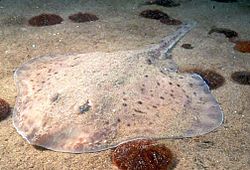
Picture of Rajiformes
- Source
- Wikipedia/Commons
- Credit
- Andy Martinez/NOAA
- Licence
- Public Domain
- Commercial use
- the licence allows it
No 3D scan of Rajiformes was found in Sketchfab.
Smithsonian Open Access and MorphoSource were not reached for this taxon, so this list is what the others held rather than everything there is.
The description on this site
- Source
- Wikipedia, “Rajiformes”
- Licence
- CC BY-SA 4.0
This is what the site found, which is not the same as what exists.
Keep going
What may have been alongside itBatomorphii through timeFormations of the Late CretaceousThe world it lived on
Occurrence data from the Paleobiology Database, CC BY 4.0. (Berg 1940)