Rosa
A rose is either a woody perennial flowering plant of the genus Rosa, in the family Rosaceae, or the flower it bears. There are over three hundred species and tens of thousands of cultivars. The plants range in size and form, from trailing and erect shrubs to climbers up to 7 metres (23 ft) in height. Sharp prickles appear on the stems of many species. Their flowers vary in size and shape and are usually large and showy, in colours ranging from white through pinks, reds, oranges and yellows.

Stan Shebs · CC BY-SA 3.0 · via Wikipedia/Commons. May be a photograph of a specimen, or an artist’s reconstruction — an interpretation of a skeleton, since colour and soft tissue are almost never preserved.
On record
Recorded, not inferred- Also called
- rosePBDB
- Sits inside
- RosaceaePBDB
- Diet
- "photoautotroph"PBDB, for Angiospermae
Time the record covers
At least 47 million years on record.
The record covers at least 48.07 Mya to 129 ka. No occurrence read is dated outside 66 Mya to 11.7 ka.
53 occurrences of Rosa on record, most of them in the Miocene. The Paleobiology Database records this as a living group. Bar height is expected occurrences, not a count: each fossil is spread across the span it is dated to, so a tall narrow bar means tight dating and a low wide one means loose.
When
53 occurrencesThese are dates about fossils, not the animal: the record can only begin after it arose and end before it died out, so either end may reach further. Shares are expected occurrences: a fossil dated to a span is counted partly in each period it straddles. More on what this infers.
Found in
18 formations
- John Day Formation10
- Renova Formation · Ruby River Basin Group2
- Itahana Formation · Tomioka Group1
- Ogawa Formation1
- Ohoka Formation1
- Eifel Formation1
Loading coastlines…
The named rock units Rosa has been recovered from, largest first. Drawn where the rock is now, not where it formed. 25 occurrences have no formation on record, which is common for older literature.
Rosa and its relatives
MioceneWhere Rosa and its relatives were recorded in the Miocene.
Found in the same rock
776 taxa- Quercus18 sites
- Alnus16 sites
- Salix16 sites
- Acer15 sites
- Ulmus12 sites
- Fraxinus10 sites
- Rhus10 sites
- Zelkova10 sites
- Abies9 sites
- Castanea9 sites
- Carpinus8 sites
- Picea8 sites
- Populus8 sites
- Typha lesquereuxi8 sites
- Betula7 sites
- Carya7 sites
- Cedrela7 sites
- Koelreuteria7 sites
- Mahonia7 sites
- Ptelea7 sites
- Sequoia affinis7 sites
- Cercidiphyllum6 sites
- Chamaecyparis6 sites
- Eucommia6 sites
The Paleobiology Database records 28 sites for Rosa, and this reads all of them. The number is how many of those sites it was catalogued from too. The 24 sharing the most are listed.
This is not a list of everything alive at the time. It is only what has come out of the same ground as this animal and been written down.
Entered from
27 references- The Oligocene Bridge Creek flora of the John Day Formation, Oregon9
- Die mittelmiozaenen und obermiozaenen Floren aus der Meuroer und Raunoer Folge in der Lausitz. III. Fundstellen und Palaeobiologie5
- A catalogue of Cenozoic megafossil plants in China5
- Fossil Plants of the Tertiary Beaverhead Basins in Southwestern Montana4
- Tracing the Cenozoic History of Roses (Rosaceae: Rosa ) in North America Based on Fossil Foliage and Fruiting Remains3
- Late Miocene and Pliocene Floras in Central Honshu, Japan3
- A Catalogue of Indian Fossil Plants3
- Die Floren des Haselbacher Serie im Weisselster-Becken (Bezirk Leipzig, DDR)2
- Systematic descriptions, in A Miocene leaf fossil record of Rosa (R. fortuita n. sp.) from its modern diversity center in SW China1
- The Oligocene Volcanic Flora of Kundratice near Litomerice, Ceske Stredohori Volcanic Complex (Czech Republic) - A review1
- The Middle Eocene plant taphocoenosis from Eckfeld (Eifel, Germany)1
- The Miocene Purple Mountain Flora of Western Nevada1
Each of the 53 occurrences read was entered from one of these publications, ordered by how many each accounts for. This is not a search for papers mentioning the name. 15 further references are not listed. Entries link to doi.org where the Paleobiology Database holds an identifier, and to its own record where it does not. Relayed as the Paleobiology Database holds them, not checked against what they resolve to.
Media and terms
Media content1
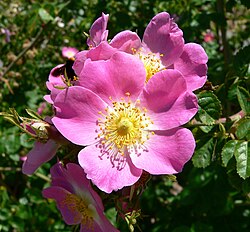
Picture of Rosa
- Source
- Wikipedia/Commons
- Credit
- Stan Shebs
- Licence
- CC BY-SA 3.0
- Commercial use
- the licence allows it
No 3D scan of Rosa was found in Sketchfab.
Smithsonian Open Access and MorphoSource were not reached for this taxon, so this list is what the others held rather than everything there is.
The description on this site
- Source
- Wikipedia, “Rose”
- Licence
- CC BY-SA 4.0
This is what the site found, which is not the same as what exists.
Keep going
What may have been alongside itRosaceae through timeFormations of the MioceneThe world it lived on
Occurrence data from the Paleobiology Database, CC BY 4.0. Linnaeus 1753