Salticidae
Jumping spiders are spiders in the family Salticidae, with almost 700 genera and around 7,000 described species, making it the largest family of spiders – comprising 13% of spider species. Jumping spiders have some of the best vision among arthropods — being capable of stereoptic color vision — and use sight in courtship, hunting, and navigation.

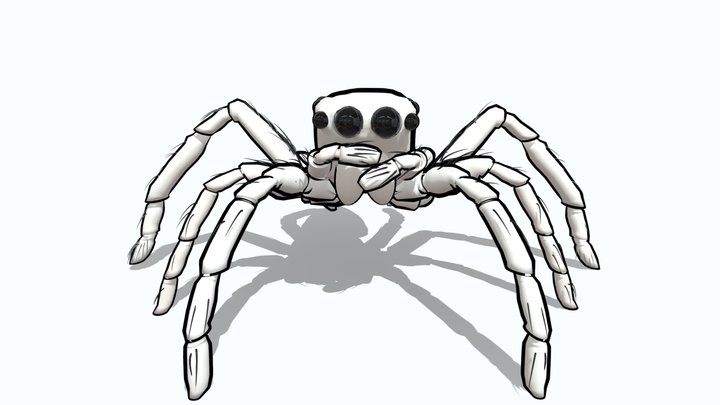
Kevincollins123 · CC BY-SA 3.0 · via Wikipedia/Commons. May be a photograph of a specimen, or an artist’s reconstruction — an interpretation of a skeleton, since colour and soft tissue are almost never preserved.
On record
Recorded, not inferred- Sits inside
- DionychaPBDB
- Life habit
- solitaryPBDB, for Arachnida
- Motility
- actively mobilePBDB, for Arachnida
- Environment
- terrestrialPBDB, for Arachnida
Time the record covers
At least 33 million years on record.
The record covers at least 33.9 Mya to 11.7 ka. No occurrence read is dated outside 37.71 Mya to 0 Mya.
153 occurrences of Salticidae on record. The Paleobiology Database records this as a living group. Bar height is expected occurrences, not a count: each fossil is spread across the span it is dated to, so a tall narrow bar means tight dating and a low wide one means loose.
When
153 occurrencesThese are dates about fossils, not the animal: the record can only begin after it arose and end before it died out, so either end may reach further. Shares are expected occurrences: a fossil dated to a span is counted partly in each period it straddles. More on what this infers.
Found in
6 formations
- Niveau du gypse d'Aix Formation2
- Barstow Formation1
- Shanwang Formation1
- Randeck Maar Formation1
- Bouldnor Formation · Solent Group1
- Mazantic Shale Formation · Simojovel Group1
Loading coastlines…
The named rock units Salticidae has been recovered from, largest first. Drawn where the rock is now, not where it formed. 146 occurrences have no formation on record, which is common for older literature.
Found in the same rock
3,702 taxa- Salticinae13 sites
- Gorgopsina frenata11 sites
- Gesomyrmex hoernesi10 sites
- Nylanderia pygmaea9 sites
- Yantaromyrmex geinitzi9 sites
- Ablator triguttatus8 sites
- Araneae8 sites
- Archaea paradoxa8 sites
- Ctenobethylus goepperti8 sites
- Episinus longimanus8 sites
- Orchestina baltica8 sites
- Prenolepis henschei8 sites
- Segestria8 sites
- Balticoroma serafinorum7 sites
- Lasaeola infulata7 sites
- Lasius schiefferdeckeri7 sites
- Pseudoteutana stigmatosa7 sites
- Dasyhelea6 sites
- Eomatachia latifrons6 sites
- Forcipomyia6 sites
- Formica flori6 sites
- Lype sericea6 sites
- Marpissina6 sites
- Pachycondyla succinea6 sites
The Paleobiology Database records 64 sites for Salticidae, and this reads all of them. Of that, one read hit the database's own return limit, so every count below is a floor rather than a total. The number is how many of those sites it was catalogued from too. The 24 sharing the most are listed.
This is not a list of everything alive at the time. It is only what has come out of the same ground as this animal and been written down.
Entered from
38 references- Fossil jumping spiders (Araneae: Salticidae) in Baltic and Domican amber, with remarks on Salticidae subfamilies39
- Jumping spiders (Araneae: Salticidae) from Miocene Mexican amber30
- Die fossilen Spinnen im dominikanischen Bernstein12
- A study of amber spiders10
- Die im Bernstein befindlichen Crustaceen, Myriapoden, Arachniden und Apteren der Vorwelt10
- Some fossil spiders (Araneae) in Eocene European ambers6
- Fossil Eocene Salticidae (Araneae) from the collection of the Museum of Earth in Warsaw6
- Footnotes and taxonomic names, in Die im Bernstein befindlichen Crustaceen, Myriapoden, Arachniden und Apteren der Vorwelt5
- Wunderlich, 19862
- Remarks on Oligocene amber spiders of the family Salticidae2
- Amber Spiders in European Collections2
- Baltic amber spiders in the Museum of Comparative Zoology2
Each of the 153 occurrences read was entered from one of these publications, ordered by how many each accounts for. This is not a search for papers mentioning the name. 26 further references are not listed. Entries link to doi.org where the Paleobiology Database holds an identifier, and to its own record where it does not. Relayed as the Paleobiology Database holds them, not checked against what they resolve to.
Media and terms
Media content2

Picture of Salticidae
- Source
- Wikipedia/Commons
- Credit
- Kevincollins123
- Licence
- CC BY-SA 3.0
- Commercial use
- the licence allows it
Smithsonian Open Access and MorphoSource were not reached for this taxon, so this list is what the others held rather than everything there is.
The description on this site
- Licence
- CC BY-SA 4.0
This is what the site found, which is not the same as what exists.
Keep going
What may have been alongside itDionycha through timeThe world it lived on
Occurrence data from the Paleobiology Database, CC BY 4.0. Blackwall 1841