Sanguinolaria
Sanguinolaria is a genus of saltwater clams, marine bivalve molluscs of the family Psammobiidae.

Hectonichus · CC BY-SA 3.0 · via Wikipedia/Commons. May be a photograph of a specimen, or an artist’s reconstruction — an interpretation of a skeleton, since colour and soft tissue are almost never preserved.
On record
Recorded, not inferred- Sits inside
- SanguinolariinaePBDB
- Diet
- deposit feederPBDB
- Life habit
- infaunalPBDB
- Motility
- facultatively mobilePBDB
- Vision
- blindPBDB, for Bivalvia
Time the record covers
At least 44 million years on record.
The record covers at least 48.07 Mya to 3.6 Mya. No occurrence read is dated outside 59.24 Mya to 2.58 Mya.
19 occurrences of Sanguinolaria on record, most of them in the Eocene. The Paleobiology Database records this as a living group, and the chart stops with its fossils rather than at the present. Bar height is expected occurrences, not a count: each fossil is spread across the span it is dated to, so a tall narrow bar means tight dating and a low wide one means loose.
When
19 occurrencesThese are dates about fossils, not the animal: the record can only begin after it arose and end before it died out, so either end may reach further. Shares are expected occurrences: a fossil dated to a span is counted partly in each period it straddles. More on what this infers.
Found in
14 formations
- Barton Beds Formation4
- Selsey Formation · Bracklesham Group1
- Jama Formation1
- Mancora Formation1
- Cercado Formation1
- Burgeschleinitz Formation1
Loading coastlines…
The named rock units Sanguinolaria has been recovered from, largest first. Drawn where the rock is now, not where it formed. 2 occurrences have no formation on record, which is common for older literature.
Sanguinolaria and its relatives
EoceneWhere Sanguinolaria and its relatives were recorded in the Eocene.
Found in the same rock
398 taxa- Corbula4 sites
- Dentalium3 sites
- Venus3 sites
- Ampullinopsis spenceri2 sites
- Arca2 sites
- Athleta (Volutospina) luctator2 sites
- Buccinum2 sites
- Cancellaria2 sites
- Chlamys2 sites
- Crassatella sulcata2 sites
- Epitonium2 sites
- Fusus2 sites
- Isognomon2 sites
- Nucula (Pronucula) similis2 sites
- Nummulites2 sites
- Pinna2 sites
- Polystira2 sites
- Strioterebrum spiriferum2 sites
- Turris2 sites
- Venericor planicosta2 sites
- Acanthocardia1 site
- Acar domingensis1 site
- Aclis1 site
- Acteocina1 site
The Paleobiology Database records 13 sites for Sanguinolaria, and this reads all of them. The number is how many of those sites it was catalogued from too. The 24 sharing the most are listed.
This is not a list of everything alive at the time. It is only what has come out of the same ground as this animal and been written down.
Entered from
16 references- On the Tertiary or SupraCretaceous Formations of the Isle of Wight as exhibited in the sections at Alum Bay and White Cliff Bay3
- Unpublished census data from Atlantic coastal plain and circum-Caribbean Neogene assemblages and taxonomic opinions2
- Sirenlagerstatten in den marinen flachwasser-ablagerungen der eggenberger bucht (Burgschleinitz-Formation, Eggenburgium, Untermiozan)1
- The Selsey Division (Bracklesham Group) at Lee-on-the-Solent, Gosport, (Hants)1
- Geology and paleontology of canal zone and adjoing parts of Panama: Description of Tertiary mollusks (Pelecypods: Propeamussiidae to Cuspidariidae).1
- The Eocene Molluscan Fauna from the Degari Coal Field in Central Baluchistan, West Pakistan1
- Paleogene and Early Neogene molluscan faunae in West Japan1
- The age of the Hannatoma mollusk fauna of South America; a symposium1
- Tertiary and Quaternary fossils from Burica Peninsula of Panama and Costa Rica1
- A Pliocene fauna from Western Ecuador1
- Geology of the eastern part of the Santa Monica Mountains, Los Angeles County, California1
- Contributions to the Tertiary Paleontology of Northern Peru: Part 4, The Peruvian Oligocene1
Each of the 19 occurrences read was entered from one of these publications, ordered by how many each accounts for. This is not a search for papers mentioning the name. 4 further references are not listed. Entries link to doi.org where the Paleobiology Database holds an identifier, and to its own record where it does not. Relayed as the Paleobiology Database holds them, not checked against what they resolve to.
Media and terms
Media content2
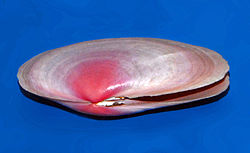
Picture of Sanguinolaria
- Source
- Wikipedia/Commons
- Credit
- Hectonichus
- Licence
- CC BY-SA 3.0
- Commercial use
- the licence allows it
CT scan
- Source
- MorphoSource
- Licence
- not stated by the source
- Commercial use
- cannot be read from the licence given — check the record
- Specimen
- Sanguinolaria sanguinolenta · USNM:IZ:USNM 589922
Smithsonian Open Access was not reached for this taxon, so this list is what the others held rather than everything there is.
The description on this site
- Licence
- CC BY-SA 4.0
This is what the site found, which is not the same as what exists.
Keep going
What may have been alongside itSanguinolariinae through timeFormations of the EoceneThe world it lived on
Occurrence data from the Paleobiology Database, CC BY 4.0. (Lamarck 1799)