Scomberomorini
Scomberomorini is a tribe of ray-finned, saltwater, bony fishes that is commonly known as Spanish mackerels, seerfishes, or seer fish. This tribe is a subset of the mackerel family (Scombridae), which it shares with four sister tribes, the tunas, mackerels, bonitos, and butterfly kingfish. Scomberomorini comprises 21 species across three genera. They are pelagic fish, fast swimmers and predatory in nature, that fight vigorously when caught. They are mainly caught using hooks and lines.

Uncredited · Public Domain · via Wikipedia/Commons. May be a photograph of a specimen, or an artist’s reconstruction — an interpretation of a skeleton, since colour and soft tissue are almost never preserved.
On record
Recorded, not inferred- Sits inside
- ScombrinaePBDB
- Motility
- actively mobilePBDB, for Osteichthyes
Time the record covers
At least 42 million years on record.
The record covers at least 48.07 Mya to 5.333 Mya. No occurrence read is dated outside 56 Mya to 3.6 Mya.
38 occurrences of Scomberomorini on record, most of them in the Eocene. The Paleobiology Database records this as a living group, and the chart stops with its fossils rather than at the present. Bar height is expected occurrences, not a count: each fossil is spread across the span it is dated to, so a tall narrow bar means tight dating and a low wide one means loose.
When
38 occurrencesThese are dates about fossils, not the animal: the record can only begin after it arose and end before it died out, so either end may reach further. Shares are expected occurrences: a fossil dated to a span is counted partly in each period it straddles. More on what this infers.
Found in
21 formations
- Selsey Formation · Bracklesham Group4
- London Clay Formation · Thames Group3
- Argile des Flandres Formation3
- Elmore Formation · Bracklesham Group2
- Stone City Formation · Claiborne Group2
- Gosport Sand Formation · Claiborne Group2
Loading coastlines…
The named rock units Scomberomorini has been recovered from, largest first. Drawn where the rock is now, not where it formed. 7 occurrences have no formation on record, which is common for older literature.
Scomberomorini and its relatives
EoceneWhere Scomberomorini and its relatives were recorded in the Eocene.
Found in the same rock
1,622 taxa- Palaeocybium proosti21 sites
- Cylindracanthus rectus16 sites
- Trichiurides sagittidens15 sites
- Albula oweni12 sites
- Hypotodus verticalis12 sites
- Myliobatis12 sites
- Physogaleus secundus11 sites
- Sphyraena11 sites
- Aetobatus10 sites
- Anoxypristis10 sites
- Brachycarcharias lerichei10 sites
- Odontaspis winkleri10 sites
- Rhinoptera10 sites
- Burnhamia daviesi9 sites
- Dasyatis9 sites
- Heterodontus9 sites
- Pycnodus9 sites
- Scyliorhinus9 sites
- Sparus9 sites
- Sphyraenodus lerichei9 sites
- Striatolamia macrota9 sites
- Teleostei9 sites
- Aetobatus irregularis8 sites
- Aetomylaeus dixoni8 sites
The Paleobiology Database records 35 sites for Scomberomorini, and this reads all of them. The number is how many of those sites it was catalogued from too. The 24 sharing the most are listed.
This is not a list of everything alive at the time. It is only what has come out of the same ground as this animal and been written down.
Entered from
24 references- The Selsey Division (Bracklesham Group) at Lee-on-the-Solent, Gosport, (Hants)5
- La faune ichthyologique de l'Ypresien de la Belgique5
- Taxonomy and biostratigraphy of the elasmobranchs and bony fishes (Chondrichthyes and Osteichthyes) of the lower-to-middle Eocene (Ypresian to Bartonian) Claiborne Group in Alabama, USA, including an analysis of otoliths3
- Geology and biostratigraphy of the Potomac River Cliffs at Stratford Hall, Westmoreland County, Virginia2
- The English Chalk and London Clay: two remarkable British bony fish Lagerstatten2
- Emergency excavation in the Grube (Unterfeld) Frauenweiler clay pit (Oligocene Rupelian; Baden-Wurttemberg, S Germany): New records and palaeoenvironmental informatino2
- Integrated Paleoecology and Marine Vertebrate Fauna of the Stone City Formation (Middle Eocene), Brazos River Section, Texas2
- Taphonomy, palaeoecology and palaeobiological significance of the Cisterna quarry fossil site: An exceptional window into the marine vertebrate biodiversity of the early Late Miocene Mediterranean Sea1
- Late Oligocene fishes (Chondrichthyes and Osteichthyes) from the Catahoula Formation in Wayne County, Mississippi, USA1
- Early Oligocene (Rupelian) fishes (Chondrichthyes, Osteichthyes) from the Ashley Formation (Cooper Group) of South Carolina, USA1
- Integrated palaeontological investigation of a new mid-late Bartonian fish fauna from Călata area, Transylvanian Basin, Romania1
- Een vroeg-miocene fauna uit het Zand van Kiel (Formatie van Berchem) bij Post X in Berchem (Antwerpen)1
Each of the 38 occurrences read was entered from one of these publications, ordered by how many each accounts for. This is not a search for papers mentioning the name. 12 further references are not listed. Entries link to doi.org where the Paleobiology Database holds an identifier, and to its own record where it does not. Relayed as the Paleobiology Database holds them, not checked against what they resolve to.
Media and terms
Media content1
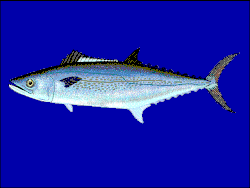
Picture of Scomberomorini
- Source
- Wikipedia/Commons
- Credit
- nobody named on the record
- Licence
- Public Domain
- Commercial use
- the licence allows it
No 3D scan of Scomberomorini was found in Sketchfab.
Smithsonian Open Access and MorphoSource were not reached for this taxon, so this list is what the others held rather than everything there is.
The description on this site
- Licence
- CC BY-SA 4.0
This is what the site found, which is not the same as what exists.
Keep going
What may have been alongside itScombrinae through timeFormations of the EoceneThe world it lived on
Occurrence data from the Paleobiology Database, CC BY 4.0. (Starks 1910)