Spatangoida
The heart urchins are members of the order Spatangoida of sea urchins. Their body are somewhat elongated ovals in form, and are distinguished by the mouth being placed towards one end of the animal, and the anus towards the other. As a result, unlike most other sea urchins, heart urchins are bilaterally symmetrical, and have a distinct anterior surface. The presence and position of the mouth and anus typically give members of this group the distinct "heart" shape from which they get their common name. Heart urchins have no feeding lantern, and often have petaloids sunk into grooves. They are a relatively diverse order, with a number of varying species.

Uncredited · via Wikipedia/Commons. May be a photograph of a specimen, or an artist’s reconstruction — an interpretation of a skeleton, since colour and soft tissue are almost never preserved.
On record
Recorded, not inferred- Also called
- heart urchinPBDB
- Sits inside
- AtelostomataPBDB
- Diet
- deposit feeder, detritivorePBDB
- Life habit
- shallow infaunalPBDB
- Motility
- slow-movingPBDB
- Vision
- limitedPBDB, for Echinoidea
- Environment
- marinePBDB
Time the record covers
At least 138 million years on record.
The record covers at least 139.1 Mya to 129 ka. No occurrence read is dated outside 161.5 Mya to 11.7 ka.
2,277 occurrences of Spatangoida on record, most of them in the Late Cretaceous. The Paleobiology Database records this as a living group. Bar height is expected occurrences, not a count: each fossil is spread across the span it is dated to, so a tall narrow bar means tight dating and a low wide one means loose.
When
2,277 occurrences- Late Jurassicunder 1%
- Early Cretaceous20%
- Late Cretaceous40%
- Paleocene4%
- Eocene14%
- Oligocene5%
- Miocene13%
- Pliocene3%
- Pleistocene1%
These are dates about fossils, not the animal: the record can only begin after it arose and end before it died out, so either end may reach further. Shares are expected occurrences: a fossil dated to a span is counted partly in each period it straddles. More on what this infers.
Found in
402 formations
- Cotinguiba Formation164
- Calcaires à Spatangues Formation94
- Olazagutia Formation52
- Castle Hayne Formation51
- Prairie Bluff Formation39
- Grès verts helvétiques Formation27
Loading coastlines…
The named rock units Spatangoida has been recovered from, largest first. Drawn where the rock is now, not where it formed. 378 further formations hold fewer occurrences each and are not listed. 574 occurrences have no formation on record, which is common for older literature.
Spatangoida and its relatives
Late CretaceousWhere Spatangoida and its relatives were recorded in the Late Cretaceous.
Found in the same rock
2,289 taxa- Bryozoa49 sites
- Ostrea41 sites
- Porifera40 sites
- Toxaster31 sites
- Turritella31 sites
- Serpula30 sites
- Hemiaster29 sites
- Lima28 sites
- Cardium27 sites
- Exogyra (Exogyra) costata25 sites
- Panopea25 sites
- Vertebrata24 sites
- Chlamys22 sites
- Pleurotomaria21 sites
- Holaster20 sites
- Arca19 sites
- Cliona19 sites
- Pecten19 sites
- Periarchus lyelli19 sites
- Pycnodonte vesicularis19 sites
- Anomia argentaria18 sites
- Anthozoa17 sites
- Crassatella17 sites
- Idonearca capax17 sites
The Paleobiology Database records at least 1,441 sites for Spatangoida, and this reads 240 of them. The number is how many of those sites it was catalogued from too. The 24 sharing the most are listed.
This is not a list of everything alive at the time. It is only what has come out of the same ground as this animal and been written down.
Entered from
397 references- American Upper Cretaceous Echinoidea113
- Cretaceous echinoids from north-eastern Brazil102
- La variation chez les échinides irréguliers. Dimensions ontogénétiques, écologiques, évolutives94
- Macrofauna of the Cantera de Margas section, Olazagutia: Coniacian/Santonian boundary, Navarro-Cantabrian Basin, northern Spain64
- Turonian inoceramids and biostratigraphy of the Sergipe Basin, northeastern Brazil: an integrated study of the Votorantim and Nassau quarries59
- Cenozoic Spatangoid Echinoids from New Zealand55
- Late Cretaceous-Early Paleocene echinoderms and the K/T boundary in the southeast Netherlands and the northeast Belgium. - part 4: Echinoids53
- Recherches géologiques sur le Crétacé inférieur de l'Estremadura (Portugal)48
- The Echinoids of the Middle Eocene Warley Hill Formation, Santee Limestone, and Castle Hayne Limestone of North and South Carolina40
- The echinoid fauna from Japan and adjacent regions, Part II40
- Jura Vaudois et Neuchatelois38
- Paléoécologie et paléobiogéographie des faunes d'échinides du Cénomanien nord-aquitain (Charente-Maritime, France)35
Each of the 2,277 occurrences read was entered from one of these publications, ordered by how many each accounts for. This is not a search for papers mentioning the name. 385 further references are not listed. Entries link to doi.org where the Paleobiology Database holds an identifier, and to its own record where it does not. Relayed as the Paleobiology Database holds them, not checked against what they resolve to.
Media and terms
Media content1
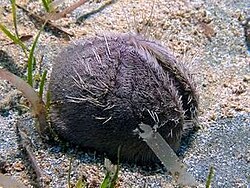
Picture of Spatangoida
- Source
- Wikipedia/Commons
- Credit
- nobody named on the record
- Licence
- not stated by the source
- Commercial use
- cannot be read from the licence given — check the record
No 3D scan was found. Smithsonian Open Access, MorphoSource and Sketchfab were all searched.
The description on this site
- Source
- Wikipedia, “Spatangoida”
- Licence
- CC BY-SA 4.0
This is what the site found, which is not the same as what exists.
Keep going
What may have been alongside itAtelostomata through timeFormations of the Late CretaceousThe world it lived on
Occurrence data from the Paleobiology Database, CC BY 4.0. (Agassiz 1840)