Porifera
Sponges or sea sponges are primarily marine invertebrates of the animal phylum Porifera. They are filter feeders that are typically bound to the seabed, being sessile. Sponges are one of the most ancient members of living seabed community (macrobenthos), with many species being important reef-builders. Some sponge species inhabit freshwater.

Twilight Zone Expedition Team 2007, NOAA-OE · Public Domain · via Wikipedia/Commons. May be a photograph of a specimen, or an artist’s reconstruction — an interpretation of a skeleton, since colour and soft tissue are almost never preserved.
On record
Recorded, not inferred- Also called
- spongePBDB
- Sits inside
- AnimaliaPBDB
- Diet
- suspension feederPBDB
- Life habit
- epifaunalPBDB
- Motility
- stationary, attachedPBDB
- Vision
- blindPBDB
Time the record covers
At least 538 million years on record.
The record covers at least 538.8 Mya to 11.7 ka. No occurrence read is dated outside 635 Mya to 0 Mya.
12,000+ occurrences of Porifera on record. The Paleobiology Database records this as a living group. Bar height is expected occurrences, not a count: each fossil is spread across the span it is dated to, so a tall narrow bar means tight dating and a low wide one means loose.
When
12,000 occurrences read- Cambrian19%
- Ordovician7%
- Silurian7%
- Devonian13%
- Carboniferous2%
- Permian20%
- Middle Triassic2%
- Late Triassic9%
- Early Jurassicunder 1%
- Middle Jurassicunder 1%
- Late Jurassic12%
- Early Cretaceous2%
- Late Cretaceous3%
- Paleoceneunder 1%
- Eoceneunder 1%
- Oligoceneunder 1%
- Mioceneunder 1%
- Plioceneunder 1%
- Pleistoceneunder 1%
- Holoceneunder 1%
These are dates about fossils, not the animal: the record can only begin after it arose and end before it died out, so either end may reach further. Shares are expected occurrences: a fossil dated to a span is counted partly in each period it straddles. The read hit its cap, so every figure above is a floor and the shares are of the occurrences read. More on what this infers.
Found in
at least 961 formations
- Usa Formation875
- Capitan Limestone Formation844
- Saikra Biohermal Complex Formation244
- Maokou Formation196
- Pestrotsvet Formation171
- Middle Shaly Facies Formation168
Loading coastlines…
The named rock units Porifera has been recovered from, largest first. Drawn where the rock is now, not where it formed. The read hit its cap, so each count is a floor. 937 further formations hold fewer occurrences each and are not listed. 2,759 occurrences have no formation on record, which is common for older literature.
Found in the same rock
2,279 taxa- Bryozoa57 sites
- Crinoidea49 sites
- Fenestella37 sites
- Ostracoda36 sites
- Brachiopoda31 sites
- Lima24 sites
- Gastropoda23 sites
- Platyceras23 sites
- Punctospirifer23 sites
- Schuchertella23 sites
- Anthozoa22 sites
- Cleiothyridina22 sites
- Fenestrata22 sites
- Ostrea21 sites
- Platycrinites21 sites
- Chaetetes20 sites
- Isotelus20 sites
- Leptaena20 sites
- Barycrinus19 sites
- Diplopodia (Pseudodiadema)19 sites
- Pecten19 sites
- Rhynchonella19 sites
- Thamniscus19 sites
- Atrypa18 sites
The Paleobiology Database records at least 1,030 sites for Porifera, and this reads 240 of them. The number is how many of those sites it was catalogued from too. The 24 sharing the most are listed.
This is not a list of everything alive at the time. It is only what has come out of the same ground as this animal and been written down.
Entered from
at least 1,037 references- Biostratigraphy of the Kiya River section. - Early Cambrian Archaeocyaths and spicular sponges from the Kiya River section (Kuznetsk Alatau)931
- Sponges of the Permian Upper Capitan Limestone, Guadalupe Mountains, New Mexico and Texas843
- Upper Permian inozoid, demospongid, and hexactinellid sponges from Djebel Tebaga, Tunisia597
- Upper Jurassic siliceous sponges from the Swabian Alb: taxonomy and paleoecology406
- Middle to Upper Oxfordian sponges of the Polish Jura277
- Upper Permian segmented sponges from Djebel Tebaga, Tunisia190
- Primordial metazoan-calcimicrobial reefs: Tommotian (Early Cambrian) of the Siberian Platform135
- Archaeocyaths of the Lower Cambrian of Morocco131
- Wu, 1991120
- Devonian reef types in the Cantabrian Mountains (NW Spain) and their faunal composition118
- Stromatoporaty i biostratigrafiya nizhnego paleozoya Mongolii [Stromatoporata and biostratigraphy of the Lower Paleozoic of Mongolia]102
- Silurian and Early Devonian benthic communities of the Ural-Tien Shan region95
Each of the 12,000 occurrences read was entered from one of these publications, ordered by how many each accounts for. This is not a search for papers mentioning the name. That read hit its cap, so each count is a floor. 1,025 further references are not listed. Entries link to doi.org where the Paleobiology Database holds an identifier, and to its own record where it does not. Relayed as the Paleobiology Database holds them, not checked against what they resolve to.
Media and terms
Media content2
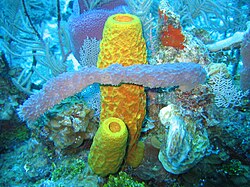
Picture of Porifera
- Source
- Wikipedia/Commons
- Credit
- Twilight Zone Expedition Team 2007, NOAA-OE
- Licence
- Public Domain
- Commercial use
- the licence allows it

3D model
- Source
- Sketchfab
- Licence
- CC Attribution-NonCommercial
- Commercial use
- the licence does not allow it
The description on this site
- Source
- Wikipedia, “Sponge”
- Licence
- CC BY-SA 4.0
This is what the site found, which is not the same as what exists.
Keep going
What may have been alongside itAnimalia through timeThe world it lived on
Occurrence data from the Paleobiology Database, CC BY 4.0. Grant 1836