Sphyraenidae
A barracuda is a large, predatory, ray-finned, saltwater fish of the genus Sphyraena, the only genus in the family Sphyraenidae, which was named by Constantine Samuel Rafinesque in 1815. It is found in tropical and subtropical oceans worldwide ranging from the eastern border of the Atlantic Ocean to the Red Sea, on its western border the Caribbean Sea, and in tropical areas of the Pacific Ocean. Barracudas reside near the top of the water and near coral reefs and sea grasses. Barracudas are often targeted by sport-fishing enthusiasts.

Uncredited · Public Domain · via Wikipedia/Commons. May be a photograph of a specimen, or an artist’s reconstruction — an interpretation of a skeleton, since colour and soft tissue are almost never preserved.
On record
Recorded, not inferred- Also called
- barracudaPBDB
- Sits inside
- CarangariaPBDB
- Motility
- actively mobilePBDB, for Osteichthyes
Time the record covers
At least 65 million years on record.
The record covers at least 66 Mya to 11.7 ka. No occurrence read is dated outside 72.2 Mya to 0 Mya.
144 occurrences of Sphyraenidae on record, most of them in the Miocene. The Paleobiology Database records this as a living group. Bar height is expected occurrences, not a count: each fossil is spread across the span it is dated to, so a tall narrow bar means tight dating and a low wide one means loose.
When
144 occurrences- Late Cretaceousunder 1%
- Eocene35%
- Oligocene8%
- Miocene41%
- Pliocene6%
- Pleistocene7%
- Holocene3%
These are dates about fossils, not the animal: the record can only begin after it arose and end before it died out, so either end may reach further. Shares are expected occurrences: a fossil dated to a span is counted partly in each period it straddles. More on what this infers.
Found in
66 formations
- Lagos-Portimão Formation8
- Tallahatta Formation · Claiborne Group5
- Mount Hillaby Formation · Oceanic Group5
- Yazoo Formation · Jackson Group3
- Pirabas Formation3
- Hrušky Formation3
Loading coastlines…
The named rock units Sphyraenidae has been recovered from, largest first. Drawn where the rock is now, not where it formed. 42 further formations hold fewer occurrences each and are not listed. 35 occurrences have no formation on record, which is common for older literature.
Sphyraenidae and its relatives
MioceneWhere Sphyraenidae and its relatives were recorded in the Miocene.
Found in the same rock
3,132 taxa- Sphyraena34 sites
- Myliobatis32 sites
- Dasyatis25 sites
- Carcharhinus24 sites
- Hemipristis serra23 sites
- Otodus megalodon19 sites
- Rhinoptera17 sites
- Aetobatus15 sites
- Carcharodon hastalis15 sites
- Galeocerdo aduncus13 sites
- Rhizoprionodon12 sites
- Sparidae12 sites
- Trichiurus12 sites
- Carcharias cuspidatus11 sites
- Raja11 sites
- Sphyraena barracuda11 sites
- Squatina11 sites
- Carcharias10 sites
- Carcharias hopei10 sites
- Hemipristis curvatus10 sites
- Isurus oxyrinchus10 sites
- Scyliorhinus10 sites
- Carcharhinus gibbesii9 sites
- Diodon9 sites
The Paleobiology Database records 121 sites for Sphyraenidae, and this reads all of them. Of that, one read hit the database's own return limit, so every count below is a floor rather than a total. The number is how many of those sites it was catalogued from too. The 24 sharing the most are listed.
This is not a list of everything alive at the time. It is only what has come out of the same ground as this animal and been written down.
Entered from
98 references- Sur la faune ichtyologique de la Formation de Bissex Hill et de la Série océanique, de l'Ile de la Barbade, et sur l'âge de ces formations11
- Vertébrés (crocodiliens, poissons) du Miocène marin de l'Argarve occidentale8
- Taxonomy and biostratigraphy of the elasmobranchs and bony fishes (Chondrichthyes and Osteichthyes) of the lower-to-middle Eocene (Ypresian to Bartonian) Claiborne Group in Alabama, USA, including an analysis of otoliths7
- New records of the genus Sphyraena (Teleostei: Sphyraenidae) from the Caribbean with comments on dental characters in the genus5
- Geology and biostratigraphy of the Potomac River Cliffs at Stratford Hall, Westmoreland County, Virginia4
- Localidades fossiliferas da Formacao Pirabas (Mioceno Inferior)3
- Faunes ichthyologiques du Néogène supérieur d'Angola, leur âge, remarques sur le Pliocène marin en Afrique australe3
- Sur un materiel ichthyologique des "Midra (and Saila) shales" du Qatar (Golfe Persique)3
- Early Oligocene (Rupelian) fishes (Chondrichthyes, Osteichthyes) from the Ashley Formation (Cooper Group) of South Carolina, USA2
- A Middle–Late Eocene vertebrate fauna (marine fish and mammals) from southwestern Morocco; preliminary report: age and palaeobiogeographical implications2
- Fish teeth from the Middle Miocene of Kienberg at Mikulov, Czech Republic, Vienna Basin2
- Stratigraphy of the Maikop Group and Pteropoda Beds in Northern Azerbaijan2
Each of the 144 occurrences read was entered from one of these publications, ordered by how many each accounts for. This is not a search for papers mentioning the name. 86 further references are not listed. Entries link to doi.org where the Paleobiology Database holds an identifier, and to its own record where it does not. Relayed as the Paleobiology Database holds them, not checked against what they resolve to.
Media and terms
Media content1
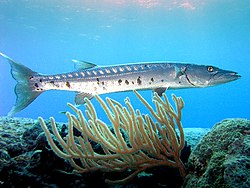
Picture of Sphyraenidae
- Source
- Wikipedia/Commons
- Credit
- nobody named on the record
- Licence
- Public Domain
- Commercial use
- the licence allows it
No 3D scan of Sphyraenidae was found in Sketchfab.
Smithsonian Open Access and MorphoSource were not reached for this taxon, so this list is what the others held rather than everything there is.
The description on this site
- Source
- Wikipedia, “Barracuda”
- Licence
- CC BY-SA 4.0
This is what the site found, which is not the same as what exists.
Keep going
What may have been alongside itCarangaria through timeFormations of the MioceneThe world it lived on
Occurrence data from the Paleobiology Database, CC BY 4.0. Rafinesque 1815