Teredina
Teredina is an extinct genus of fossil bivalve mollusc that lived from the Late Cretaceous to the late Pliocene in Asia, Europe, and North America.

via iDigBio · CC0 · via iDigBio. May be a photograph of a specimen, or an artist’s reconstruction — an interpretation of a skeleton, since colour and soft tissue are almost never preserved.
On record
Recorded, not inferred- Sits inside
- PholadidaePBDB
- Diet
- suspension feederPBDB, for Pholadidae
- Life habit
- boringPBDB, for Pholadidae
- Motility
- stationaryPBDB, for Pholadidae
- Vision
- blindPBDB, for Bivalvia
Time the record covers
At least 68 million years on record.
The record covers at least 72.2 Mya to 3.6 Mya. No occurrence read is dated outside 83.6 Mya to 2.58 Mya.
11 occurrences of Teredina on record, most of them in the Late Cretaceous. Bar height is expected occurrences, not a count: each fossil is spread across the span it is dated to, so a tall narrow bar means tight dating and a low wide one means loose.
When
11 occurrences- Late Cretaceous36%
- Paleocene18%
- Eocene18%
- Miocene9%
- Pliocene18%
These are dates about fossils, not the animal: the record can only begin after it arose and end before it died out, so either end may reach further. Shares are expected occurrences: a fossil dated to a span is counted partly in each period it straddles. More on what this infers.
Found in
6 formations
- Fruitland Formation4
- London Clay Formation2
- Woolwich and Reading Formation1
- Goose Creek Formation1
- Raysor Formation1
- Palembang Formation1
Loading coastlines…
The named rock units Teredina has been recovered from, largest first. Drawn where the rock is now, not where it formed. 1 occurrence has no formation on record, which is common for older literature.
Teredina and its relatives
Late CretaceousWhere Teredina and its relatives were recorded in the Late Cretaceous.
Found in the same rock
299 taxa- Brachychampsa4 sites
- Myledaphus bipartitus4 sites
- Paralbula casei4 sites
- Adocus3 sites
- Amia fragosa3 sites
- Crocodylia3 sites
- Euspira glaucinoides3 sites
- Lepisosteus occidentalis3 sites
- Lonchidion selachos3 sites
- Odostomia3 sites
- Panopea intermedia3 sites
- Squatirhina3 sites
- Acipenser eruciferus2 sites
- Amusium mortoni2 sites
- Anomia anomialis2 sites
- Antalis constricta2 sites
- Arcinella cornuta2 sites
- Bonellitia subevulsa2 sites
- Cantharus (Eocantharus) morrisii2 sites
- Cerithiella elongata2 sites
- Chione2 sites
- Cimomia imperialis2 sites
- Cochlespira gyrata2 sites
- Crassostrea tenera2 sites
The Paleobiology Database records 9 sites for Teredina, and this reads all of them. The number is how many of those sites it was catalogued from too. The 24 sharing the most are listed.
This is not a list of everything alive at the time. It is only what has come out of the same ground as this animal and been written down.
Entered from
7 references- Amphibia and Reptilia from the Campanian of New Mexico3
- The Early Eocene London Clay Formation mollusc fauna of the former Bursledon Brickworks, Lower Swanwick, Hampshire2
- Preliminary biostratigraphy and molluscan fauna of the Goose Creek Limestone of eastern South Carolina2
- Skwarko, 19941
- Lower Tertiary strata exposed in a temporary excavation at Well Hall, Eltham, south east London1
- Depositional environments and paleontology of Lewis Shale to lower Kirtland Shale sequence (Upper Cretaceous), Bisti area, northwestern New Mexico1
- Fauna i stratygrafia paleocenu srodkowej Wisly1
Each of the 11 occurrences read was entered from one of these publications, ordered by how many each accounts for. This is not a search for papers mentioning the name. Entries link to doi.org where the Paleobiology Database holds an identifier, and to its own record where it does not. Relayed as the Paleobiology Database holds them, not checked against what they resolve to.
Media and terms
Media content2
Picture of Teredina
- Source
- iDigBio
- Credit
- via iDigBio
- Licence
- CC0
- Commercial use
- the licence allows it
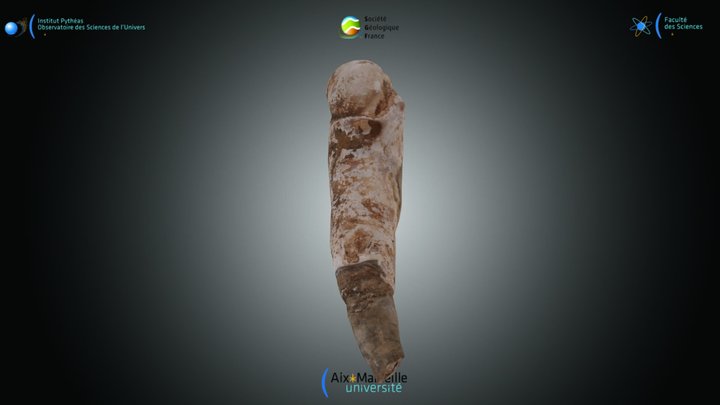
3D model
- Source
- Sketchfab
- Licence
- CC Attribution-NonCommercial-ShareAlike
- Commercial use
- the licence does not allow it
Smithsonian Open Access and MorphoSource were not reached for this taxon, so this list is what the others held rather than everything there is.
The description on this site
- Source
- Wikipedia, “Teredina”
- Licence
- CC BY-SA 4.0
This is what the site found, which is not the same as what exists.
Keep going
What may have been alongside itPholadidae through timeFormations of the Late CretaceousThe world it lived on
Occurrence data from the Paleobiology Database, CC BY 4.0.