Teredinidae
Shipworms, teredo worms or simply teredo are a group of xylophagic marine bivalve molluscs in the family Teredinidae that consume wood submerged in saltwater. Their elongated, vermiform appearance makes their classification as bivalves not obvious, and sailors generally refer to them as "worms," a term found in the English shipworm and German Schiffsbohrwurm. However, taxonomically shipworms are more akin to clams.

United States Geological Survey · Public Domain · via Wikipedia/Commons. May be a photograph of a specimen, or an artist’s reconstruction — an interpretation of a skeleton, since colour and soft tissue are almost never preserved.
On record
Recorded, not inferred- Sits inside
- PholadoideaPBDB
- Diet
- suspension feederPBDB
- Life habit
- boringPBDB
- Motility
- stationaryPBDB
- Vision
- blindPBDB, for Bivalvia
Time the record covers
At least 192 million years on record.
The record covers at least 192.9 Mya to 11.7 ka. No occurrence read is dated outside 199.5 Mya to 0 Mya.
481 occurrences of Teredinidae on record, most of them in the Miocene. The Paleobiology Database records this as a living group. Bar height is expected occurrences, not a count: each fossil is spread across the span it is dated to, so a tall narrow bar means tight dating and a low wide one means loose.
When
481 occurrences- Early Jurassicunder 1%
- Middle Jurassicunder 1%
- Early Cretaceous3%
- Late Cretaceous7%
- Paleocene16%
- Eocene23%
- Oligocene14%
- Miocene26%
- Pliocene7%
- Pleistocene2%
- Holoceneunder 1%
These are dates about fossils, not the animal: the record can only begin after it arose and end before it died out, so either end may reach further. Shares are expected occurrences: a fossil dated to a span is counted partly in each period it straddles. More on what this infers.
Found in
157 formations
- Cannonball Formation28
- Chipola Formation · Alum Bluff Group17
- Suwannee Limestone Formation · Vicksburg Group12
- Yorktown Formation · Chesapeake Group12
- Culebra Formation10
- Clayton Formation9
Loading coastlines…
The named rock units Teredinidae has been recovered from, largest first. Drawn where the rock is now, not where it formed. 133 further formations hold fewer occurrences each and are not listed. 78 occurrences have no formation on record, which is common for older literature.
Teredinidae and its relatives
MioceneWhere Teredinidae and its relatives were recorded in the Miocene.
Found in the same rock
3,962 taxa- Teredo86 sites
- Turritella45 sites
- Dentalium33 sites
- Corbula29 sites
- Glycymeris29 sites
- Chlamys23 sites
- Nucula23 sites
- Ostrea23 sites
- Modiolus22 sites
- Panopea22 sites
- Kuphus incrassatus21 sites
- Crassatella20 sites
- Natica20 sites
- Nuculana20 sites
- Turricula20 sites
- Eulima19 sites
- Odostomia19 sites
- Tellina19 sites
- Venericardia19 sites
- Limopsis18 sites
- Nassarius18 sites
- Roxania18 sites
- Barbatia17 sites
- Euspira17 sites
The Paleobiology Database records 365 sites for Teredinidae, and this reads 240 of them. Of that, one read hit the database's own return limit, so every count below is a floor rather than a total. The number is how many of those sites it was catalogued from too. The 24 sharing the most are listed.
This is not a list of everything alive at the time. It is only what has come out of the same ground as this animal and been written down.
Entered from
170 references- Revision of the fauna of the Cannonball Formation (Paleocene) of North and South Dakota27
- Notes on the fauna of the Chipola Formation - IX. On the presence of Kuphus incrassatus Gabb22
- L'Oligocene e il Miocene della Somalia. Stratigrafia, Tettonica, Paleontologia (Macroforaminferi, Coralli, Molluschi)22
- Resilience of marine invertebrate communities during the early Cenozoic hyperthermals19
- Stratigraphic Distribution of Paleocene and Eocene Fossils in the Eastern Gulf Coast Region18
- Catalogue of the Paleocene and Eocene mollusca of the southern and eastern United States. Part 1. Pelecypoda, Amphineura, Pteropoda, Scaphopoda and Cephalopoda18
- Geology and paleontology of canal zone and adjoing parts of Panama: Description of Tertiary mollusks (Pelecypods: Propeamussiidae to Cuspidariidae).17
- Tertiary Mollusca from Porto Rico13
- Die Fauna des marinen Miozäns von Kevelaer (Niederrhein). Band 2 Bivalvia, Scaphopoda, Cephalopoda, Bryozoa, Annelida, Brachiopoda12
- Molluscs of the Tampa and Suwannee Limestones10
- Megapaleontology of the Eocene Llajas Formation, Simi Valley, California9
- Yanakevich, 19779
Each of the 481 occurrences read was entered from one of these publications, ordered by how many each accounts for. This is not a search for papers mentioning the name. 158 further references are not listed. Entries link to doi.org where the Paleobiology Database holds an identifier, and to its own record where it does not. Relayed as the Paleobiology Database holds them, not checked against what they resolve to.
Media and terms
Media content2
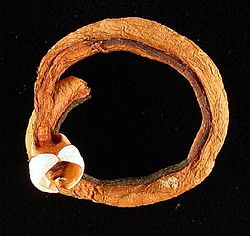
Picture of Teredinidae
- Source
- Wikipedia/Commons
- Credit
- United States Geological Survey
- Licence
- Public Domain
- Commercial use
- the licence allows it
CT scan
- Source
- MorphoSource
- Credit
- MCZ Malacology
- Licence
- In Copyright
- Commercial use
- cannot be read from the licence given — check the record
- Specimen
- Teredinidae indet. · MCZ:Mala:396633
Smithsonian Open Access was not reached for this taxon, so this list is what the others held rather than everything there is.
The description on this site
- Source
- Wikipedia, “Shipworm”
- Licence
- CC BY-SA 4.0
This is what the site found, which is not the same as what exists.
Keep going
What may have been alongside itPholadoidea through timeFormations of the MioceneThe world it lived on
Occurrence data from the Paleobiology Database, CC BY 4.0. Rafinesque 1815