Thalasseus sandvicensis
The Sandwich tern is a tern in the family Laridae. It is very closely related to the lesser crested tern, Chinese crested tern, Cabot's tern, and elegant tern and has been known to interbreed with both elegant and lesser crested terns. It breeds in the Palearctic from Europe to the Caspian Sea, and winters in the Mediterranean and on the coasts of Africa, India, and Sri Lanka.

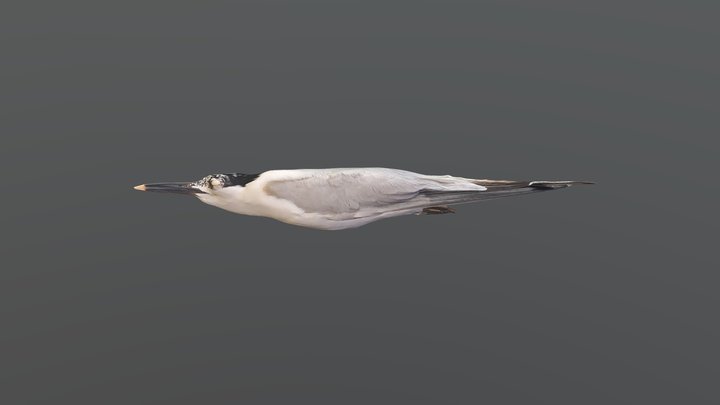
MPF · CC BY-SA 4.0 · via Wikipedia/Commons. May be a photograph of a specimen, or an artist’s reconstruction — an interpretation of a skeleton, since colour and soft tissue are almost never preserved.
On record
Recorded, not inferred- Also called
- Sandwich ternPBDB
- Sits inside
- ThalasseusPBDB
- Diet
- carnivorePBDB, for Coelurosauria
- Life habit
- ground dwelling, solitaryPBDB, for Theropoda
- Motility
- actively mobilePBDB, for Theropoda
- Environment
- marinePBDB, for Charadriiformes
Time the record covers
At most 12 thousand years on record.
Every occurrence read is dated to somewhere between 11.7 ka and 0 Mya, and nothing in the dating separates them, so that window is what the record shows rather than a span.
2 occurrences of Thalasseus sandvicensis on record, most of them in the Holocene. The Paleobiology Database records this as a living group. Bar height is expected occurrences, not a count: each fossil is spread across the span it is dated to, so a tall narrow bar means tight dating and a low wide one means loose.
When
2 occurrences- Holocene100%
These are dates about fossils, not the animal: the record can only begin after it arose and end before it died out, so either end may reach further. Shares are expected occurrences: a fossil dated to a span is counted partly in each period it straddles. More on what this infers.
Thalasseus sandvicensis and its relatives
HoloceneWhere Thalasseus sandvicensis and its relatives were recorded in the Holocene.
Found in the same rock
68 taxa- Accipiter striatus1 site
- Accipitridae1 site
- Amazona1 site
- Amazona albifrons1 site
- Anas1 site
- Ara militaris1 site
- Ardea alba1 site
- Aulacorhynchus prasinus1 site
- Aythya affinis1 site
- Burhinus capensis1 site
- Butorides virescens1 site
- Cairina moschata1 site
- Calidris minutilla1 site
- Cathartes aura1 site
- Charadrius semipalmatus1 site
- Claravis pretiosa1 site
- Colinus virginianus1 site
- Columbidae1 site
- Columbina inca1 site
- Coragyps atratus1 site
- Crotophaga sulcirostris1 site
- Cyrtonyx ocellatus1 site
- Dendrocygna autumnalis1 site
- Diomedeidae1 site
The Paleobiology Database records 2 sites for Thalasseus sandvicensis, and this reads all of them. The number is how many of those sites it was catalogued from too. The 24 sharing the most are listed.
This is not a list of everything alive at the time. It is only what has come out of the same ground as this animal and been written down.
Entered from
2 references- Prehistoric exploitation of birds on the Pacific coast of Chiapas, Mexico1
- Seasonal exploitation of seabirds by Late Holocene coastal foragers: Analysis of modern and archaeological data from Western Cape, South Africa1
Each of the 2 occurrences read was entered from one of these publications, ordered by how many each accounts for. This is not a search for papers mentioning the name. Each entry links to doi.org. Relayed as the Paleobiology Database holds them, not checked against what they resolve to.
Media and terms
Media content2

Picture of Thalasseus sandvicensis
- Source
- Wikipedia/Commons
- Credit
- MPF
- Licence
- CC BY-SA 4.0
- Commercial use
- the licence allows it
Smithsonian Open Access and MorphoSource were not reached for this taxon, so this list is what the others held rather than everything there is.
The description on this site
- Licence
- CC BY-SA 4.0
This is what the site found, which is not the same as what exists.
Keep going
What may have been alongside itThalasseus through timeFormations of the HoloceneThe world it lived on
Occurrence data from the Paleobiology Database, CC BY 4.0. (Latham 1787)