Thericium
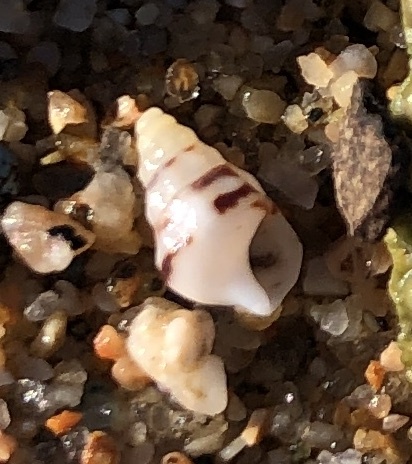
Not Thericium. This is Thericium Monterosato, 1890, a relative — both are Cerithiidae.
Valentina · CC BY-NC 4.0 · via GBIF. May be a photograph of a specimen, or an artist’s reconstruction — an interpretation of a skeleton, since colour and soft tissue are almost never preserved.
On record
Recorded, not inferred- Sits inside
- CampanilidaePBDB
- Diet
- grazerPBDB, for Campanilidae
- Life habit
- epifaunalPBDB, for Campanilidae
- Motility
- actively mobilePBDB, for Campanilidae
- Vision
- limitedPBDB, for Gastropoda
Time the record covers
At least 61 million years on record.
The record covers at least 61.66 Mya to 11.7 ka. No occurrence read is dated outside 66 Mya to 0 Mya.
185 occurrences of Thericium on record, most of them in the Miocene. The Paleobiology Database records this as a living group. Bar height is expected occurrences, not a count: each fossil is spread across the span it is dated to, so a tall narrow bar means tight dating and a low wide one means loose.
When
185 occurrencesThese are dates about fossils, not the animal: the record can only begin after it arose and end before it died out, so either end may reach further. Shares are expected occurrences: a fossil dated to a span is counted partly in each period it straddles. More on what this infers.
Found in
44 formations
- Chipola Formation · Alum Bluff Group33
- Caloosahatchee Formation11
- Mera Formation8
- Sabbie di Asti Formation7
- Calcaire de Mons Formation6
- Falun de Jeurs Formation5
Loading coastlines…
The named rock units Thericium has been recovered from, largest first. Drawn where the rock is now, not where it formed. 20 further formations hold fewer occurrences each and are not listed. 62 occurrences have no formation on record, which is common for older literature.
Thericium and its relatives
MioceneWhere Thericium and its relatives were recorded in the Miocene.
Found in the same rock
2,119 taxa- Glycymeris22 sites
- Cerithium (Thericium) vulgatum19 sites
- Conus isomatratus18 sites
- Conus sulculus18 sites
- Bittium16 sites
- Conus chipolanus16 sites
- Hemicerithium cossmanni16 sites
- Oliva (Omogymna) liodes16 sites
- Oliva (Omogymna) martensii16 sites
- Polinices16 sites
- Anadara15 sites
- Conus demiurgus15 sites
- Conus tapetus15 sites
- Cylichna15 sites
- Poirieria (Panamurex) mauryae15 sites
- Rhinoclavis (Ochetoclava) chipolana15 sites
- Calyptraea14 sites
- Cerithium (Thericium) vokesorum14 sites
- Alabina (Caloosalba) boiplex13 sites
- Cerithium (Thericium) burnsii13 sites
- Jujubinus13 sites
- Alabina (Caloosalba) turbatrix12 sites
- Arcopagia12 sites
- Conus12 sites
The Paleobiology Database records 102 sites for Thericium, and this reads all of them. Of that, one read hit the database's own return limit, so every count below is a floor rather than a total. The number is how many of those sites it was catalogued from too. The 24 sharing the most are listed.
This is not a list of everything alive at the time. It is only what has come out of the same ground as this animal and been written down.
Entered from
57 references- Cerithiidae and Potamididae (Mollusca: Gastropoda) from the Chipola Formation of northwestern Florida33
- Les Mesogastropoda Fossiles du Cenozoïque étranger des Collections de L'Institute Royale des Sciences Naturelles de Belgique: Cyclophoridae à Stilifetidae15
- Biostratigraphie et paleoecologie des gisements types du Stampian de la region d''Etampes (Essonne)11
- Les formations recifales coralliennes du Miocene superieur d'Algerie et du Maroc [Upper Miocene coral reef formations from Algeria and Morocco]9
- Pliocene Mollusca of Southern Florida9
- Fauna de moluste a depozitelor Paleogene din nord-vestul Transilvaniei [Molluscan fauna from Paleogene deposits from NW Transilvania]8
- Microgastropod trophic structure of the Yongshu reef, South China Sea, since the late Pleistocene in relation to paleoenvironment6
- Revision des Gastropoda du Danien et du Montien de la Belgique. I, Les Gastropoda du Calcaire de Mons6
- The molluscan fauna of the Pliocene strata underlying the Adelaide Plains. Part IV - Gastropoda (Turritellidae-Struthiolariidae)5
- Facies analysis, paleoecology and sequence stratigraphy in a Pliocene siliciclastic succession, Sanb Miniato (Pisa, Italy)4
- Biozonation of the Neogene invertebrate megafauna of the Hellenic area4
- The marine Quaternary of the Canary Islands4
Each of the 185 occurrences read was entered from one of these publications, ordered by how many each accounts for. This is not a search for papers mentioning the name. 45 further references are not listed. Each entry links to the Paleobiology Database's own record for the work.
Media and terms
Media content1
Picture of Thericium Monterosato, 1890
- Source
- GBIF
- Credit
- Valentina
- Licence
- CC BY-NC 4.0
- Commercial use
- the licence does not allow it
No 3D scan was found. Smithsonian Open Access, MorphoSource and Sketchfab were all searched.
This is what the site found, which is not the same as what exists.
Keep going
What may have been alongside itCampanilidae through timeFormations of the MioceneThe world it lived on
Occurrence data from the Paleobiology Database, CC BY 4.0. (Monterosato 1809)