Thyasiridae
Thyasiridae is a family of bivalve molluscs, including the cleft clams, in the order Lucinida.

Georg Ossian Sars · Public Domain · via Wikipedia/Commons. May be a photograph of a specimen, or an artist’s reconstruction — an interpretation of a skeleton, since colour and soft tissue are almost never preserved.
On record
Recorded, not inferred- Sits inside
- LucinidaPBDB
- Diet
- suspension feeder, chemosymbioticPBDB
- Life habit
- infaunalPBDB
- Motility
- facultatively mobilePBDB
- Vision
- blindPBDB, for Bivalvia
Time the record covers
At least 236 million years on record.
The record covers at least 237 Mya to 11.7 ka. No occurrence read is dated outside 247 Mya to 0 Mya.
354 occurrences of Thyasiridae on record, most of them in the Oligocene. The Paleobiology Database records this as a living group. Bar height is expected occurrences, not a count: each fossil is spread across the span it is dated to, so a tall narrow bar means tight dating and a low wide one means loose.
When
354 occurrences- Middle Triassicunder 1%
- Early Jurassicunder 1%
- Early Cretaceous1%
- Late Cretaceous11%
- Paleocene6%
- Eocene15%
- Oligocene25%
- Miocene16%
- Pliocene8%
- Pleistocene16%
- Holocene2%
These are dates about fossils, not the animal: the record can only begin after it arose and end before it died out, so either end may reach further. Shares are expected occurrences: a fossil dated to a span is counted partly in each period it straddles. More on what this infers.
Found in
131 formations
- Timms Point Silt Formation20
- Lincoln Creek Formation14
- Pysht Formation · Twin River Group10
- Keasey Formation8
- Lomita Marl Formation7
- Pierre Shale Formation6
Loading coastlines…
The named rock units Thyasiridae has been recovered from, largest first. Drawn where the rock is now, not where it formed. 107 further formations hold fewer occurrences each and are not listed. 75 occurrences have no formation on record, which is common for older literature.
Thyasiridae and its relatives
OligoceneWhere Thyasiridae and its relatives were recorded in the Oligocene.
Found in the same rock
3,697 taxa- Conchocele bisecta57 sites
- Thyasira55 sites
- Cyclocardia23 sites
- Thyasira flexuosa23 sites
- Dentalium21 sites
- Nucula21 sites
- Nuculana20 sites
- Ostrea20 sites
- Thracia19 sites
- Macoma (Macoma) calcarea18 sites
- Lucinoma annulata17 sites
- Hiatella arctica16 sites
- Limopsis16 sites
- Modiolus16 sites
- Yoldia16 sites
- Lucina15 sites
- Macoma15 sites
- Lucinoma acutilineata14 sites
- Turritella14 sites
- Acharax13 sites
- Malletia13 sites
- Yoldia (Yoldia)13 sites
- Cryptonatica affinis12 sites
- Cuspidaria12 sites
The Paleobiology Database records 203 sites for Thyasiridae, and this reads all of them. Of that, one read hit the database's own return limit, so every count below is a floor rather than a total. The number is how many of those sites it was catalogued from too. The 24 sharing the most are listed.
This is not a list of everything alive at the time. It is only what has come out of the same ground as this animal and been written down.
Entered from
146 references- Neogene and Paleogene Molluscan (Bivalvia) Cenozones of the Russian Northeast.23
- Neogene and Paleogene Molluscan (Bivalvia) Cenozones of Sakhalin and Kurile Islands22
- Thyasirid bivalves from Cretaceous and Paleogene cold seeps19
- The cool-water Timms Point Pleistocene horizon at San Pedro, California11
- Unpublished data on Cretaceous-Paleocene molluscan assemblages9
- Megafaunal zones of the Oligocene of northwestern Washington9
- Tertiary faunal horizons of western Washington8
- Paleogene molluscan faunas from the Kushiro Coal Field, Eastern Hokkaido7
- Geology and Paleontology of Palos Verdes Hills, California7
- A comprehensive approach to the study of methane-seep deposits from the Lincoln Creek Formation, western Washington State, USA6
- Paleogene marine bivalves of the deep-water Keasey Formation in Oregon, Part III: The heteroconchs5
- Paleoecology of whale-fall habitats from deep-water Oligocene rocks, Olympic Peninsula, Washington state5
Each of the 354 occurrences read was entered from one of these publications, ordered by how many each accounts for. This is not a search for papers mentioning the name. 134 further references are not listed. Entries link to doi.org where the Paleobiology Database holds an identifier, and to its own record where it does not. Relayed as the Paleobiology Database holds them, not checked against what they resolve to.
Media and terms
Media content1
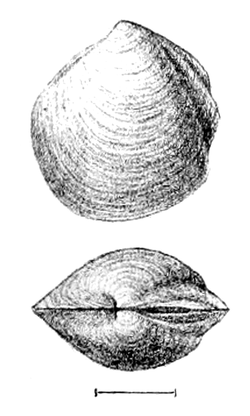
Picture of Thyasiridae
- Source
- Wikipedia/Commons
- Credit
- Georg Ossian Sars
- Licence
- Public Domain
- Commercial use
- the licence allows it
No 3D scan of Thyasiridae was found in Sketchfab.
Smithsonian Open Access and MorphoSource were not reached for this taxon, so this list is what the others held rather than everything there is.
The description on this site
- Source
- Wikipedia, “Thyasiridae”
- Licence
- CC BY-SA 4.0
This is what the site found, which is not the same as what exists.
Keep going
What may have been alongside itLucinida through timeFormations of the OligoceneThe world it lived on
Occurrence data from the Paleobiology Database, CC BY 4.0. Dall 1901