Treptoceras duseri

Yale Peabody Museum · CC0 · via GBIF. May be a photograph of a specimen, or an artist’s reconstruction — an interpretation of a skeleton, since colour and soft tissue are almost never preserved.
On record
Recorded, not inferred- Sits inside
- TreptocerasPBDB
- Diet
- carnivorePBDB, for Orthocerida
- Life habit
- nektonicPBDB, for Orthocerida
- Motility
- actively mobilePBDB, for Orthocerida
- Vision
- well-developedPBDB, for Cephalopoda
- Environment
- marinePBDB, for Orthocerida
Time the record covers
At least 700 thousand years on record.
The record covers at least 450.2 Mya to 449.5 Mya. No occurrence read is dated outside 458.2 Mya to 443.1 Mya.
14 occurrences of Treptoceras duseri on record, most of them in the Ordovician. Bar height is expected occurrences, not a count: each fossil is spread across the span it is dated to, so a tall narrow bar means tight dating and a low wide one means loose.
When
14 occurrences- Ordovician100%
These are dates about fossils, not the animal: the record can only begin after it arose and end before it died out, so either end may reach further. Shares are expected occurrences: a fossil dated to a span is counted partly in each period it straddles. More on what this infers.
Found in
6 formations
- Waynesville Formation7
- Fairview Formation3
- Whitewater Formation1
- Tate Formation1
- Kope Formation1
- Clays Ferry Formation1
Loading coastlines…
The named rock units Treptoceras duseri has been recovered from, largest first. Drawn where the rock is now, not where it formed.
Treptoceras duseri and its relatives
OrdovicianWhere Treptoceras duseri and its relatives were recorded in the Ordovician.
Found in the same rock
100 taxa- Ambonychia6 sites
- Isotelus maximus4 sites
- Sinuites subcompressa4 sites
- Treptoceras cincinnatiensis4 sites
- Treptoceras fosteri4 sites
- Flexicalymene meeki3 sites
- Paupospira bowdeni3 sites
- Pholadomorpha pholadiformis3 sites
- Pterinea demissa3 sites
- Zygospira modesta3 sites
- Corallidomus2 sites
- Cuneamya miamiensis2 sites
- Cymatonota semistriata2 sites
- Cyphotrypa2 sites
- Flexicalymene2 sites
- Halloporidae2 sites
- Hebertella occidentalis2 sites
- Hiscobeccus capax2 sites
- Isotelus2 sites
- Paupospira tropidophora2 sites
- Psiloconcha grandis2 sites
- Rafinesquina alternata2 sites
- Stromatocerium2 sites
- Strophomena planumbona2 sites
The Paleobiology Database records 14 sites for Treptoceras duseri, and this reads all of them. The number is how many of those sites it was catalogued from too. The 24 sharing the most are listed.
This is not a list of everything alive at the time. It is only what has come out of the same ground as this animal and been written down.
Entered from
6 references- Middle and Upper Ordovician nautiloid cephalopods of the Cincinnati Arch region of Kentucky, Indiana, and Ohio4
- Paleoecology of Treptoceras duseri (Michelinoceratida, Proteoceratidae) from Late Ordovician of southwestern Ohio4
- Comparative geographic and environmental diversity dynamics of gastropods and bivalves during the Ordovician Radiation (M.S. thesis, University of Cincinnati)2
- The occurrence of pelecypods in early Paleozoic epeiric-sea environments, Late Ordovician of the Cincinnati, Ohio area2
- Paleoecology of a well-preserved nautiloid assemblage from a Late Ordovician shale unit, southwestern Ohio1
- The coral horizons and stratigraphy of the upper Richmond Group in Kentucky west of the Cincinnati Arch1
Each of the 14 occurrences read was entered from one of these publications, ordered by how many each accounts for. This is not a search for papers mentioning the name. Entries link to doi.org where the Paleobiology Database holds an identifier, and to its own record where it does not. Relayed as the Paleobiology Database holds them, not checked against what they resolve to.
Media and terms
Media content2
Picture of Treptoceras duseri
- Source
- GBIF
- Credit
- Yale Peabody Museum
- Licence
- CC0
- Commercial use
- the licence allows it
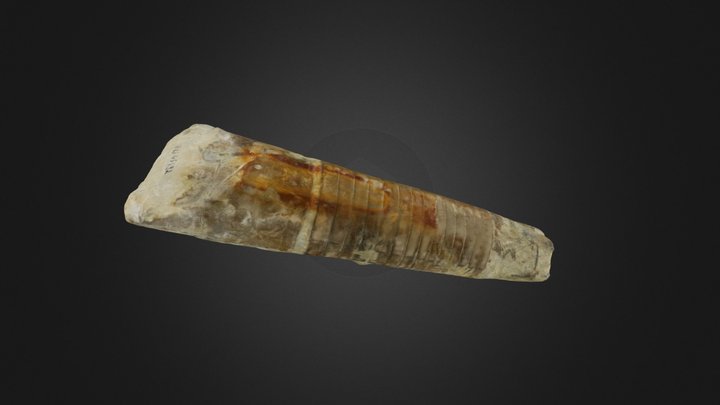
3D model
- Source
- Sketchfab
- Licence
- CC0 Public Domain
- Commercial use
- the licence allows it
Smithsonian Open Access and MorphoSource were not reached for this taxon, so this list is what the others held rather than everything there is.
This is what the site found, which is not the same as what exists.
Keep going
What may have been alongside itTreptoceras through timeFormations of the OrdovicianThe world it lived on
Occurrence data from the Paleobiology Database, CC BY 4.0. (Hall and Whitfield 1875)