Arachnida
Arachnids are arthropods in the class Arachnida of the subphylum Chelicerata. Arachnida includes, among others, spiders, scorpions, ticks, mites, pseudoscorpions, harvestmen, camel spiders, whip spiders and vinegaroons.

Lucarelli Maximilian Paradiz Jorge Armín Escalante Pasos Marshal Hedin Bernard DUPONT Cavexplorer Chantelle Bosch Ros… · CC BY-SA 4.0 · via Wikipedia/Commons. May be a photograph of a specimen, or an artist’s reconstruction — an interpretation of a skeleton, since colour and soft tissue are almost never preserved.
On record
Recorded, not inferred- Sits inside
- SclerophorataPBDB
- Life habit
- solitaryPBDB
- Motility
- actively mobilePBDB
- Environment
- terrestrialPBDB
Time the record covers
At least 432 million years on record.
The record covers at least 432.9 Mya to 11.7 ka. No occurrence read is dated outside 438.6 Mya to 0 Mya.
3,960 occurrences of Arachnida on record, most of them in the Eocene. The Paleobiology Database records this as a living group. Bar height is expected occurrences, not a count: each fossil is spread across the span it is dated to, so a tall narrow bar means tight dating and a low wide one means loose.
When
3,960 occurrences- Silurianunder 1%
- Devonian2%
- Carboniferous11%
- Permianunder 1%
- Middle Triassicunder 1%
- Late Triassicunder 1%
- Early Jurassicunder 1%
- Middle Jurassicunder 1%
- Late Jurassicunder 1%
- Early Cretaceous3%
- Late Cretaceous17%
- Paleoceneunder 1%
- Eocene47%
- Oligocene1%
- Miocene13%
- Plioceneunder 1%
- Pleistoceneunder 1%
- Holocene2%
These are dates about fossils, not the animal: the record can only begin after it arose and end before it died out, so either end may reach further. Shares are expected occurrences: a fossil dated to a span is counted partly in each period it straddles. More on what this infers.
Found in
182 formations
- Carbondale Formation · Kewanee Group85
- Florissant Formation57
- Kladno Formation45
- Crato Formation · Santana Group34
- Niveau du gypse d'Aix Formation26
- Shanwang Formation24
Loading coastlines…
The named rock units Arachnida has been recovered from, largest first. Drawn where the rock is now, not where it formed. 158 further formations hold fewer occurrences each and are not listed. 3,168 occurrences have no formation on record, which is common for older literature.
Arachnida and its relatives
EoceneWhere Arachnida and its relatives were recorded in the Eocene.
Found in the same rock
7,976 taxa- Araneae14 sites
- Anostraca12 sites
- Schistomerus californense12 sites
- Dasyhelea antiqua11 sites
- Protoarrenurus convergens11 sites
- Coleoptera10 sites
- Thripidae10 sites
- Archaea paradoxa8 sites
- Curculionidae8 sites
- Entomobrya8 sites
- Formicidae8 sites
- Atriculicoides7 sites
- Diptera7 sites
- Forcipomyia7 sites
- Gesomyrmex hoernesi7 sites
- Lepidoptera7 sites
- Nylanderia pygmaea7 sites
- Orchestina7 sites
- Segestria7 sites
- Anthracomartus hindi6 sites
- Anthracomartus priesti6 sites
- Araneidae6 sites
- Araneomorphae6 sites
- Brachycera6 sites
The Paleobiology Database records at least 307 sites for Arachnida, and this reads 240 of them. Of that, one read hit the database's own return limit, so every count below is a floor rather than a total. The number is how many of those sites it was catalogued from too. The 24 sharing the most are listed.
This is not a list of everything alive at the time. It is only what has come out of the same ground as this animal and been written down.
Entered from
711 references- Die fossilen Spinnen im dominikanischen Bernstein186
- On extant and fossil (Eocene) European comb-footed spiders (Araneae: Theridiidae), with notes on their subfamilies, and with descriptions of new taxa174
- Footnotes and taxonomic names, in Die im Bernstein befindlichen Crustaceen, Myriapoden, Arachniden und Apteren der Vorwelt136
- Die im Bernstein befindlichen Crustaceen, Myriapoden, Arachniden und Apteren der Vorwelt124
- On the evolution and the classification of spiders, the Mesozoic spider faunas, and descriptions of new Cretaceous taxa mainly in amber from Myanmar (Burma) (Arachnida: Araneae)97
- New and rare fossil spiders (Araneae) in mid Cretaceous amber from Myanmar (Burma), including the description of new extinct families of the suborders Mesothelae and Opisthothelae, as well as notes on the taxonomy, the evolution and the biogeography of the Mesothelae88
- A study of amber spiders88
- Amber Spiders in European Collections84
- Descriptions of new fossil spiders (Arachnida: Araneae) in Late (Mid) Cretaceous Burmese amber with focus on the superfamilies Palpimanoidea and Deinopoidea and members of the RTA-clade, as well as remarks on palaeobehaviour, palaeofauna, taxonomy and phylogenetics70
- The fossil spiders of the family Anapidae s. l. (Araneae) in Baltic, Dominican and Mexican amber and their extant relatives, with the description of a new subfamily Comarominae68
- A restudy of the fossil Scorpionida of the world57
- Fossil spiders (Araneae) of the superfamily Dysderoidea in Baltic and Dominican amber, with revised family diagnoses56
Each of the 3,960 occurrences read was entered from one of these publications, ordered by how many each accounts for. This is not a search for papers mentioning the name. 699 further references are not listed. Each entry links to the Paleobiology Database's own record for the work.
Media and terms
Media content2

Picture of Arachnida
- Source
- Wikipedia/Commons
- Credit
- Lucarelli Maximilian Paradiz Jorge Armín Escalante Pasos Marshal Hedin Bernard DUPONT Cavexplorer Chantelle Bosch Ros…
- Licence
- CC BY-SA 4.0
- Commercial use
- the licence allows it
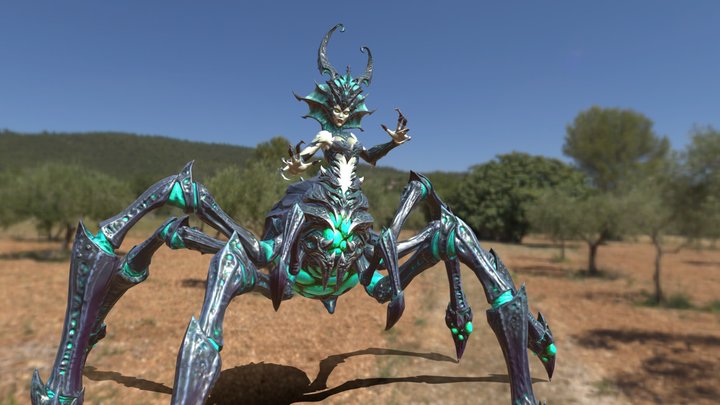
3D model
- Source
- Sketchfab
- Credit
- Vasian-Digital3D
- Licence
- CC Attribution
- Commercial use
- cannot be read from the licence given — check the record
Smithsonian Open Access was not reached for this taxon, so this list is what the others held rather than everything there is.
The description on this site
- Source
- Wikipedia, “Arachnid”
- Licence
- CC BY-SA 4.0
This is what the site found, which is not the same as what exists.
Keep going
What may have been alongside itSclerophorata through timeFormations of the EoceneThe world it lived on
Occurrence data from the Paleobiology Database, CC BY 4.0. Lamarck 1801