Typotheria
Typotheria is a suborder of the extinct South American native ungulate order Notoungulata. A majority of the members of this clade were superficially similar to lagomorphs and rodents, though this is due to convergence. The clade was named after Typotherium, a synonym of Mesotherium.

Henry Woodward · Public Domain · via Wikipedia/Commons. May be a photograph of a specimen, or an artist’s reconstruction — an interpretation of a skeleton, since colour and soft tissue are almost never preserved.
On record
Recorded, not inferred- Sits inside
- NotoungulataPBDB
- Diet
- herbivorePBDB, for Notoungulata
- Life habit
- scansorialPBDB, for Eutheria
- Motility
- actively mobilePBDB, for Osteichthyes
- Environment
- terrestrialPBDB, for Eutheria
Time the record covers
At least 55 million years on record.
The record covers at least 56 Mya to 129 ka. No occurrence read is dated outside 57 Mya to 11.7 ka.
823 occurrences of Typotheria on record, most of them in the Miocene. Bar height is expected occurrences, not a count: each fossil is spread across the span it is dated to, so a tall narrow bar means tight dating and a low wide one means loose.
When
823 occurrencesThese are dates about fossils, not the animal: the record can only begin after it arose and end before it died out, so either end may reach further. Shares are expected occurrences: a fossil dated to a span is counted partly in each period it straddles. More on what this infers.
Found in
91 formations
- Santa Cruz Formation123
- Sarmiento Formation97
- Cerro Azul Formation82
- Monte Hermoso Formation32
- Collón Cura Formation25
- Irene Formation19
Loading coastlines…
The named rock units Typotheria has been recovered from, largest first. Drawn where the rock is now, not where it formed. 67 further formations hold fewer occurrences each and are not listed. 108 occurrences have no formation on record, which is common for older literature.
Typotheria and its relatives
MioceneWhere Typotheria and its relatives were recorded in the Miocene.
Found in the same rock
1,481 taxa- Protypotherium praerutilum24 sites
- Protypotherium20 sites
- Neoreomys australis17 sites
- Caviidae16 sites
- Hapalops16 sites
- Paedotherium bonaerense16 sites
- Prozaedyus16 sites
- Dasypodidae15 sites
- Paedotherium15 sites
- Tremacyllus impressus15 sites
- Macraucheniidae14 sites
- Paedotherium minor14 sites
- Stenotatus14 sites
- Adinotherium13 sites
- Cladosictis patagonica13 sites
- Nesodon13 sites
- Adinotherium ovinum12 sites
- Hegetotherium mirabile12 sites
- Interatherium extensus12 sites
- Proeutatus12 sites
- Proterotheriidae12 sites
- Protypotherium australe12 sites
- Argyrohyrax proavus11 sites
- Borhyaenidae11 sites
The Paleobiology Database records 315 sites for Typotheria, and this reads 240 of them. The number is how many of those sites it was catalogued from too. The 24 sharing the most are listed.
This is not a list of everything alive at the time. It is only what has come out of the same ground as this animal and been written down.
Entered from
201 references- Updated knowledge on the Notoungulata (Mammalia) from the late Miocene Cerro Azul Formation, La Pampa Province, Argentina40
- Paleobiology of Santacrucian native ungulates (Meridiungulata: Astrapotheria, Litoptera and Notoungulata)32
- Biostratigraphy and biochronology of the Monte Hermoso Formation (early Pliocene) at its type locality, Buenos Aires Province, Argentina25
- Bioestratigrafía de la Formación Santa Cruz (Mioceno Inferior) en el extremo sudeste de la Patagonia25
- The Interatheriinae from the Late Oligocene of Mendoza (Argentina), with comments on some Deseadan Interatheriidae22
- Rodent-like notoungulates (Typotheria) from Gran Barranca, Chubut Province, Argentina: phylogeny and systematics21
- Notoungulata and Astrapotheria (Mammalia, Meridiungulata) of the Santa Cruz Formation (Early-Middle Miocene) Along the Río Santa Cruz, Argentine Patagonia20
- The beginning of the age of mammals in South America. Part II19
- The Interatheriinae notoungulates from the middle Miocene Collón Curá Formation in Argentina15
- Chronologic implications of new Miocene mammals from the Cura-Mallín and Trapa Trapa formations, Laguna del Laja area, south Central Chile14
- Large archaeohyracids (Typotheria, Notoungulata) from central Chile and Patagonia including a revision of Archaeotypotherium13
- A new genus of interatheres from the Miocene of Colombia13
Each of the 823 occurrences read was entered from one of these publications, ordered by how many each accounts for. This is not a search for papers mentioning the name. 189 further references are not listed. Entries link to doi.org where the Paleobiology Database holds an identifier, and to its own record where it does not. Relayed as the Paleobiology Database holds them, not checked against what they resolve to.
Media and terms
Media content1
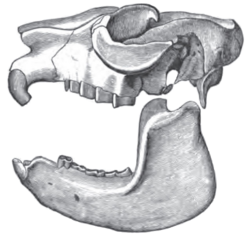
Picture of Typotheria
- Source
- Wikipedia/Commons
- Credit
- Henry Woodward
- Licence
- Public Domain
- Commercial use
- the licence allows it
No 3D scan of Typotheria was found in Sketchfab.
Smithsonian Open Access and MorphoSource were not reached for this taxon, so this list is what the others held rather than everything there is.
The description on this site
- Source
- Wikipedia, “Typotheria”
- Licence
- CC BY-SA 4.0
This is what the site found, which is not the same as what exists.
Keep going
What may have been alongside itNotoungulata through timeFormations of the MioceneThe world it lived on
Occurrence data from the Paleobiology Database, CC BY 4.0. Zittel 1892