Varanus marathonensis
Varanus marathonensis, the Samos dragon, is an extinct species of monitor lizard from the middle to late Miocene of Greece and Spain, known from several specimens. A specimen consisting of a partial skull and several vertebrae was named Varanus amnhophilis in 2012 and placed in its own subgenus, Varaneades, but a 2018 study found it to be a junior synonym of Varanus marathonensis. Comparisons with other species of monitor lizards put its size between 60 and 80 cm in length, excluding the tail. The fossil was found in the Turolian-age Mytilini Formation on the island of Samos and is currently housed in the American Museum of Natural History.

Jack L. Conrad, Ana M. Balcarcel, Carl M. Mehling · CC BY 2.5 · via Wikipedia/Commons. May be a photograph of a specimen, or an artist’s reconstruction — an interpretation of a skeleton, since colour and soft tissue are almost never preserved.
On record
Recorded, not inferred- Sits inside
- VaranusPBDB
- Diet
- carnivorePBDB, for Varanidae
- Life habit
- scansorialPBDB, for Varanidae
- Motility
- actively mobilePBDB, for Osteichthyes
- Environment
- terrestrialPBDB, for Varanidae
Time the record covers
At least 6.5 million years on record.
The record covers at least 11.63 Mya to 5.09 Mya. No occurrence read is dated outside 15.98 Mya to 3.55 Mya.
10 occurrences of Varanus marathonensis on record, most of them in the Miocene. Bar height is expected occurrences, not a count: each fossil is spread across the span it is dated to, so a tall narrow bar means tight dating and a low wide one means loose.
When
10 occurrencesThese are dates about fossils, not the animal: the record can only begin after it arose and end before it died out, so either end may reach further. Shares are expected occurrences: a fossil dated to a span is counted partly in each period it straddles. More on what this infers.
Found in
1 formation
Loading coastlines…
The named rock units Varanus marathonensis has been recovered from, largest first. Drawn where the rock is now, not where it formed. 9 occurrences have no formation on record, which is common for older literature.
Varanus marathonensis and its relatives
MioceneWhere Varanus marathonensis and its relatives were recorded in the Miocene.
Found in the same rock
108 taxa- Ancylotherium pentelicum2 sites
- Colubridae2 sites
- Helladotherium duvernoyi2 sites
- Lacertidae2 sites
- Naja2 sites
- Promephitis2 sites
- Acerorhinus neleus1 site
- Amphisbaenidae1 site
- Anguinae1 site
- Antidorcas1 site
- Apodemus1 site
- Asoriculus gibberodon1 site
- Bohlinia attica1 site
- Bovidae1 site
- Bufo viridis1 site
- Centralomys magnus1 site
- Chasmaporthetes kani1 site
- Cheirogaster1 site
- Choerolophodon pentelici1 site
- Ciconia gaudryi1 site
- Deinotherium1 site
- Deinotherium proavum1 site
- Dihoplus megarhinus1 site
- Dihoplus schleiermacheri1 site
The Paleobiology Database records 9 sites for Varanus marathonensis, and this reads all of them. The number is how many of those sites it was catalogued from too. The 24 sharing the most are listed.
This is not a list of everything alive at the time. It is only what has come out of the same ground as this animal and been written down.
Entered from
6 references- Revision of Varanus marathonensis (Squamata, Varanidae) based on historical and new material: morphology, systematics, and paleobiogeography of the European monitor lizards5
- Early Pliocene Varanus (Squamata, Varanidae) remains from Megalo Emvolon, Thessaloniki, Greece1
- Earliest Example of a Giant Monitor Lizard (Varanus, Varanidae, Squamata)1
- Pliocene vertebrate locality of Calta, Ankara, Turkey. 12. Paleoecology, biogeography and biochronology1
- Zur Kenntnis der fossilen Eidechsen1
- Beiträge zur Kenntniss der Fauna von Pikermi bei Athen1
Each of the 10 occurrences read was entered from one of these publications, ordered by how many each accounts for. This is not a search for papers mentioning the name. Entries link to doi.org where the Paleobiology Database holds an identifier, and to its own record where it does not. Relayed as the Paleobiology Database holds them, not checked against what they resolve to.
Media and terms
Media content2
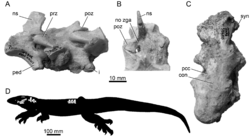
Picture of Varanus marathonensis
- Source
- Wikipedia/Commons
- Credit
- Jack L. Conrad, Ana M. Balcarcel, Carl M. Mehling
- Licence
- CC BY 2.5
- Commercial use
- the licence allows it
Structured light scan
- Source
- MorphoSource
- Licence
- not stated by the source
- Commercial use
- cannot be read from the licence given — check the record
- Specimen
- Varanus cf. marathonensis · LGPUT:MVL:1
The description on this site
- Licence
- CC BY-SA 4.0
This is what the site found, which is not the same as what exists.
Keep going
What may have been alongside itVaranus through timeFormations of the MioceneThe world it lived on
Occurrence data from the Paleobiology Database, CC BY 4.0. Weithofer 1888