Vesicomyidae
Vesicomyidae is a family of saltwater clams, marine bivalve molluscs in the superfamily Glossoidea. They thrive in communities of sulphide-rich reducing environments, at depths from 100 to 9050 m.

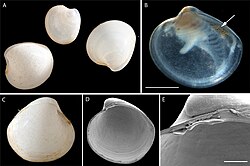
[Image: Glover, Taylor, Dahlgren & Wiklund, 2017] Wiklund H, Taylor JD, Dahlgren TG, Todt C, Ikebe C, Rabone M, Glove… · CC BY 4.0 · via Wikipedia/Commons. May be a photograph of a specimen, or an artist’s reconstruction — an interpretation of a skeleton, since colour and soft tissue are almost never preserved.
On record
Recorded, not inferred- Sits inside
- GlossoideaPBDB
- Diet
- suspension feederPBDB, for Glossoidea
- Life habit
- infaunalPBDB, for Glossoidea
- Motility
- facultatively mobilePBDB, for Glossoidea
- Vision
- blindPBDB, for Bivalvia
Time the record covers
At least 72 million years on record.
The record covers at least 72.2 Mya to 129 ka. No occurrence read is dated outside 83.6 Mya to 11.7 ka.
107 occurrences of Vesicomyidae on record, most of them in the Oligocene. The Paleobiology Database records this as a living group. Bar height is expected occurrences, not a count: each fossil is spread across the span it is dated to, so a tall narrow bar means tight dating and a low wide one means loose.
When
107 occurrences- Late Cretaceousunder 1%
- Eocene22%
- Oligocene37%
- Miocene23%
- Pliocene10%
- Pleistocene7%
These are dates about fossils, not the animal: the record can only begin after it arose and end before it died out, so either end may reach further. Shares are expected occurrences: a fossil dated to a span is counted partly in each period it straddles. More on what this infers.
Found in
42 formations
- Lincoln Creek Formation14
- Makah Formation8
- Humptulips Formation7
- Kulthieth Formation5
- Chikubetsu Formation3
- Cone Hill Formation · Chira Group3
Loading coastlines…
The named rock units Vesicomyidae has been recovered from, largest first. Drawn where the rock is now, not where it formed. 18 further formations hold fewer occurrences each and are not listed. 19 occurrences have no formation on record, which is common for older literature.
Vesicomyidae and its relatives
OligoceneWhere Vesicomyidae and its relatives were recorded in the Oligocene.
Found in the same rock
1,065 taxa- Acharax8 sites
- Bathymodiolus willapaensis8 sites
- Pleurophopsis chinookensis8 sites
- Thyasira8 sites
- Conchocele bisecta7 sites
- Naticidae7 sites
- Archivesica gibbera6 sites
- Calyptogena6 sites
- Gastropoda5 sites
- Vesicomya5 sites
- Depressigyra4 sites
- Fusitriton oregonensis4 sites
- Isorropodon humptulipsense4 sites
- Lucinoma4 sites
- Provanna antiqua4 sites
- Solariella4 sites
- Adulomya3 sites
- Archivesica tschudi3 sites
- Bittium3 sites
- Buccinidae3 sites
- Callianassa3 sites
- Calyptogena katallaensis3 sites
- Cataegis3 sites
- Cetacea3 sites
The Paleobiology Database records 64 sites for Vesicomyidae, and this reads all of them. The number is how many of those sites it was catalogued from too. The 24 sharing the most are listed.
This is not a list of everything alive at the time. It is only what has come out of the same ground as this animal and been written down.
Entered from
44 references- New taxa, records, and data for vesicomyid bivalves from Cenozoic strata of the North Pacific region16
- Oligocene and Miocene Vesicomyid Bivalves from the Katalla District, Southern Alaska8
- Fossil Vesicomyid Bivalves from the North Pacific Region8
- Thyasirid bivalves from Cretaceous and Paleogene cold seeps6
- Cenozoic Methane-Seep Faunas of the Caribbean Region5
- Contributions to the Tertiary Paleontology of Northern Peru: Part 4, The Peruvian Oligocene5
- Discovery of an Extensive Deep-Sea Fossil Serpulid Reef Associated with a Cold Seep, Santa Monica Basin, California4
- Fossil Adulomya (Vesicomyidae, Bivalvia) from Japan4
- A comprehensive approach to the study of methane-seep deposits from the Lincoln Creek Formation, western Washington State, USA3
- First Oligocene records of Calyptogena (Bivalvia: Vesicomyidae)3
- Palaeoecology of Akebiconcha kawamurai (Bivalvia: Vesicomyidae) from the Pliocene Tamari Silt Formation in the Kakegawa area, central Japan3
- Chemosymbiotic Bivalves from the Lower Miocene Kurosedani Formation in Toyama Prefecture, Central Honshu, Japan2
Each of the 107 occurrences read was entered from one of these publications, ordered by how many each accounts for. This is not a search for papers mentioning the name. 32 further references are not listed. Entries link to doi.org where the Paleobiology Database holds an identifier, and to its own record where it does not. Relayed as the Paleobiology Database holds them, not checked against what they resolve to.
Media and terms
Media content1
Picture of Vesicomyidae
- Source
- Wikipedia/Commons
- Credit
- [Image: Glover, Taylor, Dahlgren & Wiklund, 2017] Wiklund H, Taylor JD, Dahlgren TG, Todt C, Ikebe C, Rabone M, Glove…
- Licence
- CC BY 4.0
- Commercial use
- the licence allows it
No 3D scan of Vesicomyidae was found in Sketchfab.
Smithsonian Open Access and MorphoSource were not reached for this taxon, so this list is what the others held rather than everything there is.
The description on this site
- Licence
- CC BY-SA 4.0
This is what the site found, which is not the same as what exists.
Keep going
What may have been alongside itGlossoidea through timeFormations of the OligoceneThe world it lived on
Occurrence data from the Paleobiology Database, CC BY 4.0. Dall 1908