Wodnika
Wodnika is an extinct genus of cartilaginous fish which lived in the Late Permian period in the present area of Germany and Russia. It measured about 1 m (3.2 ft) in length and its tail shape indicates it was probably a good swimmer. Internally, the cartilage skeleton is preserved on the fossil, which is fairly rare for fossilized shark-like chondrichthyans.

Creator: Dmitry Bogdanov · CC BY 3.0 · via Wikipedia/Commons. May be a photograph of a specimen, or an artist’s reconstruction — an interpretation of a skeleton, since colour and soft tissue are almost never preserved.
On record
Recorded, not inferred- Sits inside
- CtenacanthoideaPBDB
- Diet
- carnivorePBDB, for Ctenacanthiformes
- Life habit
- nektonicPBDB, for Ctenacanthiformes
- Motility
- actively mobilePBDB, for Ctenacanthiformes
Time the record covers
At least 236 million years on record.
The record covers at least 259.857 Mya to 23.04 Mya. No occurrence read is dated outside 298.9 Mya to 15.98 Mya.
14 occurrences of Wodnika on record, most of them in the Permian. Bar height is expected occurrences, not a count: each fossil is spread across the span it is dated to, so a tall narrow bar means tight dating and a low wide one means loose.
When
14 occurrencesThese are dates about fossils, not the animal: the record can only begin after it arose and end before it died out, so either end may reach further. Shares are expected occurrences: a fossil dated to a span is counted partly in each period it straddles. More on what this infers.
Found in
4 formations
Loading coastlines…
The named rock units Wodnika has been recovered from, largest first. Drawn where the rock is now, not where it formed. 2 occurrences have no formation on record, which is common for older literature.
Wodnika and its relatives
PermianWhere Wodnika and its relatives were recorded in the Permian.
Found in the same rock
58 taxa- Pygopterus humboldti4 sites
- Janassa bituminosa3 sites
- Coelacanthus granulatus2 sites
- Ctenacanthus2 sites
- Eurysomus macrurus2 sites
- Menaspis armata2 sites
- Palaeoniscum freieslebeni2 sites
- Palaeoniscus freieslebeni2 sites
- Peripetoceras freieslebeni2 sites
- Platysomus macrurus2 sites
- Platysomus striatus2 sites
- Acentrophorus glaphyrus1 site
- Acrolepis sedgwickii1 site
- Archosaurus1 site
- Archosaurus rossicus1 site
- Bakevellia1 site
- Bystrowiana permica1 site
- Clinocypris cf. elongata1 site
- Clinocypris sp.1 site
- Darwinula1 site
- Darwinuloides ex gr. svijazhicus1 site
- Dicynodontidae1 site
- Dorypterus hoffmanni1 site
- Dvinosaurus egregius1 site
The Paleobiology Database records 10 sites for Wodnika, and this reads all of them. The number is how many of those sites it was catalogued from too. The 24 sharing the most are listed.
This is not a list of everything alive at the time. It is only what has come out of the same ground as this animal and been written down.
Entered from
8 references- Die Fischreste der küstennahen Sedimente des unteren Zechstein 1 Westdeutschlands3
- Nachtrag zu der Beschreibung einiger merkwürdigen Fische aus den Kupferschiefern3
- A coelacanthid-rich site at Hasbergen (NW Germany): taphonomy and palaeoenvironment of a first systematic excavation in the Kupferschiefer (Upper Permian, Lopingian)2
- Ueber einige Placoiden im Kupferschiefer zu Richelsdorf2
- Vyazniki Biotic Assemblage of the Terminal Permian1
- Upper Permian vertebrates and their sedimentological context in the South Urals, Russia1
- Studies on the Paleozoic Selachian Genus Ctenacanthus Agassiz: No. 2. Bythiacanthus St. John and Worthen, Amelacanthus, New Genus, Eunemacanthus St. John and Worthen, Sphenacanthus Agassiz, and Wodnika Munster1
- Fossil Fishes of the Miocene (Monterey) Formations1
Each of the 14 occurrences read was entered from one of these publications, ordered by how many each accounts for. This is not a search for papers mentioning the name. Entries link to doi.org where the Paleobiology Database holds an identifier, and to its own record where it does not. Relayed as the Paleobiology Database holds them, not checked against what they resolve to.
Media and terms
Media content2
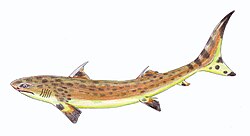
Picture of Wodnika
- Source
- Wikipedia/Commons
- Credit
- Creator: Dmitry Bogdanov
- Licence
- CC BY 3.0
- Commercial use
- the licence allows it
Smithsonian Open Access and MorphoSource were not reached for this taxon, so this list is what the others held rather than everything there is.
The description on this site
- Source
- Wikipedia, “Wodnika”
- Licence
- CC BY-SA 4.0
This is what the site found, which is not the same as what exists.
Keep going
What may have been alongside itCtenacanthoidea through timeFormations of the PermianThe world it lived on
Occurrence data from the Paleobiology Database, CC BY 4.0. Münster 1843