Xylophagidae
The Brachyceran infraorder Xylophagomorpha is a small group that consists solely of the family Xylophagidae, which presently contains subfamilies that were sometimes considered to be two small related families. Other obsolete names for members of this family include Exeretonevridae and Heterostomidae.

Richard Bartz , Munich aka Makro Freak Image:MFB.jpg · CC BY-SA 2.5 · via Wikipedia/Commons. May be a photograph of a specimen, or an artist’s reconstruction — an interpretation of a skeleton, since colour and soft tissue are almost never preserved.
On record
Recorded, not inferred- Sits inside
- HomeodactylaPBDB
- Motility
- actively mobilePBDB, for Arthropoda
- Environment
- terrestrialPBDB, for Insecta
Time the record covers
At least 146 million years on record.
The record covers at least 149.2 Mya to 2.58 Mya. No occurrence read is dated outside 154.8 Mya to 1.8 Mya.
26 occurrences of Xylophagidae on record, most of them in the Eocene. The Paleobiology Database records this as a living group, and the chart stops with its fossils rather than at the present. Bar height is expected occurrences, not a count: each fossil is spread across the span it is dated to, so a tall narrow bar means tight dating and a low wide one means loose.
When
26 occurrences- Late Jurassic4%
- Early Cretaceous12%
- Eocene46%
- Oligocene15%
- Miocene15%
- Pliocene4%
- Pleistocene4%
These are dates about fossils, not the animal: the record can only begin after it arose and end before it died out, so either end may reach further. Shares are expected occurrences: a fossil dated to a span is counted partly in each period it straddles. More on what this infers.
Found in
12 formations
- Niveau du gypse d'Aix Formation2
- Laiyang Formation2
- Lisbon Formation1
- Bowden Formation · Coastal Group1
- Grand Bay Formation1
- Lillo Formation1
Loading coastlines…
The named rock units Xylophagidae has been recovered from, largest first. Drawn where the rock is now, not where it formed. 12 occurrences have no formation on record, which is common for older literature.
Xylophagidae and its relatives
EoceneWhere Xylophagidae and its relatives were recorded in the Eocene.
Found in the same rock
3,308 taxa- Gesomyrmex hoernesi5 sites
- Plagiolepis klinsmanni5 sites
- Prenolepis henschei5 sites
- Tetraponera ocellata5 sites
- Yantaromyrmex geinitzi5 sites
- Brachycentrus labialis4 sites
- Cataglyphoides constricta4 sites
- Ctenobethylus goepperti4 sites
- Diptera4 sites
- Dolichoderus balticus4 sites
- Dolichoderus tertiarius4 sites
- Eocamponotus mengei4 sites
- Erotesis aequalis4 sites
- Formica flori4 sites
- Holocentropus affinis4 sites
- Holocentropus atratus4 sites
- Holocentropus incertus4 sites
- Holocentropus vetustus4 sites
- Hypoponera atavia4 sites
- Lasius schiefferdeckeri4 sites
- Lype sericea4 sites
- Nylanderia pygmaea4 sites
- Oecophylla brischkei4 sites
- Pachycondyla succinea4 sites
The Paleobiology Database records 18 sites for Xylophagidae, and this reads all of them. The number is how many of those sites it was catalogued from too. The 24 sharing the most are listed.
This is not a list of everything alive at the time. It is only what has come out of the same ground as this animal and been written down.
Entered from
21 references- Ueber den Bernstein und die Bernsteinfauna3
- Die sogenannten "niederen Brachycera" im Baltischen Bernstein2
- Les insectes fossiles des terrains oligocènes de France2
- Sur quelques diptères Xylophagidae, Therevidae, Arthopidae, Stratiomyidae, Tanypezinae et Ortalinae de l'ambre de la Baltique, de la collection du Prof. Dr. Klebs2
- On the enigmatic Sinonemestrius Hong & Wang, 1990, with description of a new species based on a complete fossil fly (Diptera, Brachycera, Tabanomorpha, Heterostomidae)1
- The Neogene Bivalvia (Heterodonta and Anomalodesmata) and Scaphopoda from Kallo and Doel (Oost Vlaanderen, Belgium)1
- The Marine Gram Formation at Gram, Denmark: Late Miocene Geology and Palaeontology1
- A new species of Sinonemestrius (Diptera: Brachycera) from the Weald Clay (Lower Cretaceous, southern England), with a discussion of its affnities and stratigraphical implications1
- A brief review of brachycerous flies (Diptera, Brachycera) in the Mesozoic, with descriptions of some curious taxa1
- Die Fauna des marinen Miozäns von Kevelaer (Niederrhein). Band 2 Bivalvia, Scaphopoda, Cephalopoda, Bryozoa, Annelida, Brachiopoda1
- Faunal stability and environmental change in the middle Eocene Gulf Coastal Plain (PhD Thesis, Harvard University)1
- Fossil insects from the Laiyang Basin, Shandong Province1
Each of the 26 occurrences read was entered from one of these publications, ordered by how many each accounts for. This is not a search for papers mentioning the name. 9 further references are not listed. Entries link to doi.org where the Paleobiology Database holds an identifier, and to its own record where it does not. Relayed as the Paleobiology Database holds them, not checked against what they resolve to.
Media and terms
Media content1
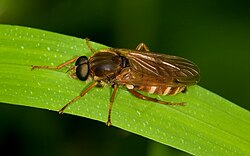
Picture of Xylophagidae
- Source
- Wikipedia/Commons
- Credit
- Richard Bartz , Munich aka Makro Freak Image:MFB.jpg
- Licence
- CC BY-SA 2.5
- Commercial use
- the licence allows it
No 3D scan of Xylophagidae was found in MorphoSource and Sketchfab.
Smithsonian Open Access was not reached for this taxon, so this list is what the others held rather than everything there is.
The description on this site
- Licence
- CC BY-SA 4.0
This is what the site found, which is not the same as what exists.
Keep going
What may have been alongside itHomeodactyla through timeFormations of the EoceneThe world it lived on
Occurrence data from the Paleobiology Database, CC BY 4.0. Fallen 1810