Acipenser
Acipenser is a genus of sturgeons, containing three species native to freshwater and estuarine systems of eastern North America and Europe. It is the type genus of the family Acipenseridae and the order Acipenseriformes.

Pierre André · CC BY-SA 4.0 · via Wikipedia/Commons. May be a photograph of a specimen, or an artist’s reconstruction — an interpretation of a skeleton, since colour and soft tissue are almost never preserved.
On record
Recorded, not inferred- Also called
- sturgeonPBDB
- Sits inside
- AcipenseridaePBDB
- Diet
- carnivorePBDB, for Acipenseriformes
- Life habit
- nektobenthicPBDB, for Acipenseriformes
- Motility
- actively mobilePBDB, for Acipenseriformes
Time the record covers
At least 72 million years on record.
The record covers at least 72.2 Mya to 11.7 ka. No occurrence read is dated outside 83.6 Mya to 0 Mya.
110 occurrences of Acipenser on record, most of them in the Late Cretaceous. The Paleobiology Database records this as a living group. Bar height is expected occurrences, not a count: each fossil is spread across the span it is dated to, so a tall narrow bar means tight dating and a low wide one means loose.
When
110 occurrences- Late Cretaceous59%
- Paleocene8%
- Eocene8%
- Oligoceneunder 1%
- Miocene10%
- Pliocene3%
- Pleistocene8%
- Holocene4%
These are dates about fossils, not the animal: the record can only begin after it arose and end before it died out, so either end may reach further. Shares are expected occurrences: a fossil dated to a span is counted partly in each period it straddles. More on what this infers.
Found in
30 formations
- Dinosaur Park Formation · Belly River Group25
- Hell Creek Formation · Montana Group22
- Lance Formation8
- Fort Union Formation5
- Calvert Formation · Chesapeake Group5
- Judith River Formation · Montana Group3
Loading coastlines…
The named rock units Acipenser has been recovered from, largest first. Drawn where the rock is now, not where it formed. 6 further formations hold fewer occurrences each and are not listed. 10 occurrences have no formation on record, which is common for older literature.
Acipenser and its relatives
Late CretaceousWhere Acipenser and its relatives were recorded in the Late Cretaceous.
Found in the same rock
2,179 taxa- Scapherpeton tectum47 sites
- Myledaphus bipartitus45 sites
- Opisthotriton kayi40 sites
- Baenidae38 sites
- Lepisosteus occidentalis37 sites
- Teleostei37 sites
- Trionychidae37 sites
- Belonostomus longirostris36 sites
- Chelydridae34 sites
- Champsosaurus29 sites
- Lepisosteus28 sites
- Champsosaurus natator27 sites
- Paralbula casei27 sites
- Anura26 sites
- Aves26 sites
- Paronychodon26 sites
- Theropoda26 sites
- Ceratopsidae25 sites
- Hadrosauridae25 sites
- Coriops amnicolus23 sites
- Leidyosuchus canadensis23 sites
- Mammalia20 sites
- Adocus19 sites
- Brachychampsa montana19 sites
The Paleobiology Database records 106 sites for Acipenser, and this reads all of them. Of that, one read hit the database's own return limit, so every count below is a floor rather than a total. The number is how many of those sites it was catalogued from too. The 24 sharing the most are listed.
This is not a list of everything alive at the time. It is only what has come out of the same ground as this animal and been written down.
Entered from
54 references- Paleoecology of an estuarine, incised-valley fill in the Dinosaur Park Formation (Judith River Group, Upper Cretaceous) of southern Alberta, Canada13
- Paleontology of the Judith River Formation (Campanian) of Dinosaur National Park, Alberta, Canada: evidence from vertebrate microfossil locality11
- Vertebrate biostratigraphy of the Hell Creek Formation in southwestern North Dakota and northwestern South Dakota9
- Fossil Vertebrate Collections5
- Non-dinosaurian lower vertebrates across the Cretaceous-Tertiary boundary in northeastern Montana5
- Fossil vertebrates from the Late Cretaceous Lance Formation, eastern Wyoming4
- The vertebrate fauna from the Judith River Formation (Late Cretaceous) of Wheatland and Golden Valley counties, Montana3
- The Selsey Division (Bracklesham Group) at Lee-on-the-Solent, Gosport, (Hants)3
- Late Cretaceous sturgeons (Acipenseridae) from North America, with two new species from the Tanis site in the Hell Creek Formation of North Dakota2
- The Kor & Bot collection revisited, with a biostratigraphic interpretation of the Early Pleistocene Oosterschelde Fauna (Oosterschelde Estuary, the Netherlands)2
- Geology and biostratigraphy of the Potomac River Cliffs at Stratford Hall, Westmoreland County, Virginia2
- The English Chalk and London Clay: two remarkable British bony fish Lagerstatten2
Each of the 110 occurrences read was entered from one of these publications, ordered by how many each accounts for. This is not a search for papers mentioning the name. 42 further references are not listed. Entries link to doi.org where the Paleobiology Database holds an identifier, and to its own record where it does not. Relayed as the Paleobiology Database holds them, not checked against what they resolve to.
Media and terms
Media content3
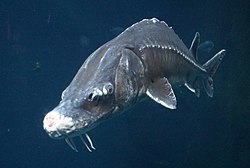
Picture of Acipenser
- Source
- Wikipedia/Commons
- Credit
- Pierre André
- Licence
- CC BY-SA 4.0
- Commercial use
- the licence allows it
CT scan
- Source
- MorphoSource
- Licence
- In Copyright
- Commercial use
- cannot be read from the licence given — check the record
- Specimen
- Acipenser stellatus · FMNH:Fishes:87365
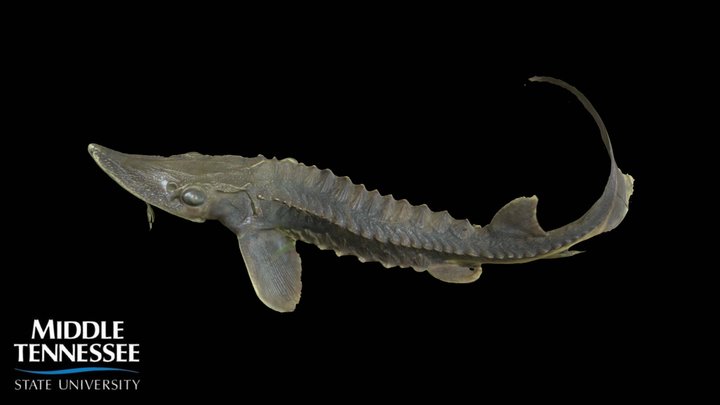
3D model
- Source
- Sketchfab
- Credit
- MTSUichthyology
- Licence
- CC Attribution
- Commercial use
- cannot be read from the licence given — check the record
Smithsonian Open Access was not reached for this taxon, so this list is what the others held rather than everything there is.
The description on this site
- Source
- Wikipedia, “Acipenser”
- Licence
- CC BY-SA 4.0
This is what the site found, which is not the same as what exists.
Keep going
What may have been alongside itAcipenseridae through timeFormations of the Late CretaceousThe world it lived on
Occurrence data from the Paleobiology Database, CC BY 4.0. Linnaeus 1758