Aeoliscus
Aeoliscus is a genus of shrimpfishes found in the Indian and Pacific Oceans.

Karelj · CC BY-SA 3.0 · via Wikipedia/Commons. May be a photograph of a specimen, or an artist’s reconstruction — an interpretation of a skeleton, since colour and soft tissue are almost never preserved.
On record
Recorded, not inferred- Sits inside
- CentriscidaePBDB
- Motility
- actively mobilePBDB, for Osteichthyes
Time the record covers
At least 21 million years on record.
The record covers at least 27.3 Mya to 5.333 Mya. No occurrence read is dated outside 143.1 Mya to 11.7 ka.
6 occurrences of Aeoliscus on record, most of them in the Oligocene. The Paleobiology Database records this as a living group. Bar height is expected occurrences, not a count: each fossil is spread across the span it is dated to, so a tall narrow bar means tight dating and a low wide one means loose.
When
6 occurrences- Early Cretaceous5%
- Late Cretaceous4%
- Paleocene1%
- Eocene3%
- Oligocene68%
- Miocene2%
- Pliocene17%
- Pleistoceneunder 1%
These are dates about fossils, not the animal: the record can only begin after it arose and end before it died out, so either end may reach further. Shares are expected occurrences: a fossil dated to a span is counted partly in each period it straddles. More on what this infers.
Aeoliscus and its relatives
OligoceneWhere Aeoliscus and its relatives were recorded in the Oligocene.
Found in the same rock
326 taxa- Lepidopus3 sites
- Maicopiella longimana2 sites
- Palaeorhynchus glarisianum2 sites
- Palaeorhynchus zitteli2 sites
- Sardina2 sites
- Scombridae2 sites
- Syngnathus incompletus2 sites
- ? Calamoideae indet.1 site
- Abadzekhia1 site
- Abadzekhia tarletskovi1 site
- Achilleodinium1 site
- Achomosphaera1 site
- Actinodaphne1 site
- Alosa sculptata1 site
- Anenchelum angustum1 site
- Anenchelum glarisianum1 site
- Apteodinium1 site
- Apterodon rauenbergensis1 site
- Araneae1 site
- Archaeus glarisianus1 site
- Arcopagia1 site
- Arecaceae1 site
- Areoligera1 site
- Argyropelecus cosmovicii1 site
The Paleobiology Database records 4 sites for Aeoliscus, and this reads all of them. The number is how many of those sites it was catalogued from too. The 24 sharing the most are listed.
This is not a list of everything alive at the time. It is only what has come out of the same ground as this animal and been written down.
Entered from
5 references- Emergency excavation in the Grube (Unterfeld) Frauenweiler clay pit (Oligocene Rupelian; Baden-Wurttemberg, S Germany): New records and palaeoenvironmental informatino2
- The Rauenberg fossil Lagerstätte (Baden-Württemberg, Germany): A window into early Oligocene marine and coastal ecosystems of Central Europe1
- A new Pliocene marine fish fauna from north-western Cyprus, with a micropalaeontological account1
- Fauna Fosila din Oligocenul de la Piatra Neamt1
- Beiträge sur Kenntniss der fossilen Fische der Karpathen1
Each of the 6 occurrences read was entered from one of these publications, ordered by how many each accounts for. This is not a search for papers mentioning the name. Entries link to doi.org where the Paleobiology Database holds an identifier, and to its own record where it does not. Relayed as the Paleobiology Database holds them, not checked against what they resolve to.
Media and terms
Media content1
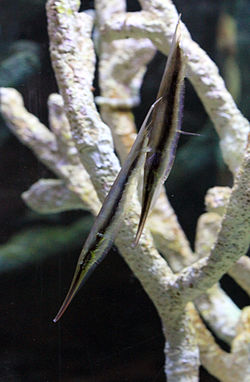
Picture of Aeoliscus
- Source
- Wikipedia/Commons
- Credit
- Karelj
- Licence
- CC BY-SA 3.0
- Commercial use
- the licence allows it
No 3D scan of Aeoliscus was found in Sketchfab.
Smithsonian Open Access and MorphoSource were not reached for this taxon, so this list is what the others held rather than everything there is.
The description on this site
- Source
- Wikipedia, “Aeoliscus”
- Licence
- CC BY-SA 4.0
This is what the site found, which is not the same as what exists.
Keep going
What may have been alongside itCentriscidae through timeFormations of the OligoceneThe world it lived on
Occurrence data from the Paleobiology Database, CC BY 4.0. Jordan and Starks 1902