Aethia pygmaea
The whiskered auklet is a small seabird of the auk family. It has a more restricted range than other members of its genus, Aethia, living only around the Aleutian Islands and on some islands off Siberia, and breeding on these islands. It is one of the smallest alcids, only the closely related least auklet being smaller. Its name is derived from the long white feathers on its face that are part of its breeding plumage.

Mckenzie Mudge/US Fish and Wildlife Service · Public Domain · via Wikipedia/Commons. May be a photograph of a specimen, or an artist’s reconstruction — an interpretation of a skeleton, since colour and soft tissue are almost never preserved.
On record
Recorded, not inferred- Also called
- whiskered aukletPBDB
- Sits inside
- AethiaPBDB
- Diet
- carnivorePBDB, for Coelurosauria
- Life habit
- ground dwelling, solitaryPBDB, for Theropoda
- Motility
- actively mobilePBDB, for Theropoda
- Environment
- marinePBDB, for Charadriiformes
Time the record covers
At most 12 thousand years on record.
Every occurrence read is dated to somewhere between 11.7 ka and 0 Mya, and nothing in the dating separates them, so that window is what the record shows rather than a span.
2 occurrences of Aethia pygmaea on record, most of them in the Holocene. The Paleobiology Database records this as a living group. Bar height is expected occurrences, not a count: each fossil is spread across the span it is dated to, so a tall narrow bar means tight dating and a low wide one means loose.
When
2 occurrences- Holocene100%
These are dates about fossils, not the animal: the record can only begin after it arose and end before it died out, so either end may reach further. Shares are expected occurrences: a fossil dated to a span is counted partly in each period it straddles. More on what this infers.
Aethia pygmaea and its relatives
HoloceneWhere Aethia pygmaea and its relatives were recorded in the Holocene.
Found in the same rock
25 taxa- Aethia cristatella2 sites
- Aethia psittacula2 sites
- Aethia pusilla2 sites
- Branta canadensis2 sites
- Cerorhinca monocerata2 sites
- Fratercula cirrhata2 sites
- Fratercula corniculata2 sites
- Hydrobates leucorhous2 sites
- Larus hyperboreus2 sites
- Phalacrocorax2 sites
- Phoebastria albatrus2 sites
- Ptychoramphus aleuticus2 sites
- Synthliboramphus antiquus2 sites
- Brachyramphus1 site
- Cepphus columba1 site
- Eumetopias jubatus1 site
- Fratercula1 site
- Fulmarus glacialis1 site
- Larus1 site
- Larus glaucescens1 site
- Melospiza melodia1 site
- Rissa brevirostris1 site
- Uria1 site
- Uria aalge1 site
The Paleobiology Database records 2 sites for Aethia pygmaea, and this reads all of them. The number is how many of those sites it was catalogued from too. The 24 sharing the most are listed.
This is not a list of everything alive at the time. It is only what has come out of the same ground as this animal and been written down.
Entered from
1 referenceEach of the 2 occurrences read was entered from one of these publications, ordered by how many each accounts for. This is not a search for papers mentioning the name. Each entry links to the Paleobiology Database's own record for the work.
Media and terms
Media content2
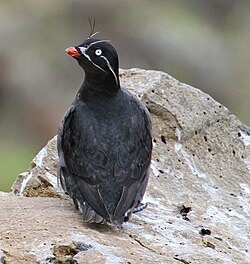
Picture of Aethia pygmaea
- Source
- Wikipedia/Commons
- Credit
- Mckenzie Mudge/US Fish and Wildlife Service
- Licence
- Public Domain
- Commercial use
- the licence allows it
Structured light scan
- Source
- MorphoSource
- Credit
- NMNH - Division of Birds
- Licence
- In Copyright
- Commercial use
- cannot be read from the licence given — check the record
- Specimen
- Aethia pygmaea · USNM:BIRDS:USNM 344544
Smithsonian Open Access was not reached for this taxon, so this list is what the others held rather than everything there is.
The description on this site
- Licence
- CC BY-SA 4.0
This is what the site found, which is not the same as what exists.
Keep going
What may have been alongside itAethia through timeFormations of the HoloceneThe world it lived on
Occurrence data from the Paleobiology Database, CC BY 4.0. (Gmelin 1789)