Allopleuron
Allopleuron is a genus of extinct sea turtle, which measured 2-to-2.5-metre long in life. The type species is Allopleuron hofmanni. It is a basal member of the clade Pancheloniidae, closely related to Protosphargis. Similar to Protosphargis, it was characterized by shell reduction.

Metalerke · CC BY 3.0 · via Wikipedia/Commons. May be a photograph of a specimen, or an artist’s reconstruction — an interpretation of a skeleton, since colour and soft tissue are almost never preserved.
On record
Recorded, not inferred- Sits inside
- CheloniidaePBDB
- Diet
- omnivorePBDB, for Cryptodira
- Life habit
- aquaticPBDB, for Cryptodira
- Motility
- actively mobilePBDB, for Osteichthyes
- Environment
- marinePBDB, for Chelonioidea
Time the record covers
At least 55 million years on record.
The record covers at least 89.8 Mya to 33.9 Mya. No occurrence read is dated outside 93.9 Mya to 27.3 Mya.
9 occurrences of Allopleuron on record, most of them in the Late Cretaceous. Bar height is expected occurrences, not a count: each fossil is spread across the span it is dated to, so a tall narrow bar means tight dating and a low wide one means loose.
When
9 occurrences- Late Cretaceous56%
- Eocene22%
- Oligocene22%
These are dates about fossils, not the animal: the record can only begin after it arose and end before it died out, so either end may reach further. Shares are expected occurrences: a fossil dated to a span is counted partly in each period it straddles. More on what this infers.
Found in
5 formations
Loading coastlines…
The named rock units Allopleuron has been recovered from, largest first. Drawn where the rock is now, not where it formed. 3 occurrences have no formation on record, which is common for older literature.
Allopleuron and its relatives
Late CretaceousWhere Allopleuron and its relatives were recorded in the Late Cretaceous.
Found in the same rock
198 taxa- Cardiotaxis2 sites
- Clidastes2 sites
- Dugongidae2 sites
- Echinocorys2 sites
- Hemiaster2 sites
- Isomicraster2 sites
- Micraster2 sites
- Micraster glyphus2 sites
- Palaeophis nessovi2 sites
- Aetomylaeus striatus1 site
- Almerarhynchia kunradensis1 site
- Amphilectella piriformis1 site
- Amphithelion (Amphithelion) macrommata1 site
- Amphithelion cupula1 site
- Anatina millepunctata1 site
- Annuntidiogenes sunuciorum1 site
- Anomotherium langewieschei1 site
- Anthracotherium1 site
- Aphrocallistes alveolites1 site
- Aphrocallistes cylindrodactylus1 site
- Apterodon intermedius1 site
- Arca geulemensis1 site
- Astrocladia subramosa1 site
- Aulaxinia melo1 site
The Paleobiology Database records 9 sites for Allopleuron, and this reads all of them. The number is how many of those sites it was catalogued from too. The 24 sharing the most are listed.
This is not a list of everything alive at the time. It is only what has come out of the same ground as this animal and been written down.
Entered from
5 references- New materials of the giant sea turtle Allopleuron (Testudines: Chelonioidea) from the marine Late Cretaceous of Central Europe and the Palaeogene of Kazakhstan4
- The fossil reptiles (Reptilia: Chelonii, Crocodylia) from the marine early Oligocene of the Weisselster Basin (Central Germany: Saxonia)2
- Meeresschildkröten (Cheloniidae) aus dem Campan von Hannover1
- New Data on the Morphology and Systematic Position of the Sea Turtle Allopleuron qazaqstanense Karl et al. from the Middle Eocene of Kazakhstan1
- Le Megalosaurus dans la Craie supérieure du Limbourg [Megalosaurus in the upper Chalk of Limburg]1
Each of the 9 occurrences read was entered from one of these publications, ordered by how many each accounts for. This is not a search for papers mentioning the name. Entries link to doi.org where the Paleobiology Database holds an identifier, and to its own record where it does not. Relayed as the Paleobiology Database holds them, not checked against what they resolve to.
Media and terms
Media content2
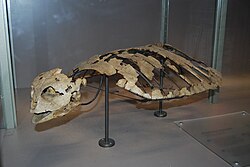
Picture of Allopleuron
- Source
- Wikipedia/Commons
- Credit
- Metalerke
- Licence
- CC BY 3.0
- Commercial use
- the licence allows it
CT scan
- Source
- MorphoSource
- Licence
- not stated by the source
- Commercial use
- cannot be read from the licence given — check the record
- Specimen
- Allopleuron sp. · nhmuk:PV R4213
Smithsonian Open Access was not reached for this taxon, so this list is what the others held rather than everything there is.
The description on this site
- Source
- Wikipedia, “Allopleuron”
- Licence
- CC BY-SA 4.0
This is what the site found, which is not the same as what exists.
Keep going
What may have been alongside itCheloniidae through timeFormations of the Late CretaceousThe world it lived on
Occurrence data from the Paleobiology Database, CC BY 4.0. Baur 1888