Micraster
Micraster is an extinct genus of echinoids from the Late Cretaceous to the early Eocene. Its remains have been found in Africa, Antarctica, Europe, and North America. Micraster was an infaunal echinoid living in a burrow below the sediment surface. The test is clearly bilateral and there is a deep anterior groove to take in water containing organic particles to the mouth. The tube feet keep a supply of nutrient-laden water moving into the burrow. The anus has a waste tube behind it.

Francisco Ruiz · CC BY-SA 4.0 · via Wikipedia/Commons. May be a photograph of a specimen, or an artist’s reconstruction — an interpretation of a skeleton, since colour and soft tissue are almost never preserved.
On record
Recorded, not inferred- Sits inside
- MicrasteridaePBDB
- Diet
- deposit feeder, detritivorePBDB, for Spatangoida
- Life habit
- shallow infaunalPBDB, for Spatangoida
- Motility
- slow-movingPBDB, for Spatangoida
- Vision
- limitedPBDB, for Echinoidea
- Environment
- marinePBDB, for Spatangoida
Time the record covers
At least 34 million years on record.
The record covers at least 93.9 Mya to 59.24 Mya. No occurrence read is dated outside 143.1 Mya to 56 Mya.
192 occurrences of Micraster on record, most of them in the Late Cretaceous. Bar height is expected occurrences, not a count: each fossil is spread across the span it is dated to, so a tall narrow bar means tight dating and a low wide one means loose.
When
192 occurrences- Early Cretaceousunder 1%
- Late Cretaceous98%
- Paleocene2%
These are dates about fossils, not the animal: the record can only begin after it arose and end before it died out, so either end may reach further. Shares are expected occurrences: a fossil dated to a span is counted partly in each period it straddles. More on what this infers.
Found in
32 formations
- Olazagutia Formation51
- Ahlen Formation16
- Lewes Nodular Chalk Formation7
- Saratoga Chalk Formation · Navarro Group6
- Gulpen Formation4
- El Zadorra Formation4
Loading coastlines…
The named rock units Micraster has been recovered from, largest first. Drawn where the rock is now, not where it formed. 8 further formations hold fewer occurrences each and are not listed. 65 occurrences have no formation on record, which is common for older literature.
Micraster and its relatives
Late CretaceousWhere Micraster and its relatives were recorded in the Late Cretaceous.
Found in the same rock
845 taxa- Belemnitella mucronata18 sites
- Cardiaster18 sites
- Porifera18 sites
- Echinocorys ovatus17 sites
- Hoploscaphites17 sites
- Cataceramus balticus16 sites
- Echinocorys13 sites
- Inoceramus13 sites
- Pachydiscus13 sites
- Hemiaster11 sites
- Hemiaster wetherbyi11 sites
- Inoceramus striatoconcentricus carpathicus10 sites
- Serpula9 sites
- Baculites vertebralis7 sites
- Inoceramus costellatus costellatus7 sites
- Pycnodonte7 sites
- Echinocorys gravesi6 sites
- Eutrephoceras darupense6 sites
- Inoceramus costellatus longealatus6 sites
- Amphithelion (Amphithelion) macrommata5 sites
- Bourgueticrinus ellipticus5 sites
- Cardiotaxis5 sites
- Cremnoceramus deformis erectus5 sites
- Cremnoceramus rotundatus5 sites
The Paleobiology Database records 156 sites for Micraster, and this reads all of them. The number is how many of those sites it was catalogued from too. The 24 sharing the most are listed.
This is not a list of everything alive at the time. It is only what has come out of the same ground as this animal and been written down.
Entered from
37 references- Macrofauna of the Cantera de Margas section, Olazagutia: Coniacian/Santonian boundary, Navarro-Cantabrian Basin, northern Spain55
- Die Oberkreide der Sack-Mulde bei Alfeld (Cenoman-Unter-Coniac) Lithologie, Biostratigraphie und Inoceramen21
- Coniacian-Maastrichtian of the Tremp Area (South Central Pyrenees)17
- Die Großfauna der Mukronatenkreide (unteres Obercampan) im östlichen Münsterland16
- American Upper Cretaceous Echinoidea15
- Djabarov, 196411
- The macrofossil biostratigraphy of the Turonian and Coniacian (Upper Cretaceous, Chalk Group) of southeast Devon7
- Rare Campanian echinoids from the Höver and Misburg (Hannover area, Lower Saxony, Germany)5
- Late Cretaceous-Early Paleocene echinoderms and the K/T boundary in the southeast Netherlands and the northeast Belgium. - part 4: Echinoids4
- Santonian (Late Cretaceous) echinoids from the Santander area (northern Cantabria, Spain)3
- Additional records of Late Cretaceous and Early Paleogene echinoids from the Gschliefgraben (Ultrahelvetic, Upper Austria)3
- Upper Cretaceous invertebrate fossils from the area northeast of Abu Zuneima, Sinai, Egypt3
Each of the 192 occurrences read was entered from one of these publications, ordered by how many each accounts for. This is not a search for papers mentioning the name. 25 further references are not listed. Entries link to doi.org where the Paleobiology Database holds an identifier, and to its own record where it does not. Relayed as the Paleobiology Database holds them, not checked against what they resolve to.
Media and terms
Media content2

Picture of Micraster
- Source
- Wikipedia/Commons
- Credit
- Francisco Ruiz
- Licence
- CC BY-SA 4.0
- Commercial use
- the licence allows it
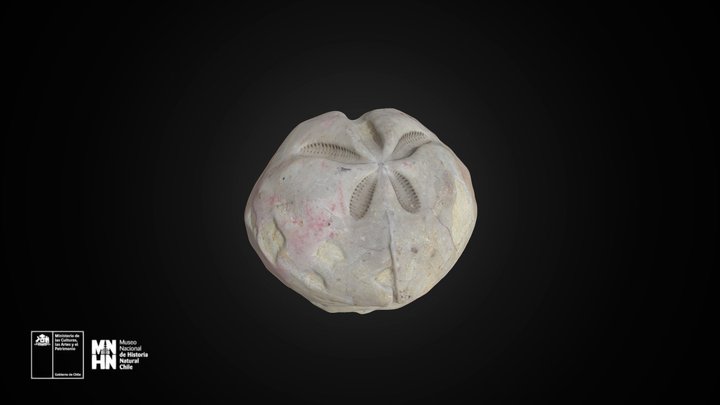
3D model
- Source
- Sketchfab
- Licence
- CC Attribution
- Commercial use
- cannot be read from the licence given — check the record
Smithsonian Open Access and MorphoSource were not reached for this taxon, so this list is what the others held rather than everything there is.
The description on this site
- Source
- Wikipedia, “Micraster”
- Licence
- CC BY-SA 4.0
This is what the site found, which is not the same as what exists.
Keep going
What may have been alongside itMicrasteridae through timeFormations of the Late CretaceousThe world it lived on
Occurrence data from the Paleobiology Database, CC BY 4.0. Agassiz 1836