Altica
Altica is a large genus of flea beetles in the subfamily Galerucinae, with about 300 species, distributed nearly worldwide. The genus is best represented in the Neotropical realm, well represented in the Nearctic and Palearctic, but occurs also in the Afrotropic, Indomalaya, and Australasia. The species are similar to each other, small metallic blue-green-bronze beetles, often distinguished from each other only by the aedeagus. The species of Altica, both as larvae and as adults, are phytophagous, feeding on plant foliage of various food plant taxa, specific for each Altica species. Onagraceae and Rosaceae are the dominant host plant families for Holarctic species. The adult Altica beetles are able to jump away when approached.

Uncredited · Attribution · via Wikipedia/Commons. May be a photograph of a specimen, or an artist’s reconstruction — an interpretation of a skeleton, since colour and soft tissue are almost never preserved.
On record
Recorded, not inferred- Sits inside
- AlticiniPBDB
- Motility
- actively mobilePBDB, for Arthropoda
- Environment
- terrestrialPBDB, for Insecta
Time the record covers
At least 59 million years on record.
The record covers at least 59.24 Mya to 129 ka. No occurrence read is dated outside 61.66 Mya to 11.7 ka.
8 occurrences of Altica on record, most of them in the Pleistocene. The Paleobiology Database records this as a living group. Bar height is expected occurrences, not a count: each fossil is spread across the span it is dated to, so a tall narrow bar means tight dating and a low wide one means loose.
When
8 occurrences- Paleocene13%
- Eocene13%
- Oligocene25%
- Miocene13%
- Pleistocene38%
These are dates about fossils, not the animal: the record can only begin after it arose and end before it died out, so either end may reach further. Shares are expected occurrences: a fossil dated to a span is counted partly in each period it straddles. More on what this infers.
Found in
5 formations
- Olympia beds Formation2
- Menat Formation1
- Florissant Formation1
- Shanwang Formation1
- Highbury Silts and Sands Formation1
Loading coastlines…
The named rock units Altica has been recovered from, largest first. Drawn where the rock is now, not where it formed. 2 occurrences have no formation on record, which is common for older literature.
Altica and its relatives
PleistoceneWhere Altica and its relatives were recorded in the Pleistocene.
Found in the same rock
456 taxa- Helophorus3 sites
- Sitona3 sites
- Stenus3 sites
- Acidota crenata2 sites
- Aegialia lacustris2 sites
- Agonum (Europhilus)2 sites
- Aphodiinae2 sites
- Apion2 sites
- Apionini2 sites
- Bembidion2 sites
- Bembidion (Asioperyphus) bimaculatum2 sites
- Bembidion (Bracteon) inaequale2 sites
- Bembidion (Notaphus) nigripes2 sites
- Bledius2 sites
- Bracon praeteritus2 sites
- Byrrhus2 sites
- Carabus (Tanaocarabus) taedatus2 sites
- Catops2 sites
- Chironomidae2 sites
- Coleoptera2 sites
- Colymbetes2 sites
- Cydnus armiger2 sites
- Cytilus2 sites
- Diapterna hamata2 sites
The Paleobiology Database records 7 sites for Altica, and this reads all of them. The number is how many of those sites it was catalogued from too. The 24 sharing the most are listed.
This is not a list of everything alive at the time. It is only what has come out of the same ground as this animal and been written down.
Entered from
6 references- The paleoenvironment of the Olympia beds based on fossil beetles from Discovery Park, Seattle, Washington, U.S.A.2
- Die Insekten der "Plattigen Steinmergels" von Brunstatt2
- Marine Isotope Stage 9 environments of fluvial deposits at Hackney, north London, UK1
- Zhang et al., 19941
- Piton, 19401
- New Miocene Coleoptera from Florissant1
Each of the 8 occurrences read was entered from one of these publications, ordered by how many each accounts for. This is not a search for papers mentioning the name. Entries link to doi.org where the Paleobiology Database holds an identifier, and to its own record where it does not. Relayed as the Paleobiology Database holds them, not checked against what they resolve to.
Media and terms
Media content1
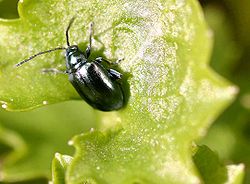
Picture of Altica
- Source
- Wikipedia/Commons
- Credit
- nobody named on the record
- Licence
- Attribution
- Commercial use
- cannot be read from the licence given — check the record
No 3D scan of Altica was found in Sketchfab.
Smithsonian Open Access and MorphoSource were not reached for this taxon, so this list is what the others held rather than everything there is.
The description on this site
- Source
- Wikipedia, “Altica”
- Licence
- CC BY-SA 4.0
This is what the site found, which is not the same as what exists.
Keep going
What may have been alongside itAlticini through timeFormations of the PleistoceneThe world it lived on
Occurrence data from the Paleobiology Database, CC BY 4.0. Geoffroy 1762