Alytes
Midwife toads are a genus (Alytes) of frogs in the family Alytidae, and are found in most of Continental Europe and Northwestern Africa. It has also been introduced to Great Britain. Characteristic of these toad-like frogs is their parental care; the males carry a string of fertilised eggs on their backs, hence the name "midwife". The female expels a strand of eggs, which the male fertilizes externally. He then wraps them around his legs to protect them from predators in the water. When they are ready to hatch, the male wades into shallow water, where he allows the tadpoles to leap out of their eggs. Five separate species of midwife toads are found across western Europe, northern Africa, and Mallorca.

Christian Fischer · CC BY-SA 3.0 · via Wikipedia/Commons. May be a photograph of a specimen, or an artist’s reconstruction — an interpretation of a skeleton, since colour and soft tissue are almost never preserved.
On record
Recorded, not inferred- Also called
- midwife toadPBDB
- Sits inside
- DiscoglossidaePBDB
- Diet
- carnivorePBDB, for Temnospondyli
- Life habit
- amphibiousPBDB, for Temnospondyli
- Motility
- actively mobilePBDB, for Temnospondyli
- Environment
- brackish,freshwater,terrestrialPBDB, for Tetrapoda
Time the record covers
At least 645 thousand years on record.
The record covers at least 774 ka to 129 ka. No occurrence read is dated outside 3.6 Mya to 11.7 ka.
18 occurrences of Alytes on record, most of them in the Pleistocene. The Paleobiology Database records this as a living group. Bar height is expected occurrences, not a count: each fossil is spread across the span it is dated to, so a tall narrow bar means tight dating and a low wide one means loose.
When
18 occurrences- Pliocene2%
- Pleistocene98%
These are dates about fossils, not the animal: the record can only begin after it arose and end before it died out, so either end may reach further. Shares are expected occurrences: a fossil dated to a span is counted partly in each period it straddles. More on what this infers.
Alytes and its relatives
PleistoceneWhere Alytes and its relatives were recorded in the Pleistocene.
Found in the same rock
184 taxa- Bufo bufo15 sites
- Lacertidae9 sites
- Bufo calamita8 sites
- Anguis fragilis7 sites
- Lacerta7 sites
- Pelodytes punctatus7 sites
- Pliomys7 sites
- Rana7 sites
- Rhinechis scalaris7 sites
- Microtus6 sites
- Allocricetus5 sites
- Apodemus5 sites
- Coronella austriaca5 sites
- Hyla arborea5 sites
- Natrix maura5 sites
- Natrix natrix5 sites
- Pelobates cultripes5 sites
- Pelophylax5 sites
- Rana temporaria5 sites
- Bison4 sites
- Coronella girondica4 sites
- Equus4 sites
- Microtus (Iberomys)4 sites
- Salamandra salamandra4 sites
The Paleobiology Database records 18 sites for Alytes, and this reads all of them. The number is how many of those sites it was catalogued from too. The 24 sharing the most are listed.
This is not a list of everything alive at the time. It is only what has come out of the same ground as this animal and been written down.
Entered from
9 references- Pleistocene Amphibians and Reptiles in Britain and Europe6
- Long-term climate record inferred from early-middle Pleistocene amphibian and squamate reptile assemblages at the Gran Dolina Cave, Atapuerca, Spain5
- Amphibians and reptiles as palaeonvironmental proxies during the Late Pleistocene (MIS3): The case of Stratigraphic Unit V of El Salt, Alcoi, Spain1
- Amphibians and squamate reptiles from the stratigraphic unit Xb of El Salt (Middle Palaeolithic; Alcoy, Spain): palaeoenvironmental and palaeoclimatic implications1
- Paleoenvironmental and paleoclimatic approach to the upper Pleistocene site of Artazu VII (Arrasate, northern Iberian Peninsula) using small vertebrates1
- A very diverse amphibian and reptile assemblage from the late Middle Pleistocene of the Sierra de Atapuerca (Sima del Elefante, Burgos, Northwestern Spain)1
- A New Species of Water Vole from the Early Pleistocene of Southern Europe1
- A new species of Pica (Aves: Corvidae) from the Plio-Pleistocene of Mallorca, Balearic Islands (Western Mediterranean).1
- Descubrimiento de dos yacimientos del Pleistoceno medio en el karst de la Sierra Alfaguara (Granada). Sintesis estratigraphica de este periodo en la region Betica1
Each of the 18 occurrences read was entered from one of these publications, ordered by how many each accounts for. This is not a search for papers mentioning the name. Entries link to doi.org where the Paleobiology Database holds an identifier, and to its own record where it does not. Relayed as the Paleobiology Database holds them, not checked against what they resolve to.
Media and terms
Media content3

Picture of Alytes
- Source
- Wikipedia/Commons
- Credit
- Christian Fischer
- Licence
- CC BY-SA 3.0
- Commercial use
- the licence allows it
CT scan
- Source
- MorphoSource
- Credit
- CAS Herpetology (HERP)
- Licence
- In Copyright
- Commercial use
- cannot be read from the licence given — check the record
- Specimen
- Alytes obstetricans · CAS:SUA:21691
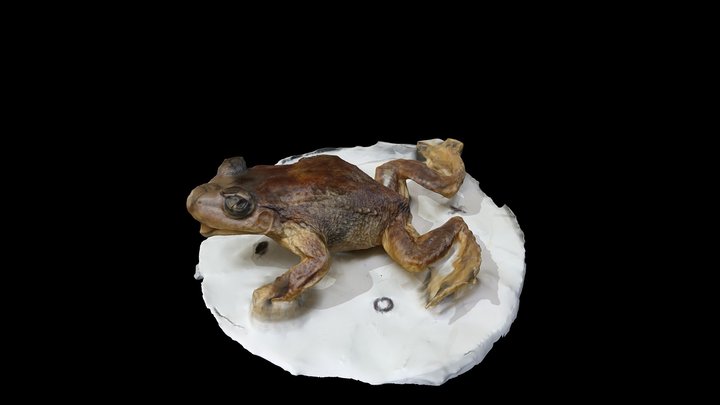
3D model
- Source
- Sketchfab
- Credit
- 3DVirtualHerp
- Licence
- CC Attribution
- Commercial use
- cannot be read from the licence given — check the record
Smithsonian Open Access was not reached for this taxon, so this list is what the others held rather than everything there is.
The description on this site
- Licence
- CC BY-SA 4.0
This is what the site found, which is not the same as what exists.
Keep going
What may have been alongside itDiscoglossidae through timeFormations of the PleistoceneThe world it lived on
Occurrence data from the Paleobiology Database, CC BY 4.0. Wagler 1829