Bufo bufo
The common toad, also known as European toad or simply the toad in Anglophone parts of Europe, is a toad found throughout most of Europe, western North Asia and a small part of Northwest Africa. It belongs to a group of closely related species descended from a common ancestral line of toads and forming a species complex. The toad is an inconspicuous animal, usually lying hidden during the day. It becomes active at dusk, hunting the invertebrates on which it feeds at night. It moves with a slow, ungainly walk or by jumping short distances, and has greyish-brown skin covered with wart-like lumps.

Tythatguy1312 · CC BY-SA 4.0 · via Wikipedia/Commons. May be a photograph of a specimen, or an artist’s reconstruction — an interpretation of a skeleton, since colour and soft tissue are almost never preserved.
On record
Recorded, not inferred- Sits inside
- BufoPBDB
- Diet
- carnivorePBDB, for Temnospondyli
- Life habit
- amphibiousPBDB, for Temnospondyli
- Motility
- actively mobilePBDB, for Temnospondyli
- Environment
- brackish,freshwater,terrestrialPBDB, for Tetrapoda
Time the record covers
At least 7.8 million years on record.
The record covers at least 7.9 Mya to 11.7 ka. No occurrence read is dated outside 8.725 Mya to 0 Mya.
95 occurrences of Bufo bufo on record, most of them in the Pleistocene. The Paleobiology Database records this as a living group. Bar height is expected occurrences, not a count: each fossil is spread across the span it is dated to, so a tall narrow bar means tight dating and a low wide one means loose.
When
95 occurrences- Miocene1%
- Pliocene7%
- Pleistocene86%
- Holocene6%
These are dates about fossils, not the animal: the record can only begin after it arose and end before it died out, so either end may reach further. Shares are expected occurrences: a fossil dated to a span is counted partly in each period it straddles. More on what this infers.
Found in
2 formations
Loading coastlines…
The named rock units Bufo bufo has been recovered from, largest first. Drawn where the rock is now, not where it formed. 92 occurrences have no formation on record, which is common for older literature.
Bufo bufo and its relatives
PleistoceneWhere Bufo bufo and its relatives were recorded in the Pleistocene.
Found in the same rock
718 taxa- Rana44 sites
- Rana temporaria40 sites
- Anguis fragilis34 sites
- Lacerta31 sites
- Natrix natrix30 sites
- Bufo calamita23 sites
- Coronella austriaca17 sites
- Equus17 sites
- Lacertidae17 sites
- Emys orbicularis16 sites
- Anura14 sites
- Vipera14 sites
- Apodemus13 sites
- Natrix13 sites
- Natrix maura13 sites
- Pelodytes punctatus13 sites
- Triturus13 sites
- Alytes obstetricans12 sites
- Hyla arborea12 sites
- Pelobates12 sites
- Pliomys12 sites
- Vipera (Pelias) berus12 sites
- Microtus11 sites
- Triturus vulgaris11 sites
The Paleobiology Database records 93 sites for Bufo bufo, and this reads all of them. The number is how many of those sites it was catalogued from too. The 24 sharing the most are listed.
This is not a list of everything alive at the time. It is only what has come out of the same ground as this animal and been written down.
Entered from
30 references- Pleistocene Amphibians and Reptiles in Britain and Europe59
- Long-term climate record inferred from early-middle Pleistocene amphibian and squamate reptile assemblages at the Gran Dolina Cave, Atapuerca, Spain5
- Trapped in a roman well: amphibians and reptiles from Tenuta Zuccarello near Marcon, Venice, Italy2
- A very diverse amphibian and reptile assemblage from the late Middle Pleistocene of the Sierra de Atapuerca (Sima del Elefante, Burgos, Northwestern Spain)2
- Anurans and squamates from the Lower Pliocene (MN 14) Osztramos 1 locality (Northern Hungary)2
- Fossil amphibians and reptiles from Tegelen (Province of Limburg) and the early Pleistocene palaeoclimate of The Netherlands1
- The Early Pleistocene herpetofauna of Rivoli Veronese (Northern Italy) as evidence for humid and forested glacial phases in the Gelasian of Southern Alps1
- Canis othmanii sp. nov. (Carnivora, Canidae) from the early Middle Pleistocene site of Wadi Sarrat (Tunisia)1
- Amphibians and squamate reptiles from the stratigraphic unit Xb of El Salt (Middle Palaeolithic; Alcoy, Spain): palaeoenvironmental and palaeoclimatic implications1
- Paleoenvironmental and paleoclimatic approach to the upper Pleistocene site of Artazu VII (Arrasate, northern Iberian Peninsula) using small vertebrates1
- Middle to Late Pleistocene herpetofauna from Scladina and Sous-Saint-Paul caves (Namur, Belgium)1
- New Neanderthal remains from Mani peninsula, Southern Greece: The Kalamakia Middle Paleolithic cave site1
Each of the 95 occurrences read was entered from one of these publications, ordered by how many each accounts for. This is not a search for papers mentioning the name. 18 further references are not listed. Entries link to doi.org where the Paleobiology Database holds an identifier, and to its own record where it does not. Relayed as the Paleobiology Database holds them, not checked against what they resolve to.
Media and terms
Media content3

Picture of Bufo bufo
- Source
- Wikipedia/Commons
- Credit
- Tythatguy1312
- Licence
- CC BY-SA 4.0
- Commercial use
- the licence allows it

CT scan
- Source
- MorphoSource
- Licence
- not stated by the source
- Commercial use
- cannot be read from the licence given — check the record
- Specimen
- Bufo bufo · L-LP
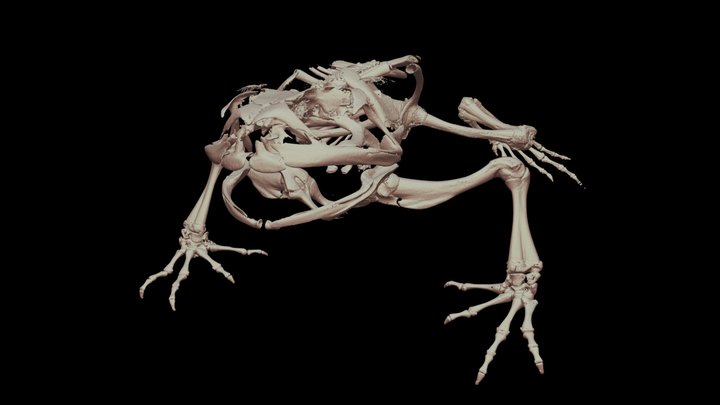
3D model
- Source
- Sketchfab
- Licence
- CC Attribution-NonCommercial-ShareAlike
- Commercial use
- the licence does not allow it
The description on this site
- Source
- Wikipedia, “Common toad”
- Licence
- CC BY-SA 4.0
This is what the site found, which is not the same as what exists.
Keep going
What may have been alongside itBufo through timeFormations of the PleistoceneThe world it lived on
Occurrence data from the Paleobiology Database, CC BY 4.0. (Linnaeus 1758)