Amaltheus
Searched as Amaltheus stokesi typica. The Paleobiology Database treats Amaltheus as the accepted name.
Amaltheus is an oxyconic ammonite with a fairly open umbilicus, serrated keel, and slightly sigmoidal ribs from the Lower Jurassic, many of which are strigate. Amaltheus, named by de Montfort, 1808, is indicative of the upper Pliensbachian stage in Europe, north Africa, Caucasus, Siberia, N. Alaska, Canada, Oregon, and possibly Honduras; and is the type for the Amaltheidae and a member of the Eoderoceratoidea.

BerndH · CC BY-SA 3.0 · via Wikipedia/Commons. May be a photograph of a specimen, or an artist’s reconstruction — an interpretation of a skeleton, since colour and soft tissue are almost never preserved.
On record
Recorded, not inferred- Sits inside
- AmaltheinaePBDB
- Diet
- carnivorePBDB, for Ammonoidea
- Life habit
- nektonicPBDB, for Ammonoidea
- Motility
- fast-movingPBDB, for Ammonoidea
- Vision
- well-developedPBDB, for Cephalopoda
- Environment
- marinePBDB, for Cephalopoda
Time the record covers
At most 8.7 million years on record.
Every occurrence read is dated to somewhere between 192.9 Mya and 184.2 Mya, and nothing in the dating separates them, so that window is what the record shows rather than a span.
5 occurrences of Amaltheus on record, most of them in the Early Jurassic. Bar height is expected occurrences, not a count: each fossil is spread across the span it is dated to, so a tall narrow bar means tight dating and a low wide one means loose.
When
5 occurrences- Early Jurassic100%
These are dates about fossils, not the animal: the record can only begin after it arose and end before it died out, so either end may reach further. Shares are expected occurrences: a fossil dated to a span is counted partly in each period it straddles. More on what this infers.
Amaltheus and its relatives
Early JurassicWhere Amaltheus and its relatives were recorded in the Early Jurassic.
Found in the same rock
328 taxa- Lytoceras fimbriatum22 sites
- Calliphylloceras bicicolae16 sites
- Liparoceras (Becheiceras) gallicum16 sites
- Amauroceras ferrugineum13 sites
- Juraphyllites13 sites
- Protogrammoceras (Matteiceras) diornatum13 sites
- Arieticeras algovianum10 sites
- Juraphyllites (Harpophylloceras) eximius10 sites
- Lytoceras10 sites
- Phylloceras hebertinum10 sites
- Arieticeras9 sites
- Fuciniceras (Matteiceras) geometricum9 sites
- Juraphyllites libertus9 sites
- Partschiceras striatocostatum9 sites
- Phylloceratoidea9 sites
- Pleuroceras solare8 sites
- Pleuroceras spinatum8 sites
- Protogrammoceras (Matteiceras) isselioides8 sites
- Tragophylloceras loscombi8 sites
- Derolytoceras tortum7 sites
- Hantkeniceras hantkeni7 sites
- Harpoceratinae7 sites
- Phylloceras7 sites
- Bivalvia6 sites
The Paleobiology Database records 165 sites for Amaltheus, and this reads all of them. The number is how many of those sites it was catalogued from too. The 24 sharing the most are listed.
This is not a list of everything alive at the time. It is only what has come out of the same ground as this animal and been written down.
Entered from
1 referenceEach of the 5 occurrences read was entered from one of these publications, ordered by how many each accounts for. This is not a search for papers mentioning the name. Each entry links to doi.org. Relayed as the Paleobiology Database holds them, not checked against what they resolve to.
Media and terms
Media content2

Picture of Amaltheus
- Source
- Wikipedia/Commons
- Credit
- BerndH
- Licence
- CC BY-SA 3.0
- Commercial use
- the licence allows it
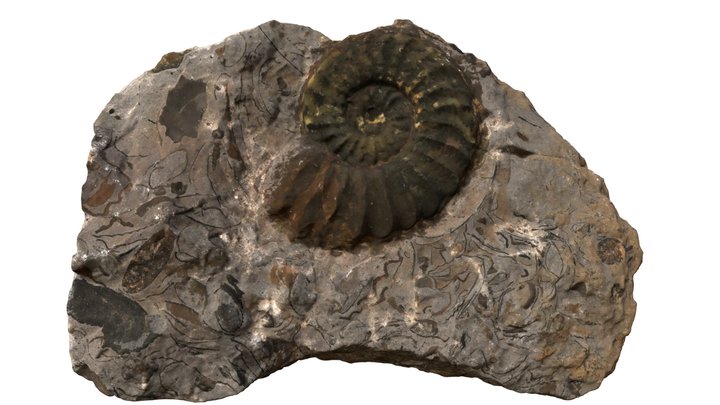
3D model
- Source
- Sketchfab
- Licence
- CC Attribution
- Commercial use
- cannot be read from the licence given — check the record
The description on this site
- Source
- Wikipedia, “Amaltheus”
- Licence
- CC BY-SA 4.0
This is what the site found, which is not the same as what exists.
Keep going
What may have been alongside itAmaltheinae through timeFormations of the Early JurassicThe world it lived on
Occurrence data from the Paleobiology Database, CC BY 4.0. (de Montfort 1808)