Amiopsis
Amiopsis is an extinct genus of freshwater and marine ray-finned fish belonging to the family Amiidae, making it closely related to the modern bowfin. Fossils are known from the Late Jurassic Solnhofen Limestone, Germany, the Early Cretaceous Purbeck Group, England, La Pedrera de Rúbies Formation, Spain and Bernnissant Iguanodon locality, Belgium and the Late Cretaceous (Cenomanian) of the Balkans. The monophyly of the genus is questionable, due to it being based on a single character, "the presence of three or more lateral fossae on each side of most abdominal centra". Remains previously assigned to this genus from the Early Cretaceous Las Hoyas, Spain have been moved into the new genus Hispanamia.

Ghedoghedo · CC BY-SA 3.0 · via Wikipedia/Commons. May be a photograph of a specimen, or an artist’s reconstruction — an interpretation of a skeleton, since colour and soft tissue are almost never preserved.
On record
Recorded, not inferred- Sits inside
- AmiopsinaePBDB
- Diet
- carnivore, piscivorePBDB, for Amiiformes
- Life habit
- nektobenthicPBDB, for Amiiformes
- Motility
- actively mobilePBDB, for Amiiformes
Time the record covers
At least 55 million years on record.
The record covers at least 145.06 Mya to 89.8 Mya. No occurrence read is dated outside 152.21 Mya to 83.6 Mya.
18 occurrences of Amiopsis on record, most of them in the Early Cretaceous. Bar height is expected occurrences, not a count: each fossil is spread across the span it is dated to, so a tall narrow bar means tight dating and a low wide one means loose.
When
18 occurrencesThese are dates about fossils, not the animal: the record can only begin after it arose and end before it died out, so either end may reach further. Shares are expected occurrences: a fossil dated to a span is counted partly in each period it straddles. More on what this infers.
Found in
8 formations
- Solnhofen Formation5
- La Huérguina Formation2
- Sainte-Barbe Clays Formation · Wealden Group2
- Grünsandstein Formation2
- Komen Limestone Formation1
- Weald Clay Formation · Wealden Group1
Loading coastlines…
The named rock units Amiopsis has been recovered from, largest first. Drawn where the rock is now, not where it formed. 3 occurrences have no formation on record, which is common for older literature.
Amiopsis and its relatives
Early CretaceousWhere Amiopsis and its relatives were recorded in the Early Cretaceous.
Found in the same rock
309 taxa- Aspidorhynchus ornatissimus3 sites
- Lepidotes3 sites
- Thrissops formosus3 sites
- Allothrissops mesogaster2 sites
- Allothrissops salmoneus2 sites
- Aspidorhynchus mandibularis2 sites
- Callipurbeckia notopterus2 sites
- Caturus2 sites
- Caturus furcatus2 sites
- Caturus pachyurus2 sites
- Leptolepis voithii2 sites
- Macromesodon2 sites
- Megalurus polyspondylus2 sites
- Ophiopsiella attenuata2 sites
- Ophiopsiella procera2 sites
- Ophiopsis muensteri2 sites
- Pholidophorus ovatus2 sites
- Pholidophorus radians2 sites
- Pleuropholis2 sites
- Propterus speciosus2 sites
- Ruffordia goepperti2 sites
- Theropoda2 sites
- Thrissops angustus2 sites
- Vidalamia catalunica2 sites
The Paleobiology Database records 13 sites for Amiopsis, and this reads all of them. The number is how many of those sites it was catalogued from too. The 24 sharing the most are listed.
This is not a list of everything alive at the time. It is only what has come out of the same ground as this animal and been written down.
Entered from
9 references- Monographie der fossilien Fische aus den Lithographischen Schiefern Bayerns6
- Amiopsis (Amiiformes, Osteichthyes) in the lower Cretaceous of Julian Pre-Alps (Udine, ne Italy)2
- An Early Cretaceous faunal and floral continental assemblage: Las Hoyas fossil site (Cuenca, Spain)2
- Les poissons wealdiens de Bernissart.2
- Figures and descriptions illustrative of British organic remains2
- Fauna and predator-prey relationships of Ettling, an actinopterygian fish-dominated Konservat-Lagerstätte from the Late Jurassic of Southern Germany1
- Noticia sobre los peces de la caliza litográfica de la provincia de Lérida (Cataluña)1
- Fosilne ribe Komena, Mrzleka, Hvara i M. Libanona uz dodatak o Oligocenskim ribama Tüffera, Zagora i Trifalja1
- Über einige fossile Fische aus den Kreide- und Tertiär- schichten von Comen und Podsused.1
Each of the 18 occurrences read was entered from one of these publications, ordered by how many each accounts for. This is not a search for papers mentioning the name. Entries link to doi.org where the Paleobiology Database holds an identifier, and to its own record where it does not. Relayed as the Paleobiology Database holds them, not checked against what they resolve to.
Media and terms
Media content1
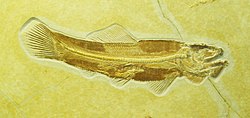
Picture of Amiopsis
- Source
- Wikipedia/Commons
- Credit
- Ghedoghedo
- Licence
- CC BY-SA 3.0
- Commercial use
- the licence allows it
No 3D scan of Amiopsis was found in MorphoSource and Sketchfab.
Smithsonian Open Access was not reached for this taxon, so this list is what the others held rather than everything there is.
The description on this site
- Source
- Wikipedia, “Amiopsis”
- Licence
- CC BY-SA 4.0
This is what the site found, which is not the same as what exists.
Keep going
What may have been alongside itAmiopsinae through timeFormations of the Early CretaceousThe world it lived on
Occurrence data from the Paleobiology Database, CC BY 4.0. Kner 1863