Ammonia
Ammonia is a genus of marine foraminifers. It is one of the most abundant foraminifer genera worldwide and is found in sheltered, shallow marine intertidal environments, sometimes in brackish waters.

Scott Fay · CC BY 2.5 · via Wikipedia/Commons. May be a photograph of a specimen, or an artist’s reconstruction — an interpretation of a skeleton, since colour and soft tissue are almost never preserved.
On record
Recorded, not inferred- Sits inside
- AmmoniinaePBDB
- Diet
- herbivorePBDB
- Life habit
- semi-infaunalPBDB, for Foraminifera
- Motility
- stationaryPBDB, for Rotaliina
- Environment
- outer shelf,marinePBDB, for Rotaliina
Time the record covers
At least 37 million years on record.
The record covers at least 37.71 Mya to 11.7 ka. No occurrence read is dated outside 56 Mya to 0 Mya.
243 occurrences of Ammonia on record, most of them in the Pleistocene. The Paleobiology Database records this as a living group. Bar height is expected occurrences, not a count: each fossil is spread across the span it is dated to, so a tall narrow bar means tight dating and a low wide one means loose.
When
243 occurrencesThese are dates about fossils, not the animal: the record can only begin after it arose and end before it died out, so either end may reach further. Shares are expected occurrences: a fossil dated to a span is counted partly in each period it straddles. More on what this infers.
Found in
32 formations
- Pebas Formation12
- Lithothamnion limestone Formation10
- Tortonian Limestone Formation5
- Cholan Formation4
- Acredale Formation4
- Canepatch Formation4
Loading coastlines…
The named rock units Ammonia has been recovered from, largest first. Drawn where the rock is now, not where it formed. 8 further formations hold fewer occurrences each and are not listed. 168 occurrences have no formation on record, which is common for older literature.
Ammonia and its relatives
PleistoceneWhere Ammonia and its relatives were recorded in the Pleistocene.
Found in the same rock
1,453 taxa- Elphidium90 sites
- Bulimina65 sites
- Brizalina60 sites
- Quinqueloculina58 sites
- Cibicides48 sites
- Cibicidoides40 sites
- Bolivina36 sites
- Amphistegina32 sites
- Foraminifera32 sites
- Lenticulina32 sites
- Uvigerina25 sites
- Asterigerina24 sites
- Bulimina marginata24 sites
- Textularia23 sites
- Lagena22 sites
- Melonis21 sites
- Amphistegina lessonii18 sites
- Bryozoa18 sites
- Discorbinella18 sites
- Nonionella18 sites
- Rosalina18 sites
- Cassidulina17 sites
- Globocassidulina17 sites
- Heterolepa17 sites
The Paleobiology Database records 181 sites for Ammonia, and this reads all of them. The number is how many of those sites it was catalogued from too. The 24 sharing the most are listed.
This is not a list of everything alive at the time. It is only what has come out of the same ground as this animal and been written down.
Entered from
70 references- Site U146223
- Site U138716
- Site U138813
- A 60-million-year Cenozoic history of western Amazonian ecosystems in Contamana, eastern Peru12
- Site U138611
- Middle Miocene warm-temperate carbonates of Central Paratethys (Mt. Zrinska Gora, Croatia): paleoenvironmental reconstruction based on bryozoans, coralline red algae, foraminifera, and calcareous nannoplankton10
- Ambergris cololites of Pleistocene sperm whales from central Italy and description of the new ichnogenus and ichnospecies Ambergrisichnus alleronae9
- The Paleocene-Eocene succession in the Guiana Basin9
- Site U14648
- Site U13897
- Paleoecology of Baripada beds (Middle Miocene), East Coast of India7
- Site U15176
Each of the 243 occurrences read was entered from one of these publications, ordered by how many each accounts for. This is not a search for papers mentioning the name. 58 further references are not listed. Entries link to doi.org where the Paleobiology Database holds an identifier, and to its own record where it does not. Relayed as the Paleobiology Database holds them, not checked against what they resolve to.
Media and terms
Media content2

Picture of Ammonia
- Source
- Wikipedia/Commons
- Credit
- Scott Fay
- Licence
- CC BY 2.5
- Commercial use
- the licence allows it
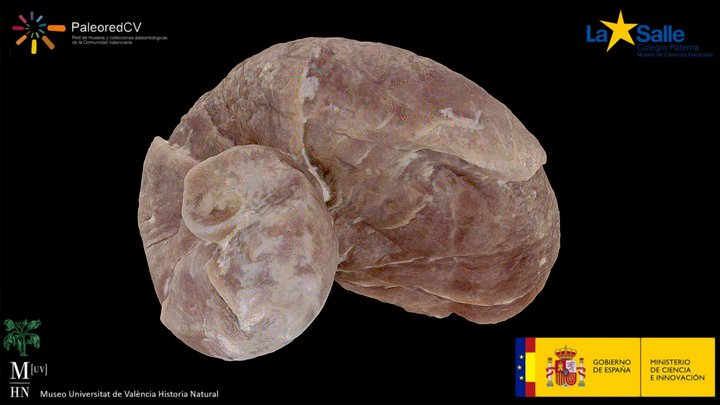
3D model
- Source
- Sketchfab
- Licence
- CC Attribution
- Commercial use
- cannot be read from the licence given — check the record
Smithsonian Open Access and MorphoSource were not reached for this taxon, so this list is what the others held rather than everything there is.
The description on this site
- Licence
- CC BY-SA 4.0
This is what the site found, which is not the same as what exists.
Keep going
What may have been alongside itAmmoniinae through timeFormations of the PleistoceneThe world it lived on
Occurrence data from the Paleobiology Database, CC BY 4.0. Bruennich 1772