Aphelognathus
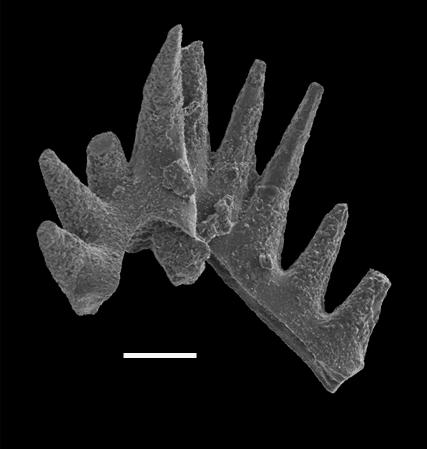
Männik, Peep · CC BY-NC 4.0 · via GBIF. May be a photograph of a specimen, or an artist’s reconstruction — an interpretation of a skeleton, since colour and soft tissue are almost never preserved.
On record
Recorded, not inferred- Sits inside
- PrioniodininaPBDB
- Diet
- carnivorePBDB, for Conodonta
- Life habit
- nektonicPBDB, for Conodonta
- Motility
- actively mobilePBDB, for Conodonta
- Vision
- well-developedPBDB, for Conodonta
Time the record covers
At least 14 million years on record.
The record covers at least 454 Mya to 439.4 Mya. No occurrence read is dated outside 458.2 Mya to 422.7 Mya.
108 occurrences of Aphelognathus on record, most of them in the Ordovician. Bar height is expected occurrences, not a count: each fossil is spread across the span it is dated to, so a tall narrow bar means tight dating and a low wide one means loose.
When
108 occurrences- Ordovician98%
- Silurian2%
These are dates about fossils, not the animal: the record can only begin after it arose and end before it died out, so either end may reach further. Shares are expected occurrences: a fossil dated to a span is counted partly in each period it straddles. More on what this infers.
Found in
27 formations
- Shiyanhe Formation35
- Ellis Bay Formation · Jolliet Group7
- Turesø Formation7
- Red Head Rapids Formation · Churchill River Group6
- White Head Formation4
- Vaureal Formation · Jolliet Group4
Loading coastlines…
The named rock units Aphelognathus has been recovered from, largest first. Drawn where the rock is now, not where it formed. 3 further formations hold fewer occurrences each and are not listed. 4 occurrences have no formation on record, which is common for older literature.
Aphelognathus and its relatives
OrdovicianWhere Aphelognathus and its relatives were recorded in the Ordovician.
Found in the same rock
285 taxa- Panderodus31 sites
- Drepanoistodus suberectus29 sites
- Panderodus gracilis20 sites
- Oulodus17 sites
- Phragmodus undatus17 sites
- Amorphognathus ordovicicus12 sites
- Panderodus unicostatus12 sites
- Pseudooneotodus beckmanni11 sites
- Belodina10 sites
- Panderodus feulneri9 sites
- Plectodina9 sites
- Walliserodus curvatus9 sites
- Gamachignathus8 sites
- Panderodus panderi8 sites
- Plegagnathus dartoni8 sites
- Rhipidognathus symmetricus7 sites
- Staufferella7 sites
- Belodina compressa6 sites
- Drepanoistodus6 sites
- Belodina confluens5 sites
- Paroistodus5 sites
- Phragmodus5 sites
- Rostricellula5 sites
- Amorphognathus4 sites
The Paleobiology Database records 53 sites for Aphelognathus, and this reads all of them. The number is how many of those sites it was catalogued from too. The 24 sharing the most are listed.
This is not a list of everything alive at the time. It is only what has come out of the same ground as this animal and been written down.
Entered from
22 references- Upper Ordovician conodont biostratigraphy and biofacies from the Sigang section, Neixiang, Henan, central China35
- Conodont biostratigraphy across the Ordovician-Silurian boundary, Ellis Bay Formation, Anticosti Island, Québec11
- Conodonts from the Upper Ordovician–lower Silurian carbonate platform of North Greenland9
- Late Ordovician- Early Silurian conodont biostratigraphy and thermal maturity, Hudson Bay Basin8
- Late Ordovician - Early Silurian conodont biostratigraphy of the Gaspé Peninsula - a preliminary report8
- Ordovician Sedimentary Basin and Paleobiotas of the Gorny Altai4
- New data on Ordovician–Silurian conodonts and stratigraphy from the Severnaya Zemlya Archipelago, Russian Arctic4
- Conodont paleontology and biostratigraphy of Ordovician carbonates and petroliferous carbonates on Southampton, Baffin, and Akpatok islands in the eastern Canadian Arctic4
- Restudy of conodonts (Late Ordovician – Early Silurian) from the Edgewood Group, Clarksville, Missouri4
- Stratigraphy and biostratigraphy of the Advance Formation, a new upper Middle Ordovician unit, northern Rocky Mountains, British Columbia3
- Conodonts from Ordovician-Silurian boundary strata, Whittaker Formation, Mackenzie Mountains, Northwest Territories3
- A major unconformity between Upper Ordovician and Lower Devonian strata in the Nanook Limestone, Shublik Mountains, northeastern Brooks Range3
Each of the 108 occurrences read was entered from one of these publications, ordered by how many each accounts for. This is not a search for papers mentioning the name. 10 further references are not listed. Entries link to doi.org where the Paleobiology Database holds an identifier, and to its own record where it does not. Relayed as the Paleobiology Database holds them, not checked against what they resolve to.
Media and terms
Media content1
Picture of Aphelognathus
- Source
- GBIF
- Credit
- Männik, Peep
- Licence
- CC BY-NC 4.0
- Commercial use
- the licence does not allow it
No 3D scan was found. Smithsonian Open Access, MorphoSource and Sketchfab were all searched.
This is what the site found, which is not the same as what exists.
Keep going
What may have been alongside itPrioniodinina through timeFormations of the OrdovicianThe world it lived on
Occurrence data from the Paleobiology Database, CC BY 4.0.