Amphora
Amphora is a major genus of marine and freshwater diatoms. With over 1000 species, it is one of the largest genera of diatoms. These diatoms are recognized by their strongly dorsiventral frustules, which means that their ridges lie close to the ventral margin of the valve, and their girdle is much wider on the dorsal side.

Uncredited · Public Domain · via Wikipedia/Commons. May be a photograph of a specimen, or an artist’s reconstruction — an interpretation of a skeleton, since colour and soft tissue are almost never preserved.
On record
Recorded, not inferred- Sits inside
- CatenulaceaePBDB
- Diet
- "photoautotroph"PBDB, for Bacillariophyceae
- Environment
- marine,brackish,freshwaterPBDB, for Bacillariophyceae
Time the record covers
At least 11 million years on record.
The record covers at least 11.63 Mya to 11.7 ka. No occurrence read is dated outside 13.82 Mya to 0 Mya.
13 occurrences of Amphora on record, most of them in the Pleistocene. The Paleobiology Database records this as a living group. Bar height is expected occurrences, not a count: each fossil is spread across the span it is dated to, so a tall narrow bar means tight dating and a low wide one means loose.
When
13 occurrences- Miocene8%
- Pliocene8%
- Pleistocene77%
- Holocene8%
These are dates about fossils, not the animal: the record can only begin after it arose and end before it died out, so either end may reach further. Shares are expected occurrences: a fossil dated to a span is counted partly in each period it straddles. More on what this infers.
Found in
2 formations
- Kelseyville Formation5
- Choptank Formation · Chesapeake Group1
Loading coastlines…
The named rock units Amphora has been recovered from, largest first. Drawn where the rock is now, not where it formed. 7 occurrences have no formation on record, which is common for older literature.
Amphora and its relatives
PleistoceneWhere Amphora and its relatives were recorded in the Pleistocene.
Found in the same rock
136 taxa- Fragilaria7 sites
- Cocconeis5 sites
- Actinocyclus4 sites
- Diploneis4 sites
- Paralia sulcata4 sites
- Thalassionema4 sites
- Thalassiosira4 sites
- Fragilariopsis3 sites
- Navicula3 sites
- Neodenticula3 sites
- Rhizosolenia3 sites
- Stephanodiscus3 sites
- Thalassiothrix longissima3 sites
- Actinocyclus ellipticus2 sites
- Actinocyclus octonarius2 sites
- Bacterosira2 sites
- Coscinodiscus marginatus2 sites
- Delphineis2 sites
- Melosira2 sites
- Nitzschia2 sites
- Paralia2 sites
- Porosira2 sites
- Stephanodiscus excentricus2 sites
- Abies balsamea1 site
The Paleobiology Database records 11 sites for Amphora, and this reads all of them. The number is how many of those sites it was catalogued from too. The 24 sharing the most are listed.
This is not a list of everything alive at the time. It is only what has come out of the same ground as this animal and been written down.
Entered from
8 references- Diatom biostratigraphy and the paleolimnology of Clear Lake, Lake County, California5
- Site U13442
- Site U14451
- Site U13451
- Regressions and transgressions of the Baltic Basin reflected by a new high-resolution deglacial and postglacial lithostratigraphy for Arkona Basin sediments (western Baltic Sea)1
- Biogeography of the Pliocene and Pleistocene vertebrate faunas of Northeastern California and their temporal significance to the development of the Modoc Plateau and Klamath Mountain Region1
- The Shelton Mastodon Site: Multidisciplinary study of a late Pleistocene (Twocreekan) locality in Southeastern Michigan1
- Miocene marine diatoms from the Choptank Formation, Calvert County, Maryland1
Each of the 13 occurrences read was entered from one of these publications, ordered by how many each accounts for. This is not a search for papers mentioning the name. Entries link to doi.org where the Paleobiology Database holds an identifier, and to its own record where it does not. Relayed as the Paleobiology Database holds them, not checked against what they resolve to.
Media and terms
Media content2

Picture of Amphora
- Source
- Wikipedia/Commons
- Credit
- nobody named on the record
- Licence
- Public Domain
- Commercial use
- the licence allows it
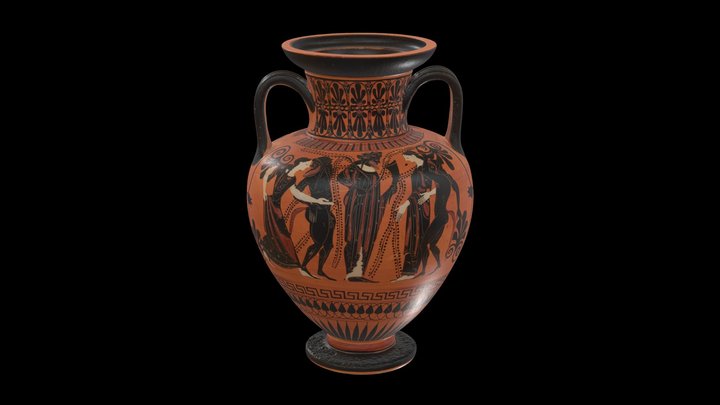
3D model
- Source
- Sketchfab
- Credit
- Cleveland Museum of Art
- Licence
- CC0 Public Domain
- Commercial use
- the licence allows it
The description on this site
- Licence
- CC BY-SA 4.0
This is what the site found, which is not the same as what exists.
Keep going
What may have been alongside itCatenulaceae through timeFormations of the PleistoceneThe world it lived on
Occurrence data from the Paleobiology Database, CC BY 4.0. Kützing 1844