Ampullinopsis
Ampullinopsis is an extinct taxonomic genus of deep-water sea snails, marine gastropod molluscs in the clade Sorbeoconcha. These sea snails were epifaunal grazers. Sea snails of this genus lived from Paleocene epoch to Miocene epoch.

Uncredited · via Wikipedia/Commons. May be a photograph of a specimen, or an artist’s reconstruction — an interpretation of a skeleton, since colour and soft tissue are almost never preserved.
On record
Recorded, not inferred- Sits inside
- AmpullinidaePBDB
- Diet
- grazerPBDB, for Ampullinoidea
- Life habit
- epifaunalPBDB, for Ampullinoidea
- Motility
- actively mobilePBDB, for Ampullinoidea
- Vision
- limitedPBDB, for Gastropoda
Time the record covers
At least 27 million years on record.
The record covers at least 48.07 Mya to 20.45 Mya. No occurrence read is dated outside 59.24 Mya to 11.63 Mya.
79 occurrences of Ampullinopsis on record, most of them in the Oligocene. Bar height is expected occurrences, not a count: each fossil is spread across the span it is dated to, so a tall narrow bar means tight dating and a low wide one means loose.
When
79 occurrencesThese are dates about fossils, not the animal: the record can only begin after it arose and end before it died out, so either end may reach further. Shares are expected occurrences: a fossil dated to a span is counted partly in each period it straddles. More on what this infers.
Found in
29 formations
- Arcadia Formation · Hawthorn Group11
- Inglis Limestone Formation · Ocala Group6
- Baska Formation6
- Qom Formation5
- Falun de Pierrefitte Formation3
- Falun de Jeurs Formation3
Loading coastlines…
The named rock units Ampullinopsis has been recovered from, largest first. Drawn where the rock is now, not where it formed. 5 further formations hold fewer occurrences each and are not listed. 13 occurrences have no formation on record, which is common for older literature.
Ampullinopsis and its relatives
OligoceneWhere Ampullinopsis and its relatives were recorded in the Oligocene.
Found in the same rock
825 taxa- Glycymeris14 sites
- Ampullina (Ampullinopsis) amphora13 sites
- Bittium13 sites
- Calyptraea13 sites
- Cerithium13 sites
- Ctena12 sites
- Granulolabium plicatum12 sites
- Turritella12 sites
- Cordiopsis incrassata11 sites
- Lucina11 sites
- Polinices11 sites
- Cytherea (Callista) splendida10 sites
- Lentidium (Ajanssenium) nitidum10 sites
- Paralucinella undulata10 sites
- Parvicardium10 sites
- Tellina (Moerella)10 sites
- Tivelina10 sites
- Turboella turbinata10 sites
- Alaba9 sites
- Aporrhais speciosa9 sites
- Arcopagia9 sites
- Bayania semidecussata9 sites
- Benoistia9 sites
- Crassostrea cyathula9 sites
The Paleobiology Database records 62 sites for Ampullinopsis, and this reads all of them. The number is how many of those sites it was catalogued from too. The 24 sharing the most are listed.
This is not a list of everything alive at the time. It is only what has come out of the same ground as this animal and been written down.
Entered from
33 references- Molluscs of the Tampa and Suwannee Limestones11
- Biostratigraphie et paleoecologie des gisements types du Stampian de la region d''Etampes (Essonne)10
- Oligocene gastropod faunas for the Eastern Mediterranean (Mesohellenic Trough/Greece and Esfahan-Sirjan Basin/Central Iran)7
- A contribution to the study of the Eocene in Western Pakistan and Western India: C. The description of the Scaphopoda and Gastropoda from standard sections in the Rakhi Nala and Zindar Pir areas of the Western Punjab and in the Kohat District6
- Karagyuleva, 19644
- Oligocene History of the Çardak-Dazkırı Sub-basin (Denizli, SW Turkey): Integrated Molluscan and Planktonic Foraminiferal Biostratigraphy3
- Geology and paleontology of Canal Zone and adjoining parts of Panama: Description of Tertiary mollusks (gastropods: Vermetidae to Thaididae)3
- Eocene Mollusks from Citrus and Levy Counties, Florida3
- Contributions to the Tertiary Paleontology of Northern Peru: Part 4, The Peruvian Oligocene3
- Molluscan biostratigraphy and paleoenvironmental reconstruction of Oligocene deposits in the Denizli and Kale-Tavas subbasins (SW Turkey)2
- Predation by naticid gastropods on late Oligocene (Egerian) molluscs collected from Wind Brickyard, Eger, Hungary2
- Catalogue of the Paleocene and Eocene mollusca of the southern and eastern United States. Part 1. Pelecypoda, Amphineura, Pteropoda, Scaphopoda and Cephalopoda2
Each of the 79 occurrences read was entered from one of these publications, ordered by how many each accounts for. This is not a search for papers mentioning the name. 21 further references are not listed. Entries link to doi.org where the Paleobiology Database holds an identifier, and to its own record where it does not. Relayed as the Paleobiology Database holds them, not checked against what they resolve to.
Media and terms
Media content1
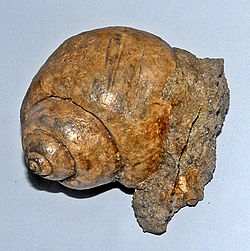
Picture of Ampullinopsis
- Source
- Wikipedia/Commons
- Credit
- nobody named on the record
- Licence
- not stated by the source
- Commercial use
- cannot be read from the licence given — check the record
No 3D scan of Ampullinopsis was found in Sketchfab.
Smithsonian Open Access and MorphoSource were not reached for this taxon, so this list is what the others held rather than everything there is.
The description on this site
- Licence
- CC BY-SA 4.0
This is what the site found, which is not the same as what exists.
Keep going
What may have been alongside itAmpullinidae through timeFormations of the OligoceneThe world it lived on
Occurrence data from the Paleobiology Database, CC BY 4.0. (Conrad 1865)