Aphanapteryx bonasia
The red rail is an extinct species of rail that was endemic to the Mascarene island of Mauritius, east of Madagascar in the Indian Ocean. It had a close relative on Rodrigues island, the likewise extinct Rodrigues rail, with which it is sometimes considered congeneric, but their relationship with other rails is unclear. Rails often evolve flightlessness when adapting to isolated islands, free of mammalian predators, and that was also the case for this species. The red rail was a little larger than a chicken and had reddish, hairlike plumage, with dark legs and a long, curved beak. The wings were small, and its legs were slender for a bird of its size. It was similar to the Rodrigues rail, but was larger, and had proportionally shorter wings. It has been compared to a kiwi or a limpkin in appearance and behaviour.

after George Hoefnagel · Public Domain · via Wikipedia/Commons. May be a photograph of a specimen, or an artist’s reconstruction — an interpretation of a skeleton, since colour and soft tissue are almost never preserved.
On record
Recorded, not inferred- Also called
- red railPBDB
- Sits inside
- AphanapteryxPBDB
- Diet
- carnivorePBDB, for Coelurosauria
- Life habit
- ground dwelling, solitaryPBDB, for Theropoda
- Motility
- actively mobilePBDB, for Theropoda
- Environment
- terrestrialPBDB, for Theropoda
Time the record covers
At most 12 thousand years on record.
Every occurrence read is dated to somewhere between 11.7 ka and 0 Mya, and nothing in the dating separates them, so that window is what the record shows rather than a span.
4 occurrences of Aphanapteryx bonasia on record, most of them in the Holocene. Bar height is expected occurrences, not a count: each fossil is spread across the span it is dated to, so a tall narrow bar means tight dating and a low wide one means loose.
When
4 occurrences- Holocene100%
These are dates about fossils, not the animal: the record can only begin after it arose and end before it died out, so either end may reach further. Shares are expected occurrences: a fossil dated to a span is counted partly in each period it straddles. More on what this infers.
Aphanapteryx bonasia and its relatives
HoloceneWhere Aphanapteryx bonasia and its relatives were recorded in the Holocene.
Found in the same rock
42 taxa- Fulica newtonii3 sites
- Lophopsittacus mauritianus3 sites
- Alectroenas nitidissimus2 sites
- Circus maillardi2 sites
- Cryptopsar ischyrhynchus2 sites
- Foudia rubra2 sites
- Hypsipetes olivaceus2 sites
- Nesoenas mayeri2 sites
- Nycticorax mauritianus2 sites
- Otus sauzieri2 sites
- Phoenicopterus roseus2 sites
- Pteropus2 sites
- Raphus cucullatus2 sites
- Allopeas1 site
- Alopochen mauritianus1 site
- Anas theodori1 site
- Bulinus1 site
- Cyclotopsis1 site
- Cylindraspis inepta1 site
- Cylindraspis triserrata1 site
- Egretta garzetta dimorpha1 site
- Gyraulus1 site
- Lalage typica1 site
- Leiolopisma mauritiana1 site
The Paleobiology Database records 4 sites for Aphanapteryx bonasia, and this reads all of them. The number is how many of those sites it was catalogued from too. The 24 sharing the most are listed.
This is not a list of everything alive at the time. It is only what has come out of the same ground as this animal and been written down.
Entered from
4 references- Systematics, morphology, and ecological history of the Mascarene starlings (Aves: Sturnidae) with the description of a new genus and species from Mauritius1
- Mid-Holocene vertebrate bone Concentration-Lagerstätte on oceanic island Mauritius provides a window into the ecosystem of the dodo (Raphus cucullatus)1
- On additional bones of the Dodo and other extinct birds of Mauritius obtained by Mr. Théodore Sauzier1
- Researches into the zoological affinities of the bird recently described by Herr von Frauenfeld under the name of Aphanapteryx imperialis1
Each of the 4 occurrences read was entered from one of these publications, ordered by how many each accounts for. This is not a search for papers mentioning the name. Entries link to doi.org where the Paleobiology Database holds an identifier, and to its own record where it does not. Relayed as the Paleobiology Database holds them, not checked against what they resolve to.
Media and terms
Media content1
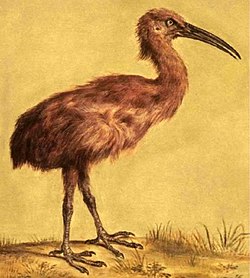
Picture of Aphanapteryx bonasia
- Source
- Wikipedia/Commons
- Credit
- after George Hoefnagel
- Licence
- Public Domain
- Commercial use
- the licence allows it
No 3D scan of Aphanapteryx bonasia was found in Sketchfab.
Smithsonian Open Access and MorphoSource were not reached for this taxon, so this list is what the others held rather than everything there is.
The description on this site
- Source
- Wikipedia, “Red rail”
- Licence
- CC BY-SA 4.0
This is what the site found, which is not the same as what exists.
Keep going
What may have been alongside itAphanapteryx through timeFormations of the HoloceneThe world it lived on
Occurrence data from the Paleobiology Database, CC BY 4.0. (Frauenfeld 1868)