Aphrophoridae
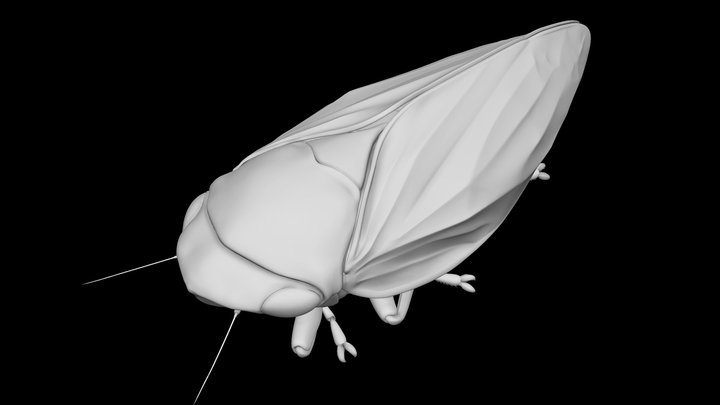
The Aphrophoridae are a family of spittlebugs belonging to the order Hemiptera. There are at least 160 genera and 990 described species in Aphrophoridae.

Didier Descouens · CC BY-SA 4.0 · via Wikipedia/Commons. May be a photograph of a specimen, or an artist’s reconstruction — an interpretation of a skeleton, since colour and soft tissue are almost never preserved.
On record
Recorded, not inferred- Sits inside
- CercopoideaPBDB
- Motility
- actively mobilePBDB, for Arthropoda
- Environment
- terrestrialPBDB, for Insecta
Time the record covers
At least 46 million years on record.
The record covers at least 59.24 Mya to 12.8 Mya. No occurrence read is dated outside 61.66 Mya to 11.63 Mya.
66 occurrences of Aphrophoridae on record, most of them in the Eocene. The Paleobiology Database records this as a living group, and the chart stops with its fossils rather than at the present. Bar height is expected occurrences, not a count: each fossil is spread across the span it is dated to, so a tall narrow bar means tight dating and a low wide one means loose.
When
66 occurrencesThese are dates about fossils, not the animal: the record can only begin after it arose and end before it died out, so either end may reach further. Shares are expected occurrences: a fossil dated to a span is counted partly in each period it straddles. More on what this infers.
Found in
9 formations
- Florissant Formation12
- Bouldnor Formation · Solent Group9
- Niveau du gypse d'Aix Formation6
- Allenby Formation · Princeton Group5
- Salt Formation4
- Upper Freshwater-Molasse Formation4
Loading coastlines…
The named rock units Aphrophoridae has been recovered from, largest first. Drawn where the rock is now, not where it formed. 23 occurrences have no formation on record, which is common for older literature.
Aphrophoridae and its relatives
EoceneWhere Aphrophoridae and its relatives were recorded in the Eocene.
Found in the same rock
1,764 taxa- Formicidae10 sites
- Plecia8 sites
- Aphanus pulchellus7 sites
- Aphrophora7 sites
- Plecia bucklandi7 sites
- Anisoptera6 sites
- Bibio6 sites
- Coleoptera6 sites
- Curculionidae6 sites
- Plecia foersteri6 sites
- Zygoptera6 sites
- Cydnus brevicollis5 sites
- Eysarcoris5 sites
- Ichneumonidae5 sites
- Plecia lygaeoides5 sites
- Polyphaga5 sites
- Thripidae5 sites
- Acrididae4 sites
- Aphanus murchisonae4 sites
- Aphidoidea4 sites
- Aphrophora coquandi4 sites
- Aphrophora spumarioides4 sites
- Apioninae4 sites
- Bibio fusiformis4 sites
The Paleobiology Database records 38 sites for Aphrophoridae, and this reads all of them. The number is how many of those sites it was catalogued from too. The 24 sharing the most are listed.
This is not a list of everything alive at the time. It is only what has come out of the same ground as this animal and been written down.
Entered from
18 references- Les insectes fossiles des terrains oligocènes de France9
- The Tertiary Insects of North America9
- Heer, 18539
- Aphids, true hoppers, jumping plant-lice, scale insects, true bugs and whiteflies (Insecta: Hemiptera) from the Insect Limestone (latest Eocene) of the Isle of Wight, UK8
- Treticnye ravokrylye Stravropol'ja5
- Insectos del Mioceno inferior de Ribesalbes (Castellón, España). Paleoptera y Neoptera poli- y paraneoptera4
- Canadian fossil insects, myriapods and arachnids, 1. The Tertiary Hemiptera of British Columbia4
- Die Insekten der "Plattigen Steinmergels" von Brunstatt4
- Die im Bernstein befindlichen Hemipteren und Orthopteren der Vorwelt3
- Tertiary insects from Kudia River, Maritime Province, Siberia2
- An Account of Some Insects of Unusual Interest from the Tertiary Rocks of Colorado and Wyoming2
- First record of a fossil spittlebug (Hemiptera: Auchenorrhyncha: Aphrophoridae) in Miocene deposits in Bulgaria1
Each of the 66 occurrences read was entered from one of these publications, ordered by how many each accounts for. This is not a search for papers mentioning the name. 6 further references are not listed. Entries link to doi.org where the Paleobiology Database holds an identifier, and to its own record where it does not. Relayed as the Paleobiology Database holds them, not checked against what they resolve to.
Media and terms
Media content2

Picture of Aphrophoridae
- Source
- Wikipedia/Commons
- Credit
- Didier Descouens
- Licence
- CC BY-SA 4.0
- Commercial use
- the licence allows it
Smithsonian Open Access and MorphoSource were not reached for this taxon, so this list is what the others held rather than everything there is.
The description on this site
- Licence
- CC BY-SA 4.0
This is what the site found, which is not the same as what exists.
Keep going
What may have been alongside itCercopoidea through timeFormations of the EoceneThe world it lived on
Occurrence data from the Paleobiology Database, CC BY 4.0. (Amyot and Audinet-Serville 1843)