Arvicola
Water voles are large voles in the genus Arvicola. They are found in both aquatic and dry habitat through Europe and much of northern Asia. A water vole found in Western North America was historically considered a member of this genus, but has been shown to be more closely related to members of the genus Microtus. Head and body lengths are 12–22 cm (4.7–8.7 in), tail lengths are 6.5–12.5 cm (2.6–4.9 in), and their weights are 70–250 g (2.5–8.8 oz). The animals may exhibit indeterminate growth. They are thick-furred and have hairy fringes on their feet that improve their swimming ability.

Rabensteiner · Public Domain · via Wikipedia/Commons. May be a photograph of a specimen, or an artist’s reconstruction — an interpretation of a skeleton, since colour and soft tissue are almost never preserved.
On record
Recorded, not inferred- Sits inside
- ArvicoliniPBDB
- Diet
- herbivorePBDB, for Rodentia
- Life habit
- amphibiousPBDB
- Motility
- actively mobilePBDB, for Osteichthyes
- Environment
- terrestrialPBDB, for Eutheria
Time the record covers
At least 3.5 million years on record.
The record covers at least 3.6 Mya to 11.7 ka. No occurrence read is dated outside 5.333 Mya to 0 Mya.
114 occurrences of Arvicola on record, most of them in the Pleistocene. The Paleobiology Database records this as a living group. Bar height is expected occurrences, not a count: each fossil is spread across the span it is dated to, so a tall narrow bar means tight dating and a low wide one means loose.
When
114 occurrences- Plioceneunder 1%
- Pleistocene95%
- Holocene4%
These are dates about fossils, not the animal: the record can only begin after it arose and end before it died out, so either end may reach further. Shares are expected occurrences: a fossil dated to a span is counted partly in each period it straddles. More on what this infers.
Found in
5 formations
- Cromer Forest Bed Formation5
- Wroxham Formation · Crag Group2
- Latamne Formation1
- Yuanmou Formation1
- Urk Formation1
Loading coastlines…
The named rock units Arvicola has been recovered from, largest first. Drawn where the rock is now, not where it formed. 104 occurrences have no formation on record, which is common for older literature.
Arvicola and its relatives
PleistoceneWhere Arvicola and its relatives were recorded in the Pleistocene.
Found in the same rock
733 taxa- Microtus75 sites
- Myodes48 sites
- Microtus arvalis39 sites
- Apodemus sylvaticus38 sites
- Pliomys32 sites
- Equus31 sites
- Canis lupus30 sites
- Talpa europaea30 sites
- Apodemus28 sites
- Lepus28 sites
- Sorex24 sites
- Allocricetus22 sites
- Cervus elaphus22 sites
- Capreolus capreolus21 sites
- Cervus21 sites
- Microtus agrestis21 sites
- Sus scrofa21 sites
- Vulpes vulpes20 sites
- Citellus19 sites
- Crocidura19 sites
- Panthera leo18 sites
- Aves17 sites
- Cricetus cricetus17 sites
- Equus caballus17 sites
The Paleobiology Database records 106 sites for Arvicola, and this reads all of them. The number is how many of those sites it was catalogued from too. The 24 sharing the most are listed.
This is not a list of everything alive at the time. It is only what has come out of the same ground as this animal and been written down.
Entered from
50 references- I giacimenti Quaternari di vertebrati fossili nell'Italia Nord-Orientale21
- Mittelpleistozane Saugetierfaunen aus Mitteleuropa - der Versuch einer biostratigraphischen Zuordnung9
- Pleistocene vertebrate faunas of Hungary9
- Le gisement Pleistocene moyen et superieur d'Artenac (Saint-Mary, Charent): premier bilan interdisciplinaire5
- Les rongeurs de l'Aven I des Abimes de la Fage a Noailles (Correze)5
- The Vertebrata of the Forest Bed Series of Norfolk and Suffolk5
- The small mammal fauna from the palaeolithic site Marathousa 1 (Greece)4
- New microstratigraphic horizons in the vertebrate chronology of the Hungarian Pleistocene3
- Paleoenvironmental and paleoclimatic approach to the upper Pleistocene site of Artazu VII (Arrasate, northern Iberian Peninsula) using small vertebrates2
- The micromammals of the Quaternary deposits from Cave A, Loutra Almopias (Pella, Northern Greece): Stratigraphy-Taphonomy-Paleoenvironment2
- Pre-Anglican fluvial and coastal deposits in Eastern England; lithostratigraphy and palaeoenvironments2
- Biochronological implications of the Arvicolidae (Rodentia, Mammalia) from the Lower Pleistocene hominid-bearing level of Trinchera Dolina 6 (TD6, Atapuerca, Spain)2
Each of the 114 occurrences read was entered from one of these publications, ordered by how many each accounts for. This is not a search for papers mentioning the name. 38 further references are not listed. Entries link to doi.org where the Paleobiology Database holds an identifier, and to its own record where it does not. Relayed as the Paleobiology Database holds them, not checked against what they resolve to.
Media and terms
Media content3
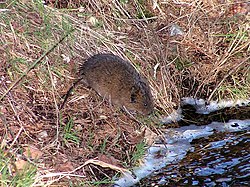
Picture of Arvicola
- Source
- Wikipedia/Commons
- Credit
- Rabensteiner
- Licence
- Public Domain
- Commercial use
- the licence allows it
CT scan
- Source
- MorphoSource
- Licence
- In Copyright
- Commercial use
- cannot be read from the licence given — check the record
- Specimen
- Arvicola amphibius scherman · UMMZ:mammals:138456
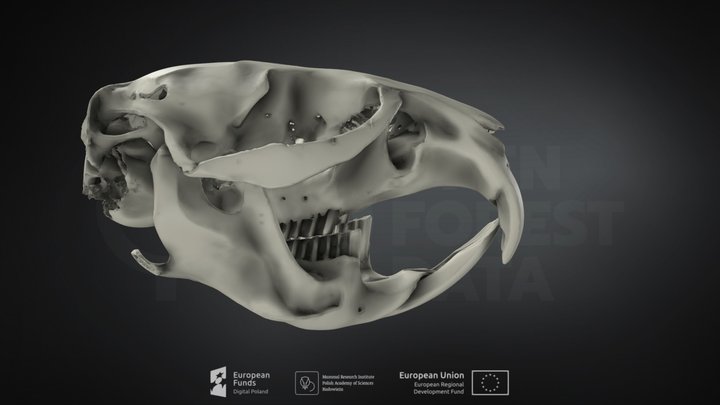
3D model
- Source
- Sketchfab
- Licence
- CC Attribution
- Commercial use
- cannot be read from the licence given — check the record
Smithsonian Open Access was not reached for this taxon, so this list is what the others held rather than everything there is.
The description on this site
- Source
- Wikipedia, “Arvicola”
- Licence
- CC BY-SA 4.0
This is what the site found, which is not the same as what exists.
Keep going
What may have been alongside itArvicolini through timeFormations of the PleistoceneThe world it lived on
Occurrence data from the Paleobiology Database, CC BY 4.0. Lacépède 1799